unit 4 monopolistic comp
Shanmao online question bank | Archived 2026-10-25
Section I - Multiple Choice (42 questions)
Question 1
An industry consists of 100 small firms, and the largest firm accounts for only 2 percent of sales. Brand names are considered a signal of quality. The industry described is best classified as
A. monopoly
B. perfectly competitive
C. monopolistically competitive
D. oligopolistic
E. monopsonistic
Question 2
Which of the following is true of both monopolistically competitive and perfectly competitive firms in long-run equilibrium?
A. Marginal revenue equals average total cost.
B. Marginal cost equals average total cost.
C. Price equals average total cost.
D. Price is greater than marginal cost.
E. Production occurs at minimum average total cost.
Question 3
A monopolistically competitive firm advertises in order to
A. shift the demand curve for its product to the left.
B. make the demand for its product less price elastic
C. make its product more similar to its competitors'
D. increase its positive externalities
E. reduce the industry's barriers to entry
Question 4
In monopolistic competition, a goal of advertising is to
A. reduce a firm’s short-run average total cost
B. minimize a firm’s long-run average total cost
C. make a firm’s demand curve more elastic
D. make a firm’s demand curve less elastic
E. shift a firm’s demand curve to the left
Question 5
A monopolistically competitive profit-maximizing firm is currently producing and selling 2,000 units of output. At this output level, marginal revenue is $9, average revenue is $10, and the average variable cost is $8. The product price is
A. $8
B. $9
C. $10
D. greater than $10
E. less than $8
Question 6
Assume that a monopolistically competitive firm is currently maximizing profit with an output of 100 units and a price of $50. Which of the following is true?
A. Total revenue is maximized when the firm produces 100 units of output.
B. Marginal revenue equals $50 when the firm produces 100 units of output.
C. Marginal cost is greater than marginal revenue when the firm produces 150 units of output.
D. Marginal cost is minimized when the firm produces 100 units of output.
E. Average total cost is minimized when the firm produces 100 units of output.
Question 7
A well-known fast-food franchise substantially increases the price of its hamburgers, and loses only some of its customers. Which of the following best explains why the franchise has not lost all of its customers
A. Its hamburgers are a perfect substitute for other types of fast food.
B. Its hamburgers are differentiated.
C. The demand for its hamburgers is perfectly elastic.
D. The other competitive fast-food restaurants decrease the price for their hamburgers.
E. The barriers to entry are very low for entrepreneurs trying to enter the fast-food business.
Question 8
The Question refers to the following graph, which shows the cost and revenue curves for a profit-maximizing monopolistically competitive firm.
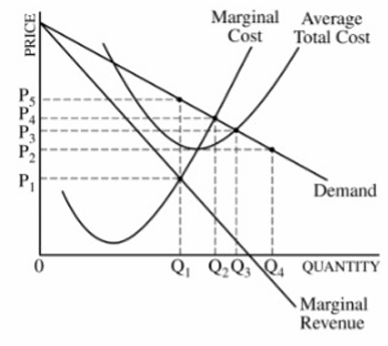
What is the profit-maximizing price and quantity?
Question 9
Is the firm in short-run or long-run equilibrium?
A. Short run, because price is greater than marginal cost
B. Short run, because the firm is earning a positive economic profit
C. Long run, because price is greater than average total cost
D. Long run, because marginal revenue is not equal to zero
E. Either short run or long run, because the firm is producing where marginal revenue equals marginal cost
Question 10
The demand curve for a monopolistically competitive firm is downward sloping because
A. there are a large number of firms
B. the product is produced by using scarce resources
C. the products produced by different firms are not identical
D. it is easy for firms to enter or exit the market
E. the marginal cost rises as output produced increases
Question 11
A monopolistically competitive firm is currently producing the profit-maximizing level of output. If the price of a variable input increases, which of the following will occur?
A. The firm will increase its output to increase its revenue.
B. The firm will increase the price of its output by the same amount.
C. The firm’s average total cost and marginal cost curves will shift upward.
D. The firm’s average fixed cost will decrease as it decreases production.
E. The firm’s fixed cost will increase, but its output level will be unaffected.
Question 12
Firms in monopolistic competition do not attain allocative efficiency because at the long-run equilibrium output, which of the following is true?
A. Price is greater than marginal cost.
B. Marginal cost is greater than minimum average total cost.
C. Marginal revenue is greater than marginal cost.
D. There is an overallocation of resources to the market.
E. Products are homogeneous.
Question 13
Which of the following is true of a monopolistically competitive firm in long-run equilibrium?
A. Price is greater than marginal cost, and marginal revenue is equal to average total cost.
B. Price is greater than marginal revenue, and marginal cost is equal to average total cost.
C. Price is greater than marginal revenue, and marginal cost is greater than average total cost.
D. Marginal revenue is equal to marginal cost, and price is equal to average total cost.
E. Marginal revenue is greater than marginal cost, and price is equal to average total cost.
Question 14
Which of the following statements is true for both a monopolistically competitive firm and a perfectly competitive firm in long-run profit-maximizing equilibrium?
A. Economic profits equal zero, and price equals marginal cost.
B. Economic profits equal zero, and price equals marginal revenue.
C. Marginal revenue equals marginal cost, and profits are positive.
D. Economic profits equal zero, and marginal revenue equals marginal cost.
E. Economic profits equal zero, and price exceeds marginal cost.
Question 15
Let P = price, MR = marginal revenue, MC = marginal cost, and ATC = average total cost. In monopolistic competition, which of the following most accurately describes the long-run equilibrium conditions for a firm?
A. P > ATC, MR = MC, and P > MC
B. P > ATC, MR > MC, and P = MC
C. P = ATC, MR = MC, and P > MC
D. P = ATC, MR = MC, and P = MC
E. P = ATC, MR > MC, and P > MC
Question 16
Which of the following statements about a monopolistically competitivefirm in long-run equilibrium is true?
A. It has excess capacity, even though its long-run profit is zero and its output prices equals its marginal cost.
B. It has excess capacity, and its long-run profit is positive, even though its marginal revenue equals its marginal cost.
C. It has excess capacity and its output price exceeds its marginal cost, even though its long-run profit is zero.
D. It has no excess capacity and its long-run profit is zero.
E. It has no excess capacity and its marginal revenue equals its marginal cost.
Question 17
Monopolistically competitive firms are considered inefficient in allocating society’s resources for which of the following reasons?
A. In equilibrium, the marginal benefit exceeds the price charged by the firms.
B. In equilibrium, the marginal benefit exceeds the marginal cost of production.
C. In equilibrium, the marginal revenue of the firm is not equal to its marginal cost.
D. In long-run equilibrium, the firm is earning economic profits.
E. Firms exhibit significant market power and therefore the number of firms in the industry is strictly limited.
Question 18
Which of the following is true for both a monopolistically competitive firm and a perfectly competitive firm in long-run equilibrium?
A. Marginal cost is greater than marginal revenue.
B. Price is greater than marginal cost.
C. Price is equal to average total cost.
D. Price is equal to marginal cost.
E. Marginal revenue is equal to average revenue.
Question 19
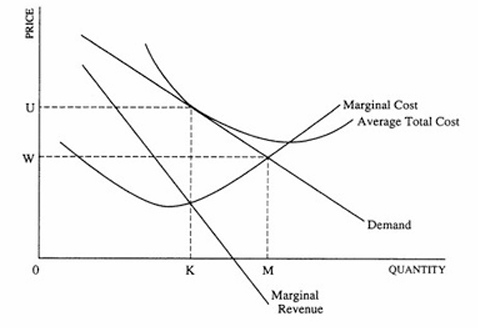
The graph above depicts cost and revenue curves for a typical firm in a monopolistically competitive industry. Suppose that the firm is producing 0M units of output. To maximize profits, it should do which of the following to output and price?
A.
| Output |
Price |
| Increase |
Decrease |
B.
| Output |
Price |
| Increase |
Increase |
C.
| Output |
Price |
| Decrease |
Increase |
D.
| Output |
Price |
| Not change |
Increase |
E.
| Output |
Price |
| Not change |
Not change |
Question 20
Monopolistically competitive product markets are inefficient because
A. price equals the marginal value to the buyer of the last item produced
B. price is greater than marginal cost
C. excessive competition prevents other firms from entering the market
D. homogeneous goods are usually overpriced
E. short-run economic profit-making opportunities exist
Question 21
Which of the following must be true if a profit-maximizing monopolistically competitive firm continues to operate in the short run while incurring a loss?
A. Marginal revenue equals marginal cost and price is greater than average total cost.
B. Marginal revenue equals marginal cost and price is greater than average variable cost.
C. Marginal revenue equals marginal cost and price is less than average variable cost.
D. Price equals both marginal cost and marginal revenue.
E. Price is less than marginal revenue, but greater than average variable cost.
Question 22
In long-run equilibrium, at which of the following output levels will a monopolistically competitive firm operate?
A. Where long-run average total cost is at a minimum
B. Where price equals marginal revenue
C. Where price equals average total cost
D. Where marginal revenue equals average total cost
E. Where marginal revenue equals average revenue
Question 23
Which of the following is true of the marginal revenue curve for a monopolistically competitive firm?
A. It is the same as the demand curve because there are many firms in the market.
B. It is the same as the demand curve because marginal revenue is always equal to price.
C. It is upward sloping because total revenue increases as the quantity sold increases.
D. It lies below the demand curve because the firm must lower its price for all units in order to increase sales.
E. It lies below the demand curve because marginal revenue increases when price decreases.
Question 24
Which of the following is true about price (P), marginal cost (MC), marginal revenue (MR), and economic profit of a monopolistically competitive firm in long-run equilibrium?
A. P > MC; Marginal revenue is below demand; Economic profit is zero
B. P < MC; Marginal revenue is below demand; Economic profit is positive
C. P > MC; Marginal revenue is above demand; Economic profit is positive
D. P = MR = MC; Marginal revenue is equal to demand; Economic profit is zero
E. P = MR = MC; Marginal revenue is above demand; Economic profit is positive
Question 25
Which of the following is true for a firm in long-run equilibrium in monopolistic competition?
A. Given barriers to entry, the firm earns economic profits in long-run equilibrium.
B. The firm is productively efficient, producing at the minimum of long-run average total cost.
C. Price equals marginal revenue and marginal cost.
D. There is neither allocative nor productive efficiency.
E. Price is greater than average total cost in long-run equilibrium.
Question 26
Which of the following is true of a monopolistically competitive firm in long-run equilibrium?
A. It produces where price equals marginal cost, and it earns zero economic profits.
B. It produces where marginal revenue exceeds marginal cost, and it earns positive economic profits.
C. It produces where marginal cost equals marginal revenue, and the price is equal to average total cost.
D. It produces at the minimum average total cost, and it utilizes all excess capacity.
E. It produces more than the allocatively efficient quantity, and the price is greater than marginal cost.
Question 27
Which of the following is true of monopolistically competitive firms in long-run equilibrium?
A. Firms can earn positive economic profits.
B. Firms face a perfectly elastic demand curve.
C. Price equals marginal cost, which equals marginal revenue.
D. Price will always be above average total cost.
E. Marginal revenue equals marginal cost, and price equals average total cost.
Question 28
Which of the following is true of a monopolistically competitive firm in long-run equilibrium?
A. Price exceeds marginal revenue, and the firm earns positive economic profits.
B. Price equals marginal revenue, and the firm earns positive economic profits.
C. Price equals marginal cost, and the firm earns zero economic profits.
D. Price exceeds marginal cost, and the firm earns zero economic profits.
E. Price exceeds marginal cost, and the firm earns positive economic profits.
Question 29
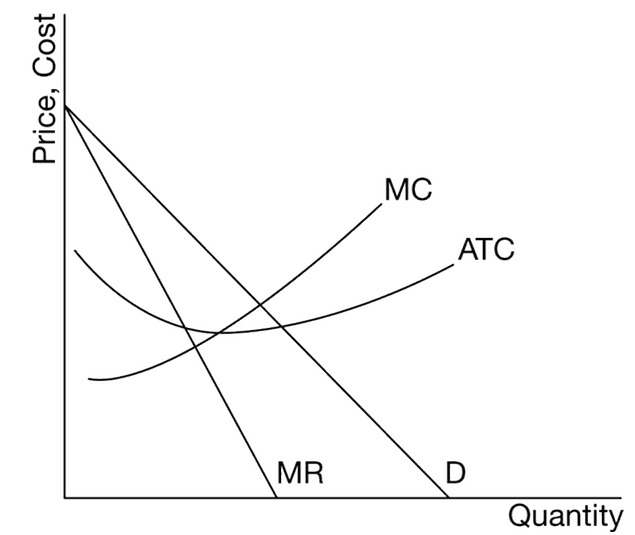
Based on the information in the above graph describing a monopolistically competitive firm, which of the following is true?
A. The firm is productively efficient since marginal cost intersects average cost at the minimum of average cost.
B. When maximizing profits, this firm will have economic losses but will still continue to produce.
C. The firm will produce where marginal revenue equals marginal cost and will set its price to equal average total cost.
D. With the firm making economic profits, it can be expected that new firms will enter this market.
E. The firm will produce where demand is inelastic to capture all economies of scale.
Question 30
Which of the following is true for a monopolistically competitive firm in long-run equilibrium?
A. It earns a normal profit.
B. It sets price equal to marginal cost.
C. It is allocatively efficient.
D. It is a price taker.
E. It produces at minimum average total cost.
Question 31
In the long run, a monopolistically competitive firm is allocatively inefficient because the firm will
A. produce only when marginal cost is greater than marginal revenue
B. produce only when marginal revenue is greater than marginal cost
C. charge a price greater than the marginal cost
D. earn positive economic profits
E. experience economic losses
Question 32
Which of the following is NOT a characteristic of monopolistically competitive markets?
A. Relatively easy market entry
B. Differentiated products
C. Substantial product advertising
D. A large number of both buyers and sellers
E. Long-run economic profits
Question 33
Which of the following statements correctly identifies a difference between perfect competition and monopolistic competition?
A. In perfect competition there are no barriers to entry, but there are strong barriers in monopolistic competition.
B. In perfect competition there are many firms, but in monopolistic competition there are only a few firms.
C. In perfect competition the firms all sell products that are exactly the same, but in monopolistic competition each firm sells a slightly differentiated product.
D. In perfect competition firms maximize profit by selling the quantity where marginal revenue equals marginal cost, but in monopolistic competition firms maximize profit by selling the quantity where marginal revenue exceeds marginal cost.
E. In perfect competition there are few consumers, but in monopolistic competition there are many consumers.
Question 34
All of the following characterize both perfectly competitive and monopolistically competitive markets EXCEPT:
A. Price is equal to average revenue.
B. Individual firms produce output where marginal cost equals marginal revenue.
C. Firms can affect the selling price of their product.
D. The market has a large number of firms.
E. Firms can easily enter or exit the market.
Question 35
A monopolistically competitive firm’s demand curve will be highly elastic if which of the following exists?
A. A high degree of product differentiation
B. A highly elastic supply curve for the firm
C. High barriers to entry in this industry
D. A high degree of product substitutability
E. A small number of competitors
Question 36
Which of the following about the relationship between marginal revenue (MR) and price (P) under monopolistic competition and perfect competition is correct?
A.
| Monopolistic Competition |
Perfect Competition |
| MR>P |
MR=P |
B.
| Monopolistic Competition |
Perfect Competition |
| MR<P |
MR=P |
C.
| Monopolistic Competition |
Perfect Competition |
| MR decreases when P increases |
MR increases when P decreases |
D.
| Monopolistic Competition |
Perfect Competition |
| MR=P |
MR=P |
E.
| Monopolistic Competition |
Perfect Competition |
| MR=P |
MR<P |
Question 37
Monopolistically competitive firms are inefficient because they
A. produce a lower level of output at a higher average cost than do perfectly competitive firms
B. use production processes that are more capital-intensive than do perfectly competitive firms
C. face downward-sloping demand curves, ensuring that marginal revenue is greater than average revenue
D. produce at that level of output where price equals marginal cost
E. realize diseconomies of scale
Question 38
Compared with firms in a perfectly competitive industry, firms in a monopolistically competitive industry are inefficient because they
A. make economic profits in the long run
B. do not lower the product price if input prices fall
C. restrict their output level to maximize profits
D. charge the highest price that consumers will pay
E. waste resources by producing an excess amount of output
Question 39
Which of the following is true of a monopolistically competitive firm in long-run equilibrium?
A. The firm produces the allocatively efficient level of output.
B. The firm is allocatively inefficient, because it produces an output level at which price is greater than marginal cost.
C. The firm produces an output level that minimizes average total cost.
D. The firm produces in the inelastic range of its demand curve.
E. The firm earns positive economic profits but zero accounting profits.
Question 40
Which of the following is true of a monopolisti-cally competitive firm in long-run equilibrium?
A. Price equals marginal cost and average total cost.
B. Price equals average total cost but is greater than marginal cost.
C. Price equals marginal cost and is greater than average total cost.
D. The firm makes no attempt to differentiate its products.
E. The firm earns positive economic profits by producing at minimum average cost.
Question 41
In monopolistic competition, an individual firm’s market power stems from which of the following?
A. Economies of scale in production
B. The production of a differentiated product
C. The absence of perfectly competitive firms that produce similar products
D. Barriers to entry allowing firms to earn economic profit
E. The maintenance of excess capacity to meet unexpected increase in demand
Question 42
Over the past 5 years, 50 new restaurants have opened and 30 have closed in the city of Zuni. Currently there are 110 restaurants operating in the city. Which of the following best represents the market structure, barriers to entry, and economic profits in the long run?
A.
| Market Structure |
Barriers to Entry |
Long-Run Economic Profits |
| Perfect competition |
Low |
Negative |
B.
| Market Structure |
Barriers to Entry |
Long-Run Economic Profits |
| Perfect competition |
High |
Positive |
C.
| Market Structure |
Barriers to Entry |
Long-Run Economic Profits |
| Monopolistic competition |
Low |
Zero |
D.
| Market Structure |
Barriers to Entry |
Long-Run Economic Profits |
| Monopolistic competition |
High |
Positive |
E.
| Market Structure |
Barriers to Entry |
Long-Run Economic Profits |
| Monopolistic competition |
High |
Zero |
Section II - Free Response (8 questions)
Question 1
Include correctly labeled diagrams, if useful or required, in explaining your answers. A correctly labeled diagram must have all axes and curves clearly labeled and must show directional changes. If the question prompts you to “Calculate,” you must show how you arrived at your final answer.
Use the following graph to answer parts (a)-(e). Prices and costs are in dollars.
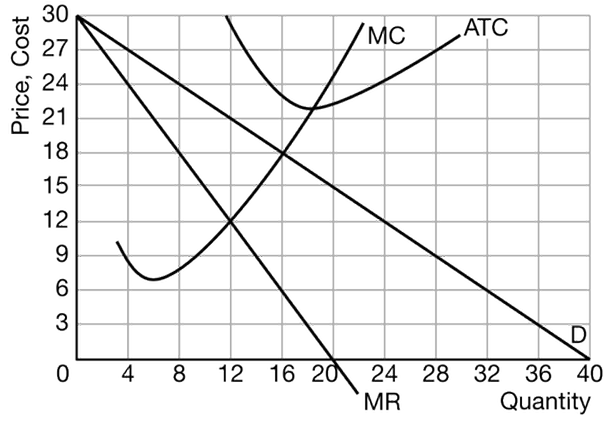
The graph above shows the demand (D), marginal revenue (MR), marginal cost (MC), and average total cost (ATC) curves for one of many profit-maximizing firms operating in the short run in an industry in which there are no barriers to entry. Each firm sells a similar but not identical product.
Part A
What will happen to total revenue if the firm raises the price from $9 to $12? Explain.
Part B
At 16 units, is the firm producing at the allocatively efficient quantity? Explain.
Part C
If the firm produces 12 units, will the firm’s economic profit be positive, negative, or zero? Explain.
Part D
Use the relationship between the marginal cost curve and the average total cost curve to explain why the average total cost curve is increasing at 20 units.
Part E
Calculate the consumer surplus if the firm charges the profit-maximizing price. Show your work.
Question 2
Include correctly labeled diagrams, if useful or required, in explaining your answers. A correctly labeled diagram must have all axes and curves clearly labeled and must show directional changes. If the question prompts you to “Calculate,” you must show how you arrived at your final answer.
The table below shows the total cost and total benefit of advertisements placed by Foods, a firm in the retail food market.
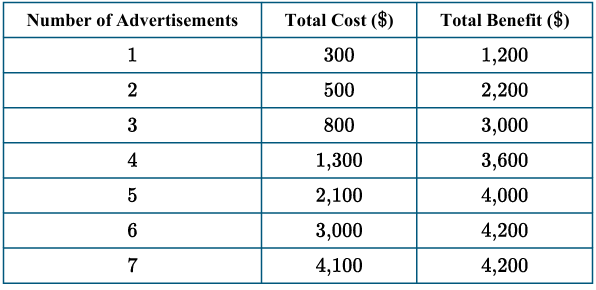
Part A
Calculate the total net benefit of placing three advertisements. Show your work.
Part B
Calculate the marginal net benefit of the third advertisement. Show your work.
Part C
What is the optimal number of advertisements placed by AZY Foods? Explain using marginal analysis.
Part D
Suppose over the next year the marginal benefit that AZY Foods receives from each advertisement increases by $300. Identify the optimal number of advertisements.
Part E
There are many firms in the retail food market. Each firm places its own firm-specific advertisements without
considering the actions of its competitors. In what market structure is AZY Foods operating?
Question 3
Assume that the cellular telephone industry is monopolistically competitive.
Part A
Assume that cellular telephone manufacturers are earning short-run economic profits. Draw a correctly labeled graph for a typical firm in the industry and show each of the following.
i. The profit-maximizing output and price
ii. The area representing economic profit
Part B
At the profit-maximizing price you identified in part (a), would the typical firm’s demand curve be price
inelastic? Explain.
Part C
Given the information in part (a), what happens to the demand curve for the typical firm in the long run? Explain.
Part D
Using a new correctly labeled graph, show the profit-maximizing output and price for the typical firm in the long run.
Part E
Does the typical firm produce an output level that minimizes its average total cost in the long run?
Part F
In long-run equilibrium, does the typical firm produce the allocatively efficient level of output? Explain.
Question 4
Assume that a profit-maximizing firm in a monopolistically competitive industry is in long-run equilibrium.
Part A
Draw a correctly labeled graph that shows the profit-maximizing firm’s price and output.
Part B
Assume that the city in which this industry operates eliminates the business license fee (a fixed cost) for all firms in this industry. How does the elimination of the license fee affect each of the following for the individual firm in the short run? Explain your answers.
i. Output
ii. Economic profits
Question 5
Rice is produced in a perfectly competitive industry. Grand Farm is a typical firm in the rice industry earning a positive economic profit.
Part A
Using correctly labeled side-by-side graphs for the rice industry and Grand Farm, show each of the following in the short run.
i. The industry price and quantity, labeled PM and QM
ii. Grand Farm’s demand curve and marginal revenue curve, labeled DF and MRF
iii. Grand Farm’s quantity of output, labeled QF
iv. Grand Farm’s profit, shaded completely
Question 6
Part B
In the long run, what happens to each of the following?
i. The number of firms in the industry. Explain.
ii. The equilibrium price; does it increase, decrease, or remain the same relative to PM ?
Question 7
Part C
Suppose Lori’s Quick Eats sells fried rice in a monopolistically competitive fast-food industry. Lori’s Quick Eats is earning positive economic profits in the short run. Using a correctly labeled graph for this monopolistically competitive firm, show each of the following in the short run.
i. The demand and marginal revenue curves, labeled DL and MRL
ii. The marginal cost and average total cost curves, labeled MC and ATC
iii. The profit-maximizing price and quantity, labeled PL and QL
Question 8
Part D
Draw a correctly labeled graph for Lori’s Quick Eats in long-run equilibrium showing the demand curve and the long-run average total cost curve.
Multiple-choice answer key
Answers reproduced from the website. No FRQ scoring guide was provided in the question pages.
1: C | 2: C | 3: B | 4: D | 5: C
6: C | 7: B | 8: E | 9: B | 10: C
11: C | 12: A | 13: D | 14: D | 15: C
16: C | 17: B | 18: C | 19: C | 20: B
21: B | 22: C | 23: D | 24: A | 25: D
26: C | 27: E | 28: D | 29: D | 30: A
31: C | 32: E | 33: C | 34: C | 35: D
36: B | 37: A | 38: C | 39: B | 40: B
41: B | 42: C