unit 3 production function
Shanmao online question bank | Archived 2026-10-25
Section I - Multiple Choice (103 questions)
Question 1
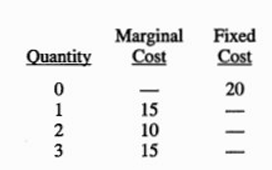
According to the table above, which shows the costs of production for a firm, the average total cost of producing 3 units of output is
A. 5.00
B. 11.67
C. 13.33
D. 15.00
E. 20.00
Question 2
As output of a firm increases, the difference between the firm’s average total cost and its average variable cost gets smaller because the firm’s
A. total cost is increasing
B. marginal cost is increasing
C. average fixed cost is decreasing
D. marginal product of labor is decreasing
E. long-run average total cost is decreasing
Question 3
Which of the following MUST be true of the long run?
A. It is at least one year in duration.
B. All factors of production are variable.
C. At least one factor of production is fixed.
D. Marginal costs are constant.
E. Average total costs are constant.
Question 4
Suppose a firm’s production process exhibits diseconomies of scale. How and why will costs change if the firm reduces its output?
A. Long-run average total cost will increase because it becomes more difficult for the firm to manage its workforce.
B. Long-run average total cost will increase because it becomes more difficult for the firm to manage its workforce.
C. Long-run average total cost will decrease because it becomes easier for the firm to manage its workforce.
D. Long-run average fixed costs will decrease because the firm produces fewer units of output.
E. Long-run average total cost will decrease because it becomes more difficult for the firm to manage its workforce.
Question 5
Which of the following is true for a firm that uses labor as a variable input and capital as a fixed input in the short run?
A. If the marginal product of labor is negative, the average product of labor must also be negative.
B. If the marginal product of labor is rising, the average product of labor must be greater than the marginal product of labor.
C. If the average product of labor is rising, the marginal product of labor must be rising.
D. If the average product of labor is falling, the marginal product of labor must be less than the average product of labor.
E. The average product of labor can never be equal to the marginal product of labor.
Question 6
What does the minimum efficient scale measure?
A. The smallest output level at which short-run average total cost is minimized.
B. The smallest output level at which short-run total cost is minimized.
C. The smallest output level at which long-run average total cost is minimized.
D. The largest output level at which long-run average total cost is minimized.
E. The largest output level at which long-run total cost is minimized.
Question 7
In the short run, which of the following is true of a firm's average total cost of production?
A. It is equal to marginal cost plus average variable cost.
B. It is equal to marginal cost plus average fixed cost.
C. It is equal to average fixed cost plus average variable cost.
D. It always increases when a firm increases production.
E. It is zero if the firm shuts down.
Question 8
Which of the following must be true if at the tenth unit of output, marginal cost (MC) is $130 and average total cost ( ATC) is $150?
A. ATC of producing the ninth unit is higher than $150.
B. ATC of producing the ninth unit is less than $150.
C. MC of producing the ninth unit is higher than $130.
D. The average variable cost of producing the tenth unit is higher than $150.
E. The average variable cost of producing the tenth unit is equal to $20.
Question 9
Which of the following is true about a firm's average variable cost?
A. It will rise if marginal cost is less than average variable cost.
B. It will never equal the firm's marginal cost.
C. It will decline when the firm's marginal product declines.
D. It will be negative if marginal revenue declines.
E. It will equal average total cost when fixed costs are zero.
Question 10
Which of the following is always true of the relationship between average and marginal costs?
A. Average total costs are increasing when marginal costs are increasing.
B. Marginal costs are increasing when average variable costs are higher than marginal costs.
C. Average variable costs are increasing when marginal costs are increasing.
D. Average variable costs are increasing when marginal costs are higher than average variable costs.
E. Average total costs are constant when marginal costs are constant.
Question 11
The following questions are based on the table below, which shows a firm’s average variable cost and average total cost.
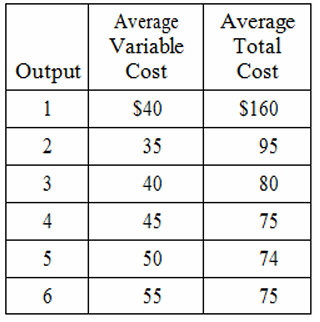
The average fixed cost of producing four units of output is equal to
A. $120
B. $95
C. $75
D. $50
E. $30
Question 12
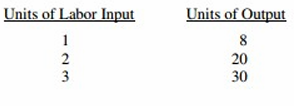
The table above shows the amount of labor inputs necessary to produce given levels of output. If the cost of a unit of labor is $20 and total fixed cost is $100, the average total cost of producing 20 units of output is
A. $1
B. $2
C. $7
D. $40
E. $120
Question 13
Assume that total fixed costs are $46, that the average product of labor is 5 units when 10 units of output are produced, and that the wage rate is $12. If labor is the only variable input, what is the average total cost of producing 10 units of output?
A. $2
B. $5
C. $7
D. $9
E. $12
Question 14
The following questions are based on the table below, which gives cost information for a perfectly competitive firm.
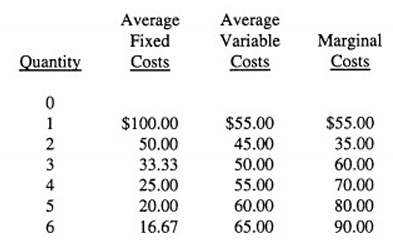
The average total cost to the firm of producing 2 units of output is
A. $35.00
B. $85.00
C. $95.00
D. $100.00
E. $130.00
Question 15
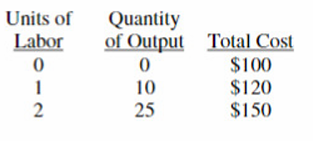
Given the information above, the average variable cost of 25 units of output is
A. $2
B. $6
C. $25
D. $50
E. $75
Question 16
At 100 units of output, a firm’s total cost is $10,000. If the firm’s total fixed cost is $4,000, its average variable cost is equal to
A. $140
B. $100
C. $60
D. $40
E. $0
Question 17
If the marginal cost of producing the first unit of some good is $20 and the marginal cost of producing the second unit is $30, the average variable cost of producing 2 units is
A. $5
B. $10
C. $20
D. $25
E. $50
Question 18
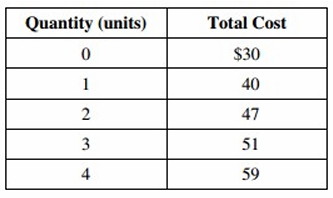
The table above shows a firm’s total cost of producing various units of output. What is the average variable cost of producing three units?
A. $4
B. $7
C. $10
D. $17
E. Cannot be determined from the given information
Question 19
The table below shows a competitive firm’s total variable cost (TVC) and total fixed cost (TFC) at various units of output.
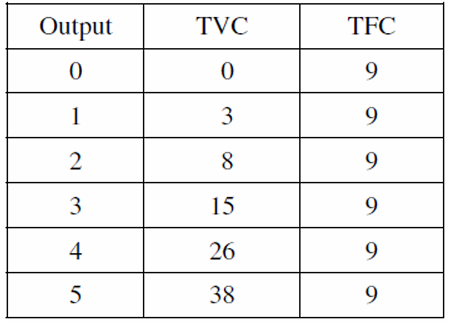
When output is 3 units, which of the following is correct?
A.
| Average Variable Cost |
Marginal Cost |
| 5 |
6 |
B.
| Average Variable Cost |
Marginal Cost |
| 5 |
7 |
C.
| Average Variable Cost |
Marginal Cost |
| 6 |
5 |
D.
| Average Variable Cost |
Marginal Cost |
| 7 |
7 |
E.
| Average Variable Cost |
Marginal Cost |
| 7 |
6 |
Question 20
A firm is producing 100 units of output at a total cost of $400. The firm’s average variable cost is $3 per unit. What is the firm’s total fixed cost?
A. $1
B. $50
C. $100
D. $300
E. $400
Question 21
The following question is based on the output and cost data in the table below.
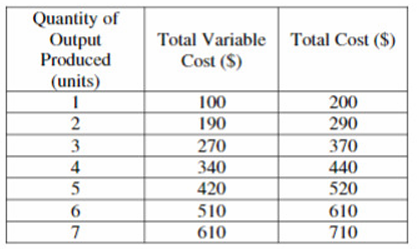
According to the cost schedule in the table above, the firm’s total fixed cost is
A. increasing
B. decreasing
C. $90
D. $100
E. impossible to determine
Question 22
If there is only one variable input, diminishing marginal returns first occur with the production of which unit of output?
A. 7th
B. 6th
C. 5th
D. 4th
E. 3rd
Question 23
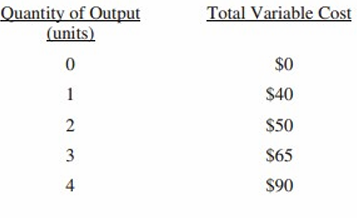
Assume that the fixed cost is $50. Based on the cost and output data in the table above, what is the marginal cost when the firm increases its output from three to four units and the average total cost of producing 4 units?
A.
| Marginal Cost |
Average Total Cost |
| $35 |
$45 |
B.
| Marginal Cost |
Average Total Cost |
| $35 |
$35 |
C.
| Marginal Cost |
Average Total Cost |
| $25 |
$35 |
D.
| Marginal Cost |
Average Total Cost |
| $25 |
$25 |
E.
| Marginal Cost |
Average Total Cost |
| $10 |
$25 |
Question 24
Assume that a profit-maximizing firm is perfectly competitive in both the output and the factor markets and is at its long-run equilibrium. The firm's output is 100 units, its total revenue is $600.00, and the fixed cost of production is $50.00. Based on this information, which of the following is true for the firm?
A. Its marginal cost is $5.50, and its average total cost is $5.50.
B. Its marginal cost is $5.50, and its average variable cost is $5.50.
C. Its marginal cost is $6.00, and its average total cost is $5.50.
D. Its marginal cost is $6.00, and its average fixed cost is $5.50.
E. Its marginal cost is $6.00, and its average variable cost is $5.50.
Question 25
If labor is the only variable input and it costs $15 per hour and if the marginal product of labor is 3 units per hour, the short-run marginal cost of 1 unit of output is approximately
A. $0.20
B. $3.00
C. $5.00
D. $15.00
E. $45.00
Question 26
The table below shows a production function for a firm.
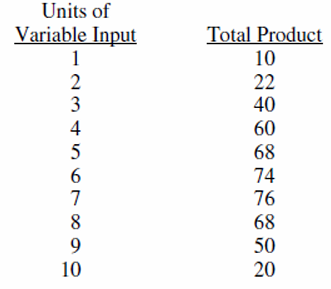
All of the following can be concluded from the information in the table EXCEPT:
A. Diminishing marginal returns set in after the fourth unit of the variable input.
B. Marginal product is positive if total product is increasing.
C. This is a production function for a perfectly competitive firm.
D. A profit-maximizing firm would never voluntarily employ the eighth unit of the variable input.
E. Total product starts to decrease when marginal product changes from positive to negative.
Question 27
If the output of a firm doubles when the firm doubles all of its inputs, the firm must be experiencing
A. economies of scale
B. increasing returns to scale
C. constant returns to scale
D. decreasing returns to scale
E. diseconomies of scale
Question 28
A competitive firm produces a product using labor and plastic. The firm is initially in equilibrium. If the cost of plastic suddenly increases, which of the following will occur?
A. The demand curve for the product will shift to the left.
B. The firm's demand curve for plastic will shift to the left.
C. The firm will increase the number of units offered for sale.
D. The firm will definitely go out of business, since competitive firms earn zero economic profits in equilibrium.
E. The firm's marginal costs will increase at each level of output.
Question 29
With capital held constant, when Zane employs one additional worker, the marginal product of labor decreases by units. Which economic concept best characterizes Zane’s production process?
A. Diminishing marginal returns
B. Increasing marginal returns
C. Constant returns to scale
D. Economies of scale
E. Diseconomies of scale
Question 30
The table below shows the long-run total cost function of a firm.
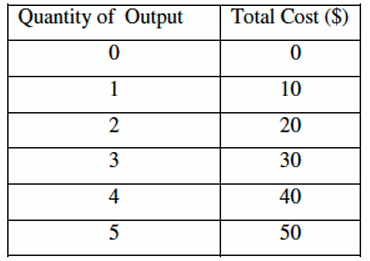
The firm’s cost function exhibits
A. diseconomies of scale
B. constant returns to scale
C. economies of scale
D. decreasing marginal cost
E. increasing marginal cost
Question 31
Economies of scale can be illustrated by
A. an increasing short-run marginal cost curve as a firm produces more output
B. a decreasing short-run average total cost curve as a firm produces more output
C. a downward-sloping long-run supply curve for an industry
D. a decreasing long-run average total cost curve as a firm produces more output
E. an increasing long-run average total cost curve as a firm produces more output
Question 32
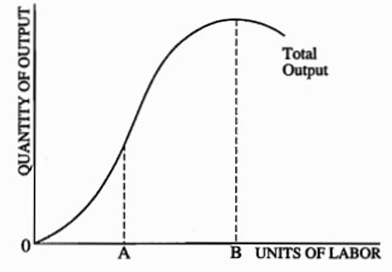
The relationship in the graph above best illustrates the economic concept of
A. opportunity cost
B. diminishing marginal utility in consumption
C. diminishing marginal returns in production
D. production possibilities
E. comparative advantage
Question 33
If a firm’s production function exhibits diminishing marginal product of the variable input in the short run, which of the following about the firm’s short-run marginal cost (MC) curve must be true?
A. As output increases, the MC curve slopes upward.
B. As output increases, the MC curve slopes downward and becomes flatter.
C. As output increases, the MC curve slopes downward and becomes steeper.
D. The MC curve is horizontal.
E. The MC curve is vertical.
Question 34
Short-run marginal costs eventually increase because of the effects of
A. increasing marginal product
B. diminishing marginal product
C. diseconomies of scale
D. economies of scale
E. increasing fixed costs
Question 35
For a firm where labor is the only variable input, which of the following happens when diminishing returns set in?
A. Average variable cost begins to increase.
B. Average product of labor begins to decline.
C. Total product begins to decline.
D. Marginal cost begins to increase.
E. Average total cost begins to increase.
Question 36
Assume that a firm uses only one variable input. If a firm is experiencing diminishing returns, which of the following is true as more of the variable input is used?
A. Marginal cost will decrease at a constant rate.
B. Marginal cost will decrease at a diminishing rate.
C. Marginal cost will increase.
D. Marginal product will increase at a constant rate.
E. Marginal product will increase at a diminishing rate.
Question 37
Which of the following indicates the presence of economies of scale as the quantity of output increases?
A. Average variable cost decreases.
B. Long-run average total cost decreases.
C. Marginal cost decreases.
D. Average fixed cost decreases.
E. Marginal cost exceeds average total cost.
Question 38
Which of the following must be true if a firm is experiencing economies of scale?
A. All costs are explicit.
B. Long-run average total cost decreases as the firm’s output increases.
C. Economic profits decrease as the firm’s output increases.
D. Long-run average total cost remains constant as the firm’s output decreases.
E. Proportionate increases in inputs result in less-than-proportionate increases in output.
Question 39
Economies of scale exist when
A. the doubling of all inputs doubles the output produced
B. short-run average total cost decreases as output increases
C. short-run average total cost remains constant as output increases
D. long-run average total cost increases as output increases
E. long-run average total cost decreases as output increases
Question 40
If a firm experiences economies of scale over the entire range of output, the long-run average cost curve will be
A. U-shaped
B. upward sloping
C. downward sloping
D. horizontal
E. below the marginal cost curve
Question 41
If a firm is experiencing economies of scale, which of the following will decrease as output increases?
A. Fixed cost
B. Long-run total cost
C. Long-run average total cost
D. Marginal cost
E. Marginal revenue
Question 42
F&D Manufacturing Company increases all its inputs by 50 percent each. If F&D’s output increases by 100 percent, then F&D is experiencing
A. increasing returns to scale
B. constant returns to scale
C. diseconomies of scale
D. increasing marginal cost
E. decreasing profits
Question 43
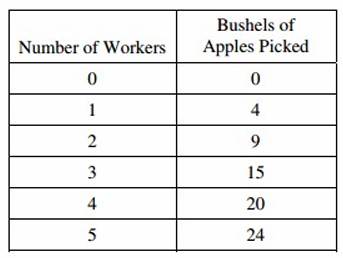
The table above shows the short-run production function for picking apples. Based on the production data, which of the following statements about the marginal product of the fifth worker is true?
A. It is the maximum that can be attained.
B. It is greater than the marginal product of the first worker due to increasing returns.
C. It is greater than the combined marginal products of all the other workers.
D. It is less than the marginal product of the third worker due to diminishing returns.
E. It is rising due to increasing marginal returns.
Question 44
Suppose that a firm begins to hire workers for a newly completed plant with a fixed amount of machinery. As the firm hires additional workers, one would expect the marginal product to
A. fall initially, but eventually rise
B. rise initially, but eventually fall
C. rise consistently due to diminishing return
D. rise consistently due to the advantages of specialization
E. rise consistently due to economies of scale
Question 45
Currently, Corporation can produce 50 units of output using 20 workers and 8 units of capital. Which of the following changes in the number of workers, units of capital, and quantity of output are consistent with constant returns to scale?
A.
| Workers |
Capital |
Output |
| 40 |
8 |
100 |
B.
| Workers |
Capital |
Output |
| 40 |
16 |
90 |
C.
| Workers |
Capital |
Output |
| 20 |
4 |
25 |
D.
| Workers |
Capital |
Output |
| 10 |
4 |
25 |
E.
| Workers |
Capital |
Output |
| 10 |
8 |
25 |
Question 46
The following questions refer to the graph below, which shows the cost curves for a profit maximizing, perfectly competitive firm.
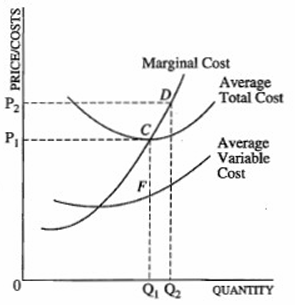
The vertical distance CF represents the
A. total cost of producing Q1 units of output
B. average total cost of producing Q1 units of output
C. average fixed cost of producing Q1 units of output
D. average variable cost of producing Q1 units of output
E. amount of the firm's loss resulting from producing Q1 units of output
Question 47
If a firm's average total cost decreases as the firm increases its output, the firm's marginal cost must be
A. greater than the average variable cost
B. less than the average fixed cost
C. less than the average total cost
D. decreasing
E. negative
Question 48
Which of the following factors can cause a firm's cost curves to shift upward?
A. An increase in wages
B. An increase in the firm's output
C. An increase in the output price
D. A decrease in the firm's output
E. A decrease in the price of energy
Question 49
Which of the following provides an example of the law of diminishing returns?
A. A farm doubles all its inputs and observes that output less than doubles.
B. A textile producer’s output increases by 5 units when adding a fourth worker and by 7 units when adding a fifth worker.
C. If a fixed input increases, fewer additional units of a variable input will be needed to increase output by one unit.
D. As more of a variable input—for example, labor is used with a fixed number of machines— output increases but at a diminishing rate.
E. More cooks in a single kitchen will increase the number of meals produced by increasing amounts.
Question 50
In the short run, assume diminishing marginal product of labor sets in with the hiring of the second worker. Which of the following will remain constant as a firm produces more output?
A. Average product of labor
B. Total cost
C. Total fixed cost
D. Total variable cost
E. Marginal cost
Question 51
At 100 units of a firm’s output, average total cost is $10, average variable cost is $8, average fixed cost is $2, and marginal cost is $12. How will each of the following change as the firm's output further increases?
A.
| Average Total Cost |
Average Variable Cost |
Average Fixed Cost |
| Increase |
Increase |
Increase |
B.
| Average Total Cost |
Average Variable Cost |
Average Fixed Cost |
| Increase |
Increase |
Decrease |
C.
| Average Total Cost |
Average Variable Cost |
Average Fixed Cost |
| Increase |
Decrease |
Decrease |
D.
| Average Total Cost |
Average Variable Cost |
Average Fixed Cost |
| Decrease |
Increase |
Increase |
E.
| Average Total Cost |
Average Variable Cost |
Average Fixed Cost |
| Decrease |
Decrease |
Decrease |
Question 52
If a firm's production process exhibits economiesof scale, which of the following will occur when the firm's output increases?
A. Its short-run average total costs will rise.
B. Its long-run average total costs will rise.
C. Its long-run average total costs will fall.
D. Its short-run average total costs will fall.
E. Its long-run total costs will fall.
Question 53
Which of the following is a result of increasing returns to scale?
A. Upward-sloping short-run marginal cost curve
B. Downward-sloping marginal physical product of labor curve
C. Downward-sloping long-run average total cost curve
D. Diseconomies of scale
E. Diminishing returns
Question 54
A farmer grows wheat using two inputs: labor and land whose prices are constant. If she doubles her inputs, she finds that the quantity of wheat produced more than doubles. Therefore, it must be true that in this output range her long-run average total cost curve is
A. upward sloping
B. downward sloping
C. horizontal
D. vertical
E. U-shaped
Question 55
Locotek produces toy trains and pays each worker $350 per week. Five workers can produce 40 trains per week and six workers can produce 45 trains per week. The marginal product per week of the sixth worker is
A. $70
B. $350
C. 5 trains
D. 7.5 trains
E. 42.5 trains
Question 56
Which of the following indicates that a firm is experiencing economies of scale?
A. The firm’s long-run supply curve is horizontal.
B. The firm’s long-run marginal cost increases as output increases.
C. The firm’s long-run average total cost decreases as output increases.
D. The firm’s long-run total cost decreases as output increases.
E. The firm’s total revenues increase as output sold increases.
Question 57
If a firm's long-run average total cost increases as output increases, the firm is experiencing
A. economies of scale
B. diseconomies of scale
C. increasing returns to scale
D. efficiency in plant size
E. maximum economic profit
Question 58
The long-run average cost curve will be sloping downward if a firm experiences
A. diminishing marginal returns
B. decreasing returns to scale
C. constant returns to scale
D. diseconomies of scale
E. economies of scale
Question 59
Under which of the following circumstances is a firm experiencing economics of scale?
A. The firm increases only its labor input, and output decreases.
B. The firm doubles its inputs, and output triples.
C. The firm builds a new plant, and the average cost of production increases.
D. The firm hires a new plant manager, and profits increase.
E. The product price increases, and the firm increases its output.
Question 60
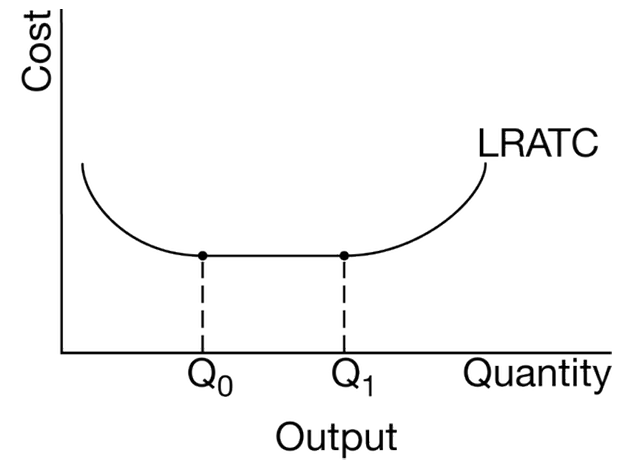
The graph above shows a firm’s long-run average total cost curve (LRATC). Which of the following statements is true as the firm increases its scale of production?
A. From zero output to Q0, the firm experiences diseconomies of scale.
B. From Q0 to Q1, the firm experiences increasing returns to scale.
C. For output levels above Q1, the firm experiences diseconomies of scale.
D. At all output levels, the firm’s long-run marginal cost must be constant.
E. From Q0 to Q1, LRATC falls because average fixed cost decreases; after Q1, LRATC rises due to diminishing returns to labor.
Question 61
Assume that the short-run marginal cost curve initially falls, and it then rises as quantity of output increases. Which of the following must be true?
A. The marginal product of labor is always falling.
B. At every output level, the short-run marginal cost curve is always above the average variable cost curve.
C. As output increases, the unit price of labor (the wage rate) is first falling and then rising.
D. Initially the marginal product of labor increases but eventually marginal product of labor decreases.
E. The average variable cost curve must always be rising.
Question 62
Marginal cost is defined as the
A. change in total cost resulting from producing an additional unit of output
B. change in total cost resulting from using an additional unit of input
C. difference between total cost and total variable cost
D. difference between total variable cost and total fixed cost
E. difference between average total cost and average variable cost divided by output
Question 63
The chart below gives a firm’s total cost of producing different levels of output.
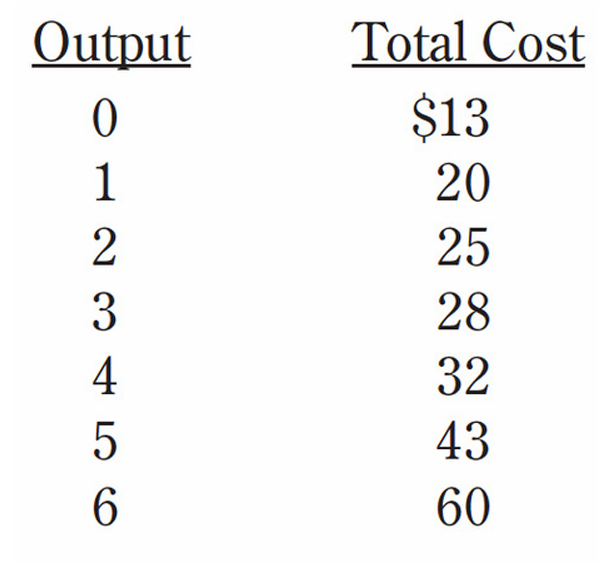
The marginal cost of producing the fourth unit of output is
A. $ 4
B. $11
C. $19
D. $32
E. impossible to determine from the information given
Question 64
The total variable cost of producing five units of output is
A. $ 6
B. $11
C. $30
D. $43
E. impossible to determine from the information given
Question 65
Assume that labor is the only variable input. If a firm’s short-run marginal cost is increasing as output rises, which of the following must be true?
A. Average product of labor is constant.
B. Average product of labor is increasing.
C. Marginal product of labor is greater than average product of labor.
D. Marginal product of labor is decreasing.
E. Total product of labor is decreasing.
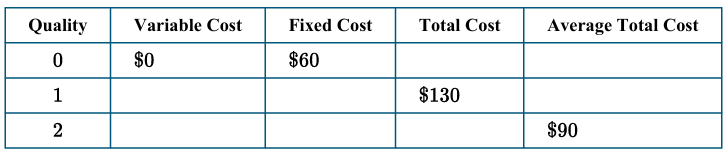
Question 66
The table below is partially filled in with the different types of costs for a firm. Based on the information in the table, what is the marginal cost of producing the second unit?
A. $50
B. $60
C. $70
D. $90
E. $180
Question 67
If the average variable cost of producing 5 units of a good is $100 and the average variable cost of producing 6 units is $150, then the marginal cost of increasing output from 5 to 6 units is
A. $50
B. $250
C. $300
D. $400
E. $500
Question 68
A firm’s short-run production function uses capital and labor as inputs. Assume the quantity of capital is fixed in the short run. The marginal product of labor will decrease as more labor is used in the short run because each unit of labor will have
A. zero units of capital to work with
B. fewer units of capital to work with
C. an increase in the capital-to-labor ratio
D. more units of capital to work with
E. an infinite number of units of capital to work with
Question 69
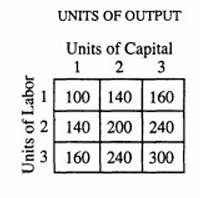
The table above shows the various units of output that can be produced with different combinations of capital and labor. Which of the following statements is correct according to the information in the table?
A. In the long run, there are constant returns to scale.
B. In the long run, there are increasing returns to scale.
C. In the short run, the marginal product of capital is constant.
D. In the short run, the marginal product of labor is constant.
E. In the short run, the law of diminishing marginal returns does not hold.
Question 70
Assume the marginal product of labor first rises, reaches a maximum, and then falls. If the average product of labor is falling, which of the following is true?
A. The marginal product of labor is greater than the average product of labor.
B. The level of output produced must be at its maximum.
C. The marginal product of labor must be falling.
D. The marginal product of labor must be negative.
E. The average product of labor has not yet reached its maximum.
Question 71
The following two questions refer to the data in the table below.
A perfectly competitive firm operates with a fixed amount of capital that costs per day. Labor is the only variable input. The firm hires labor in a perfectly competitive labor market at per day per worker. The table below shows the firm’s production function.
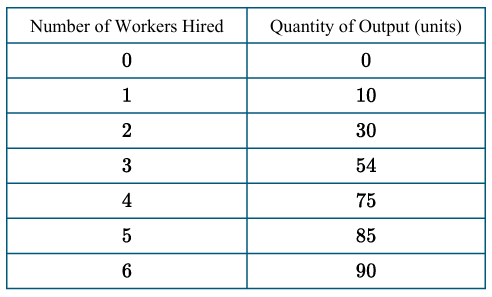
What is the marginal product of the third worker?
A. 5
B. 10
C. 20
D. 24
E. It cannot be determined from the information given.
Question 72
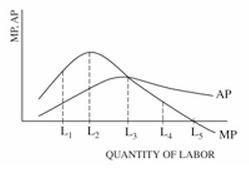
The graph above shows the marginal product (MP) and the average product (AP) of labor for a firm that uses labor as the only variable input and hires its labor in a perfectly competitive market. At which quantity of labor does marginal cost change from decreasing to increasing?
A. L1
B. L2
C. L3
D. L4
E. L5
Question 73
When the marginal cost curve lies below the average total cost curve, it is true that as output increases
A. marginal cost is decreasing
B. marginal cost is increasing
C. average total cost is decreasing
D. average total cost is increasing
E. average variable cost is decreasing
Question 74
Which of the following statements about cost is always true for both monopolies and perfectly competitive firms?
A. Average total cost equals marginal cost when average total cost is a minimum.
B. Marginal cost decreases as production increases.
C. Average fixed cost is equal to marginal cost when average fixed cost is a minimum.
D. Average variable cost is equal to marginal cost when marginal cost is a minimum.
E. Average variable cost decreases as production increases.
Question 75
Beyond a certain level of output, the short-run marginal cost will rise because
A. there is no fixed input and costs will increase
B. at least one input is fixed and eventually diminishing returns will occur
C. the cost of the variable input increases when marginal product increases
D. the demand for the good decreases when production is limited
E. input prices increase when production increases and consumption is limited
Question 76
A merger of two firms may increase economic efficiency by
A. decreasing average total cost through an increase in economies of scale
B. decreasing output to reduce marginal cost and equalize price
C. increasing economic profits but decreasing consumer surplus
D. increasing consumer surplus by decreasing economic profits
E. increasing consumer surplus by shifting the demand curve for the product to the right
Question 77
In the short run, a profit-maximizing firm, faced with U-shaped average cost curves, is producing a level of output at which the average total cost of production is minimized. At this level of output, which of the following is true for the firm?
A. Marginal cost equals average fixed cost.
B. Marginal cost equals average variable cost.
C. Marginal cost equals average total cost.
D. Profit per unit equals average total cost.
E. Profit per unit equals marginal cost.
Question 78
If labor is the only variable input in the production process, the short-run marginal cost curve is upward sloping because which of the following occurs as more and more labor is added?
A. Output decreases, and thus marginal cost increases.
B. Output increases, and thus marginal cost increases.
C. Output increases at an increasing rate, and thus the cost of producing each additional unit of output increases.
D. Output increases at a decreasing rate, and thus the cost of producing each additional unit of output increases.
E. Output increases at a decreasing rate, and thus the cost of producing each additional unit of output decreases.
Question 79
Which of the following is true of the marginal cost curve?
A. It intersects the average variable cost curve and the average total cost curve at each curve’s minimum point.
B. It intersects the average variable cost curve and the average fixed cost curve at each curve’s minimum point.
C. It lies between the total cost curve and the total variable cost curve.
D. It increases initially, for a time, but begins to decline when the point of diminishing returns is reached.
E. It decreases, because average variable cost is less than marginal cost.
Question 80
In microeconomics, the short run is defined as which of the following?
A. A period that is less than one year
B. A period that is between one year and four years
C. A period that is too short for a firm to be able to change its level of output
D. A period during which some inputs in a firm’s production process cannot be changed
E. A period during which a firm’s fixed costs exceed its variable costs
Question 81
Which of the following best explains why a firm’s short-run marginal cost curve shifts down when it purchases new, more efficient equipment and experiences an increase in its total cost?
A. The situation represents an exception to the law of diminishing returns.
B. The average total cost curve shifts upward as a result of the equipment purchase, and there is a movement up along the marginal cost curve.
C. The equipment purchase is a fixed cost, and the new equipment will cause a reduction in the cost of producing each additional unit.
D. The average variable cost curve shifts upward as a result of the equipment purchase, and the marginal cost curve shifts downward.
E. The marginal cost curve shifts downward because of the law of diminishing returns.
Question 82
In the short run, which of the following costs must continuously decrease as output produced increases?
A. Total variable cost
B. Total fixed cost
C. Average variable cost
D. Average fixed cost
E. Average total cost
Question 83
In most cases the supply curve for a perfectly competitive industry can be described as which of the following?
A. More elastic in the short run than in the long run
B. More elastic in the long run than in the short run
C. Downward sloping in the short run
D. Perfectly inelastic in the long run
E. Perfectly elastic in the short run
Question 84
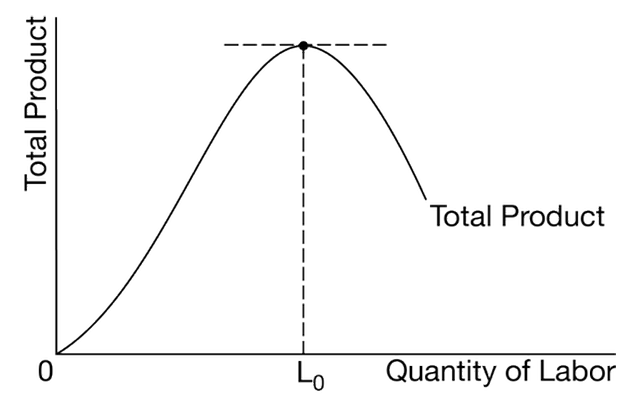
Based on the short-run production function graph above showing the relationship between the quantity of labor and total product, which of the following statements is true?
A. The marginal product of labor is always increasing.
B. At L0 the marginal product of labor is at its maximum.
C. Total product is maximized when marginal product is zero.
D. At L0 the marginal product of labor exceeds the average product of labor.
E. The marginal product of labor is always positive.
Question 85
The following questions refer to the diagram below, which shows the short-run production function of a perfectly competitive firm that produces potatoes using one variable input, labor.
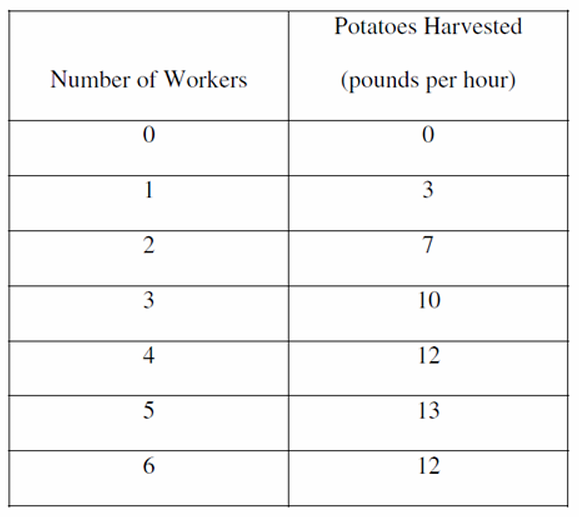
After which worker does diminishing marginal product first occur?
A. Second worker
B. Third worker
C. Fourth worker
D. Fifth worker
E. Sixth worker
Question 86
As its output increases, a firm’s short-run marginal cost will eventually increase because of
A. diseconomies of scale
B. a lower product price
C. inefficient production
D. the firm's need to break even
E. diminishing returns
Question 87
The following questions refer to the graph below, which shows the cost curves of a firm.
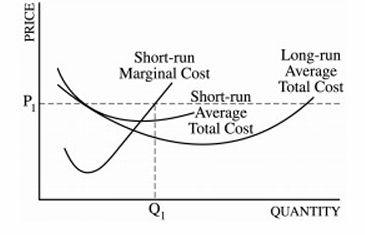
If the firm produces Q1 units of output with two inputs, the firm will be experiencing which of the following in the short run and in the long run?
A.
| Short Run |
Long Run |
| Increasing marginal returns |
Economies of scale |
B.
| Short Run |
Long Run |
| Increasing marginal returns |
Diseconomies of scale |
C.
| Short Run |
Long Run |
| Diminishing marginal returns |
Economies of scale |
D.
| Short Run |
Long Run |
| Diminishing marginal returns |
Diseconomies of scale |
E.
| Short Run |
Long Run |
| Constant marginal returns |
Diseconomies of scale |
Question 88
Which of the following best describes the relationship between the average total cost curve and the marginal cost curve in the short run?
A. If the average total cost curve is rising, the marginal cost curve is above the average total cost curve.
B. If the average total cost curve is rising, the marginal cost curve is below the average total cost curve.
C. If the average total cost curve is above the marginal cost curve, the marginal cost curve is rising.
D. If the average total cost curve is below the marginal cost curve, the marginal cost curve is falling.
E. If the average and marginal cost curves intersect, the marginal cost curve is at a minimum.
Question 89
Which of the following statements about short-run costs is true?
A. Average fixed cost plus variable cost equals total cost.
B. Average total cost plus average fixed cost equals average variable cost.
C. Total fixed cost increases in constant increments as output produced increases.
D. Total fixed cost plus total variable cost equals total cost.
E. At low output levels, as output increases, total fixed cost and total variable cost decrease, reducing average total cost.
Question 90
Assume a firm doubles its usage of each input, resulting in a doubling of the firm’s output. Which of the following describes this result?
A. Increasing total cost
B. Diminishing marginal returns
C. Decreasing returns to scale
D. Constant returns to scale
E. Increasing returns to scale
Question 91
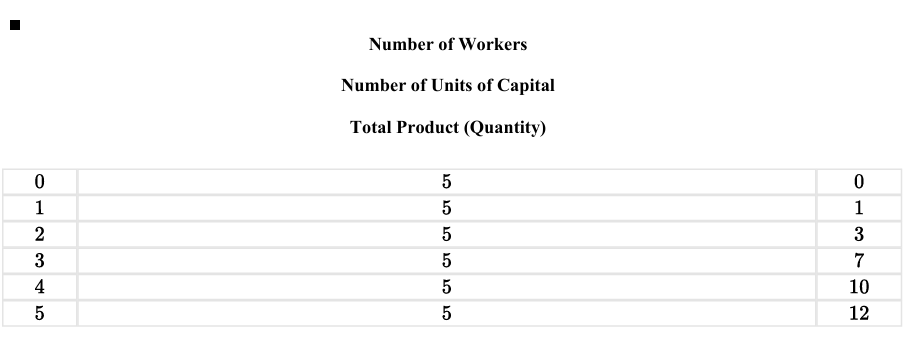
Suppose labor and capital can be hired in a competitive market. The wage is $15 per worker and the rental rate of capital is $10 per unit. Based on the table, what are the average variable cost ( AVC) and average total cost (ATC ) of producing 10 units of output?
A. AVC is $5 and ATC is $12
B. AVC is $6 and ATC is $11
C. AVC is $15 and ATC is $25
D. AVC is $60 and ATC is $110
E. AVC is $105 and ATC is $175
Question 92
Which of the following explains the difference between short-run and long-run costs?
A. All costs are variable in the short run but not in the long run.
B. All costs are fixed in the long run but not in the short run.
C. All costs are variable in the long run but not in the short run.
D. All costs are fixed in the short run but not in the long run.
E. All costs are variable in the short run and fixed in the long run.
Question 93
If a new tax on capital increases a firm’s fixed cost of production, which of the following will occur in the short run?
A. Marginal cost will increase.
B. Average variable cost will increase.
C. Average total cost will increase.
D. The profit-maximizing level of output will increase.
E. The profit-maximizing level of output will decrease.
Question 94
A short-run production function shows the relationship between a firm’s inputs and the output it produces when the firm
A. does not vary any of its inputs
B. has at least one fixed input
C. varies all of its inputs
D. has constant marginal cost
E. has no fixed costs
Question 95
When total physical product is at its maximum, marginal physical product must be
A. greater than one
B. equal to one
C. equal to zero
D. less than zero
E. constant
Question 96
If the price of a firm’s variable input increases, which of the following will occur?
A. The firm will decrease its level of production.
B. The price of the good will decrease in the short run.
C. The firm’s marginal costs will decrease at every level of output.
D. The firm’s average fixed cost will decrease.
E. More firms will enter the industry in the long run.
Question 97
If a single firm can produce and supply an entire market at a lower unit cost than many small firms can, the long-run average total cost must be
A. increasing as firm size increases
B. remaining constant as firm size increases
C. decreasing as the firm’s output increases
D. inelastic due to specialization
E. constant and equal to marginal cost
Question 98
An increase in which of the following will cause a firm’s marginal cost curve to shift upward?
A. The price of a variable input
B. The price of a fixed input
C. The level of output
D. Labor productivity
E. The demand for the firm’s product
Question 99
When marginal product exceeds average product, which of the following must be true?
A. Average product is increasing.
B. Average product is decreasing.
C. Marginal product is increasing.
D. Total product is decreasing.
E. Total product is at its maximum.
Question 100
Which of the following best explains why the short-run average total cost curve is U-shaped?
A. Spreading total fixed costs over a larger output, and constant returns
B. Spreading total fixed costs over a larger output, and eventually diminishing returns
C. Increasing total fixed costs and increasing returns
D. Increasing average variable costs and decreasing returns
E. Decreasing average variable costs and increasing returns
Question 101
Technological advances will lead to
A. an increase in marginal utility
B. a decrease in average total costs
C. a decrease in net exports
D. an increase in marginal costs
E. diseconomies of scale
Question 102
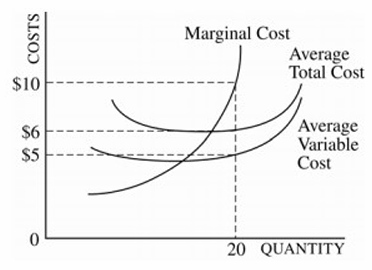
The graph above shows the cost curves for a competitive firm that produces 20 units of output. What are the total cost and the total fixed cost of producing 20 units of output?
A.
| Total Cost |
Total Fixed Cost |
| $10 |
$0 |
B.
| Total Cost |
Total Fixed Cost |
| $120 |
100 |
C.
| Total Cost |
Total Fixed Cost |
| $120 |
$20 |
D.
| Total Cost |
Total Fixed Cost |
| $200 |
$100 |
E.
| Total Cost |
Total Fixed Cost |
| $200 |
$20 |
Question 103
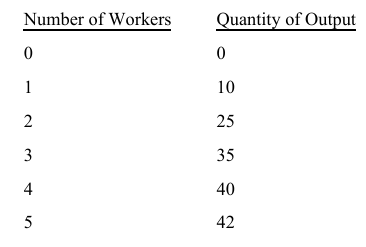
Given the production schedule above, what is the maximum number of workers the firm can hire before the effects of diminishing marginal returns set in?
A. 1
B. 2
C. 3
D. 4
E. 5
Section II - Free Response (30 questions)
Question 1
Include correctly labeled diagrams, if useful or required, in explaining your answers. A correctly labeled diagram must have all axes and curves clearly labeled and must show directional changes. If the question prompts you to “Calculate,” you must show how you arrived at your final answer.
The table below shows the total costs faced by Allura’s Little Robotics Company for different quantities of Good S sold.
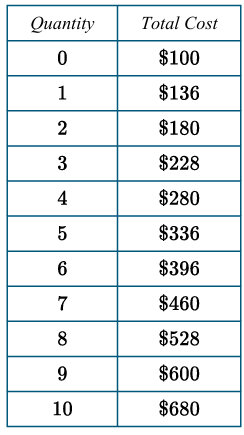
Allura’s Little Robotics Company sells Good S in a perfectly competitive market with a downward-sloping demand curve and an upward-sloping supply curve. The market price is $62 per unit.
Part A
Calculate the average fixed cost of producing 2 units. Show your work.
Part B
Identify the profit-maximizing quantity. Explain using marginal analysis.
Part C
Calculate the economic profit at the profit-maximizing quantity you identified in part (b).
Show your work.
Part D
Based on your answer to part (c), will the number of firms in the industry increase, decrease, or stay the same in the long run? Explain.
Part E
Based on your answer to part (c), will the market price increase, decrease, or stay the same in the long run? Explain.
Part F
The income elasticity of demand for Good S is -0.5, and the cross-price elasticity of demand for toy robots with respect to the price of Good S is 0.8. Based on your answer to part (e), what will happen to the demand for toy robots? Explain.
Part G
Now assume that the market in which Allura’s Little Robotics Company operates is in long-run equilibrium at a price $65 of per unit.
(i) Suppose shipping costs per order for Allura’s Little Robotics Company decrease. Will the profit maximizing quantity of Good S for Allura’s Little Robotics Company increase, decrease, or stay the same in the short run? Explain.
(ii) Instead suppose the government imposes a price ceiling of $60 on the market for Good S. Will total economic surplus in the market for Good S increase, decrease, or stay the same in the short run as a result of the price ceiling? Explain.
Question 2
Assume that in a perfectly competitive market, a firm's costs and revenues are
marginal cost = average variable cost at $20
marginal cost = average total cost at $30
marginal cost = average revenue at $25
Part A
How will this firm determine the profit maximizing level of output?
Part B
What price will this firm charge? Explain how the firm determined this price.
Part C
Should this firm produce in the short run? Why or why not?
Part D
Will this firm earn a profit or incur a loss? Why?
Question 3
In answering the question, you should emphasize the line of reasoning that generated your results; it is not enough to list the results of your analysis. Include correctly labeled diagrams, if useful or required, in explaining your answers. A correctly labeled diagram must have all axes and curves clearly labeled and must show directional changes.
Bestmilk, a typical profit-maximizing dairy firm, is operating in a constant-cost, perfectly competitive industry that is in long-run equilibrium.
Part A
Draw correctly labeled side-by-side graphs for the dairy market and for Bestmilk and show each of the
following.
i. Price and output for the industry
ii. Price and output for Bestmilk
Part B
Assume that milk is a normal good and that consumer income falls. Assume that Bestmilk continues to produce. On your graphs in part (a), show the effect of the decrease in income on each of the following in the short run.
i. Price and output for the industry
ii. Price and output for Bestmilk
iii. Area of loss or profit for Bestmilk
Part C
Following the decrease in consumer income, what must be true for Bestmilk to continue to produce in the short
run?
Part D
Assume that the industry adjusts to a new long-run equilibrium. Compare the following between the initial and the new long-run equilibrium.
i. Price in the industry
ii. Output of a typical firm
iii. The number of firms in the dairy industry
Question 4
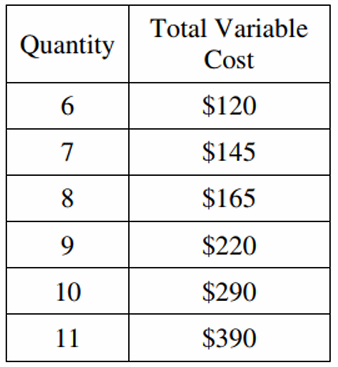
Brody’s firm produces trumpets in a perfectly competitive market. The table below shows Brody’s total variable cost. He has a fixed cost of $240, and the price per trumpet is $60.
Part A
Calculate the average total cost of producing 6 trumpets. Show your work.
Part B
Calculate the marginal cost of producing the 11th trumpet.
Part C
What is Brody’s profit-maximizing quantity? Use marginal analysis to explain your answer.
Part D
At the profit-maximizing quantity you determined in part (c), calculate Brody’s profit or loss. Show your work.
Part E
Brody also produces saxophones at a loss in a perfectly competitive market. Draw a correctly labeled graph for Brody’s firm showing the following at a market price of $200.
i. Brody’s profit-maximizing quantity of saxophones
ii. Brody’s loss, completely shaded
Question 5
Include correctly labeled diagrams, if useful or required, in explaining your answers. A correctly labeled diagram must have all axes and curves clearly labeled and must show directional changes. If the question prompts you to “Calculate,” you must show how you arrived at your final answer.
The table below shows the total costs faced by Dave’s General Store for different quantities of Good X sold.
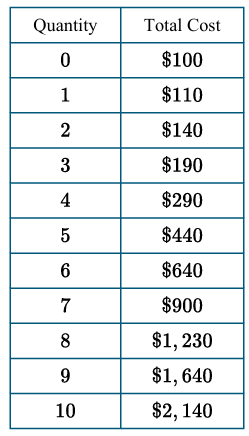
Dave’s General Store sells Good X in a perfectly competitive market with a downward-sloping demand curve and an upward-sloping supply curve. The market price is $120 per unit.
Part A
Calculate the average fixed cost of producing 5 units. Show your work.
Part B
Identify the profit-maximizing quantity. Explain using marginal analysis.
Part C
Calculate the economic profit at the profit-maximizing quantity you identified in part (b). Show your work.
Part D
Based on your answer to part (c), will the number of firms in the industry increase, decrease, or stay the same in the long run? Explain.
Part E
Based on your answer to part (c), will the market price increase, decrease, or stay the same in the long run? Explain.
Part F
The income elasticity of demand for Good X is 2.5, and the cross-price elasticity of demand for shoes with respect to the price of Good X is -0.4. Based on your answer to part (e), what will happen to the demand for shoes? Explain.
Part G
Now assume that the market in which Dave’s General Store operates is in long-run equilibrium.
(i) Suppose the rent paid by Dave’s General Store decreases. Will Dave’s General Store’s profit-maximizing quantity of Good X increase, decrease, or stay the same in the short run? Explain.
(ii) Instead suppose Dave’s General Store hires labor in a perfectly competitive market and the market wage increases. Will Dave’s General Store’s profit-maximizing quantity of Good X increase, decrease, or stay the same in the short run? Explain.
Question 6
Assume that a firm uses capital as a fixed factor of production and uses labor as a variable factor. The marginal product of labor at first increases and then decreases with the amount of labor.
Part A
Using a correctly labeled graph, draw and identify the firm's average total cost curve (ATC), average variable cost curve (AVC), and marginal cost curve (MC).
Part B
Given your graph in part (a), answer each of the following.
i. Why is the MC shaped as it is?
ii. What does the difference between the AVC and the ATC represent?
Part C
Define economies of scale.
Part D
Draw a long-run average total cost curve that has a region of economies of scale followed by a region of diseconomies of scale, as output increases.
Question 7
Include correctly labeled diagrams, if useful or required, in explaining your answers. A correctly labeled diagram must have all axes and curves clearly labeled and must show directional changes. If the question prompts you to “Calculate,” you must show how you arrived at your final answer.
The table below shows the total variable costs faced by Emily’s Eye Care Store for different quantities of Good M sold.
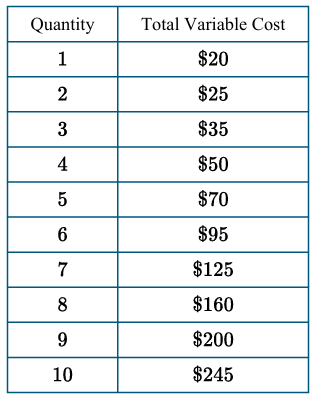
Emily’s Eye Care Store sells Good M in a perfectly competitive market with a downward-sloping demand curve and an upward-sloping supply curve. The market price is $33 per unit, and the total fixed cost is $30.
Part A
Identify the profit-maximizing quantity. Explain using marginal analysis.
Part B
Calculate the economic profit at the profit-maximizing quantity you identified in part (a). Show your work.
Part C
Calculate the average fixed cost of producing 6 units. Show your work.
Part D
Based on your answer to part (b), will the number of firms in the industry increase, decrease, or stay the same in the long run? Explain.
Part E
Based on your answer to part (b), will the market price increase, decrease, or stay the same in the long run? Explain.
Part F
The income elasticity of demand for Good M is 1.4, and the cross-price elasticity of demand for eyeglasses with respect to the price of Good M is -0.75. Based on your answer to part (e), what will happen to the demand for eyeglasses? Explain.
Part G
Now assume that the market in which Emily’s Eye Care Store operates is in long-run equilibrium at a price of $30 per unit.
(i) Suppose annual property taxes for Emily’s Eye Care Store increase by $2,000. Will the profit-maximizing quantity of Good M for Emily’s Eye Care Store increase, decrease, or stay the same in the short run? Explain.
(ii) Instead suppose the government imposes a price floor at $35 on the market for Good M. Will deadweight loss in the market for Good M increase, decrease, or stay the same in the short run as a result of the price floor? Explain.
Question 8
Include correctly labeled diagrams, if useful or required, in explaining your answers. A correctly labeled diagram must have all axes and curves clearly labeled and must show directional changes. If the question prompts you to “Calculate,” you must show how you arrived at your final answer.
The table below shows the total costs faced by Faizah’s Manufacturing Firm for different quantities of Good G sold.
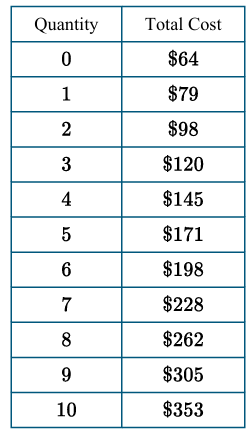
Faizah’s Manufacturing Firm sells Good G in a perfectly competitive market with a downward-sloping demand curve and an upward-sloping supply curve. The market price is $32 per unit.
Part A
Calculate the average fixed cost of producing 8 units. Show your work.
Part B
Identify the profit-maximizing quantity. Explain using marginal analysis.
Part C
Calculate the economic profit at the profit-maximizing quantity you identified in part (b). Show your work.
Part D
Based on your answer to part (c), will the number of firms in the industry increase, decrease, or stay the same in the long run? Explain.
Part E
Based on your answer to part (c), will the market price increase, decrease, or stay the same in the long run? Explain.
Part F
The income elasticity of demand for Good G is -3, and the cross-price elasticity of demand for gizmos with respect to the price of Good G is 0.1. Based on your answer to part (e), what will happen to the demand for gizmos? Explain.
Part G
Now assume that the market in which Faizah’s Manufacturing Firm operates is in long-run equilibrium at a price of $35 per unit.
(i) Suppose the government imposes a price floor at $30 per unit on the market for Good G. Will consumer surplus in the market for Good G increase, decrease, or stay the same in the short run as a result of the price floor? Explain.
(ii) Suppose instead the cost of energy, a variable cost for Faizah’s Manufacturing Firm, decreases. Will the profit maximizing quantity of Good G for Faizah’s Manufacturing Firm increase, decrease, or stay the same in the short run? Explain.
Question 9
Include correctly labeled diagrams, if useful or required, in explaining your answers. A correctly labeled diagram must have all axes and curves clearly labeled and must show directional changes. If the question prompts you to “Calculate,” you must show how you arrived at your final answer.
The table below shows the total costs faced by Hank’s Clothing Emporium for different quantities of Good A sold.
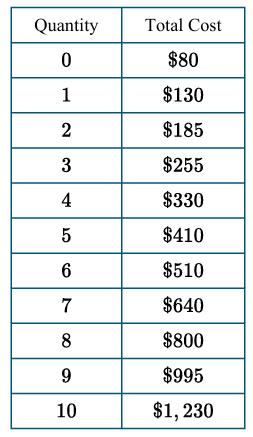
Hank’s Clothing Emporium sells Good A in a perfectly competitive market with a downward-sloping demand curve and an upward-sloping supply curve. The market price is
$60 per unit.
Part A
Calculate the average fixed cost of producing 5 units. Show your work.
Part B
Identify the profit-maximizing quantity. Explain using marginal analysis.
Part C
Calculate the economic profit at the profit-maximizing quantity you identified in part (b). Show your work.
Part D
Based on your answer to part (c), will the number of firms in the industry increase, decrease, or stay the same in the long run? Explain.
Part E
Based on your answer to part (c), will the market price increase, decrease, or stay the same in the long run? Explain.
Part F
The income elasticity of demand for Good A is -2, and the cross-price elasticity of demand for khaki pants with respect to the price of Good A is 0.8. Based on your answer to part (e), what will happen to the demand for khaki pants? Explain.
Part G
Now assume that the market in which Hank’s Clothing Emporium operates is in long-run equilibrium.
(i) Suppose the rent paid by Hank’s Clothing Emporium increases. Will Hank’s Clothing Emporium’s profit-maximizing quantity of Good A increase, decrease, or stay the same in the short run? Explain.
(ii) Instead suppose Hank’s Clothing Emporium hires labor in a perfectly competitive market and the market wage decreases. Will Hank’s Clothing Emporium’s profit-maximizing quantity of Good A increase, decrease, or stay the same in the short run? Explain.
Question 10
Include correctly labeled diagrams, if useful or required, in explaining your answers. A correctly labeled diagram must have all axes and curves clearly labeled and must show directional changes. If the question prompts you to “Calculate,” you must show how you arrived at your final answer.
The table below shows the total variable costs faced by Julia’s Accessories Store for different quantities of Good E sold.
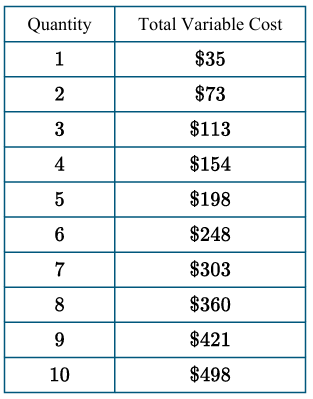
Julia’s Accessories Store sells Good E in a perfectly competitive market with a downward-sloping demand curve and an upward-sloping supply curve. The market price is $62 per unit, and the total fixed cost is $152.
Part A
Identify the profit-maximizing quantity. Explain using marginal analysis.
Part B
Calculate the economic profit at the profit-maximizing quantity you identified in part (a). Show your work.
Part C
Calculate the average fixed cost of producing 8 units. Show your work.
Part D
Based on your answer to part (b), will the number of firms in the industry increase, decrease, or stay the same in the long run? Explain.
Part E
Based on your answer to part (b), will the market price increase, decrease, or stay the same in the long run? Explain.
Part F
The income elasticity of demand for Good E is -1.2, and the cross-price elasticity of demand for bracelets with respect to the price of Good E is 0.6. Based on your answer to part (e), what will happen to the demand for bracelets? Explain.
Part G
Now assume that the market in which Julia’s Accessories Store operates is in long-run equilibrium.
(i) Suppose the market demand for Good E decreases. Will the profit-maximizing quantity of Good E for Julia’s Accessories Store increase, decrease, or stay the same in the short run? Explain.
(ii) Suppose instead the wages that Julia’s Accessories Store pays its workers increase. Will the profit-maximizing quantity of Good E for Julia’s Accessories Store increase, decrease, or stay the same in the short run? Explain.
Question 11
Include correctly labeled diagrams, if useful or required, in explaining your answers. A correctly labeled diagram must have all axes and curves clearly labeled and must show directional changes. If the question prompts you to “Calculate,” you must show how you arrived at your final answer.
The table below shows the total variable costs faced by Karen’s Kaleidoscope Store for different quantities of Good N sold.
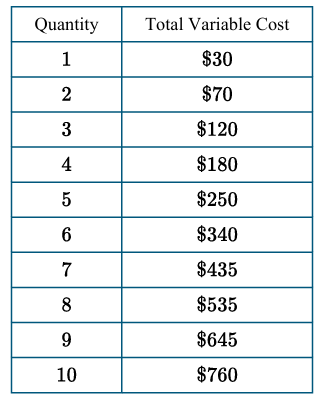
Karen’s Kaleidoscope Store sells Good N in a perfectly competitive market with a downward-sloping demand curve and an upward-sloping supply curve. The market price is $80 per unit, and the total fixed cost is $300.
Part A
Identify the profit-maximizing quantity. Explain using marginal analysis.
Part B
Calculate the economic profit at the profit-maximizing quantity you identified in part (a). Show your work.
Part C
Calculate the average fixed cost of producing 3 units. Show your work.
Part D
Based on your answer to part (b), will the number of firms in the industry increase, decrease, or stay the same in the long run? Explain.
Part E
Based on your answer to part (b), will the market price increase, decrease, or stay the same in the long run? Explain.
Part F
The income elasticity of demand for Good N is -1.8, and the cross-price elasticity of demand for kaleidoscopes with respect to the price of Good N is -0.5. Based on your answer to part (e), what will happen to the demand for kaleidoscopes? Explain.
Part G
Now assume that the market in which Karen’s Kaleidoscope Store operates is in long-run equilibrium at a price of $85 per unit.
(i) Suppose annual property taxes for Karen’s Kaleidoscope Store decrease by $2,500. Will the profit-maximizing quantity of Good N for Karen’s Kaleidoscope Store increase, decrease, or stay the same in the short run? Explain.
(ii) Instead suppose the government imposes a price floor at $75 on the market for Good N. Will deadweight loss in the market for Good N increase, decrease, or stay the same in the short run as a result of the price floor? Explain.
Question 12
Include correctly labeled diagrams, if useful or required, in explaining your answers. A correctly labeled diagram must have all axes and curves clearly labeled and must show directional changes. If the question prompts you to “Calculate,” you must show how you arrived at your final answer.
The table below shows the total costs faced by Kiyoshi’s Clothing Store for different quantities of Good F sold.
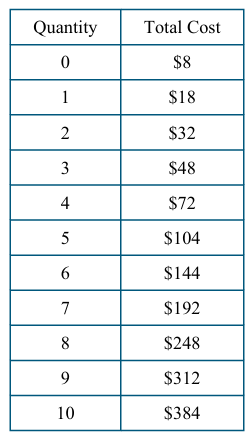
Kiyoshi’s Clothing Store sells Good F in a perfectly competitive market with a downward-sloping demand curve and an upward-sloping supply curve. The market price is $60 per unit.
Part A
Calculate the average fixed cost of producing 4 units. Show your work.
Part B
Identify the profit-maximizing quantity. Explain using marginal analysis.
Part C
Calculate the economic profit at the profit-maximizing quantity you identified in part (b). Show your work.
Part D
Based on your answer to part (c), will the number of firms in the industry increase, decrease, or stay the same in the long run? Explain.
Part E
Based on your answer to part (c), will the market price increase, decrease, or stay the same in the long run? Explain.
Part F
The income elasticity of demand for Good F is 3, and the cross-price elasticity of demand for gloves with respect to the price of Good F is 0.5. Based on your answer to part (e), what will happen to the demand for gloves? Explain.
Part G
Now assume that the market in which Kiyoshi’s Clothing Store operates is in long-run equilibrium at a price of $50 per unit.
(i) Suppose the government imposes a price floor at $55 per unit on the market for Good F. Will consumer surplus in the market for Good F increase, decrease, or stay the same in the short run as a result of the price floor? Explain.
(ii) Suppose instead the cost of energy, a variable cost for Kiyoshi’s Clothing Store, increases. Will the profit-maximizing quantity of Good F for Kiyoshi’s Clothing Store increase, decrease, or stay the same in the short run? Explain.
Question 13
Include correctly labeled diagrams, if useful or required, in explaining your answers. A correctly labeled diagram must have all axes and curves clearly labeled and must show directional changes. If the question prompts you to “Calculate,” you must show how you arrived at your final answer.
The table below shows the total costs faced by Lynda’s Office Supply Store for different quantities of Good P sold.
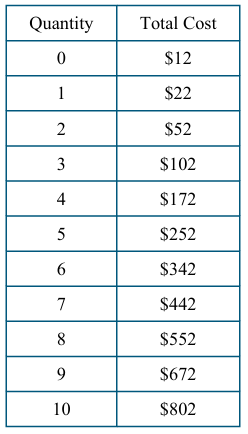
Lynda’s Office Supply Store sells Good P in a perfectly competitive market with a downward-sloping demand curve and an upward-sloping supply curve. The market price is $45 per unit.
Part A
Calculate the average fixed cost of producing 4 units. Show your work.
Part B
Identify the profit-maximizing quantity. Explain using marginal analysis.
Part C
Calculate the economic profit at the profit-maximizing quantity you identified in part (b). Show your work.
Part D
Based on your answer to part (c), will the number of firms in the industry increase, decrease, or stay the same in the long run? Explain.
Part E
Based on your answer to part (c), will the market price increase, decrease, or stay the same in the long run? Explain.
Part F
The income elasticity of demand for Good P is 1.8, and the cross-price elasticity of demand for chair mats with respect to the price of Good P is 0.9. Based on your answer to part (e), what will happen to the demand for chair mats? Explain.
Part G
Now assume that the market in which Lynda’s Office Supply Store operates is in long-run equilibrium at a price of $40 per unit.
(i) Suppose shipping costs per order for Lynda’s Office Supply Store increase. Will the profit-maximizing quantity of Good P for Lynda’s Office Supply Store increase, decrease, or stay the same in the short run? Explain.
(ii) Instead suppose the government imposes a price ceiling of $50 on the market for Good P. Will total economic surplus in the market for Good P increase, decrease, or stay the same in the short run as a result of the price ceiling? Explain.
Question 14
Assume that pencils are manufactured in a perfectly competitive market that is in long-run equilibrium.
Part A
Draw correctly labeled side-by-side graphs for the pencil market and for a representative firm and show each of the following.
i. The market price and quantity, labeled PM and QM, respectively
ii. The firm’s profit-maximizing price and quantity, labeled PF and QF, respectively
Part B
What is the relationship between PM and PF? Explain.
Part C
Rent on the factory building is an important fixed cost in the production of pencils, and the industry experiences significant increases in rent.
i. What will happen to the firm’s profit-maximizing quantity in the short run? Explain.
ii. On your graph in part (a), show the impact of the rent increase and completely shade the area representing the firm’s profit or loss in the short run.
Part D
As a result of the rent increase, what will happen to each of the following in the long run?
I. The number of firms in the market. Explain.
II. The market equilibrium quantity relative to QM and the market equilibrium price relative to PM. Explain.
Question 15
Include correctly labeled diagrams, if useful or required, in explaining your answers. A correctly labeled diagram must have all axes and curves clearly labeled and must show directional changes. If the question prompts you to “Calculate,” you must show how you arrived at your final answer.
A firm’s short-run production function shows the relationship between the firm’s input and output. Assume the firm uses one variable input, labor, and one fixed input, capital. The following table shows short-run production function for a firm that produces widgets.
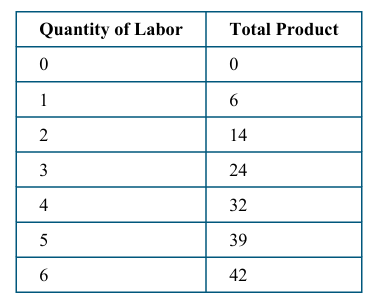
Part A
Calculate the marginal product of the sixth worker. Show your work.
Part B
Does the production function exhibit diminishing returns to labor? Explain.
Part C
When marginal product is falling, what happens to marginal cost?
Part D
On a single correctly labeled graph, draw the firm’s short-run average total cost curve (ATC), average variable cost curve (AVC), and marginal cost curve (MC).
Question 16
Include correctly labeled diagrams, if useful or required, in explaining your answers. A correctly labeled diagram must have all axes and curves clearly labeled and must show directional changes. If the question prompts you to “Calculate,” you must show how you arrived at your final answer.
Assume that Jasmine is a typical firm that produces and sells T-shirts in a perfectly competitive constant-cost industry. The market is currently in long-run equilibrium. The market price is $5, and Jasmine’s marginal cost at each level of output is listed in the table below.
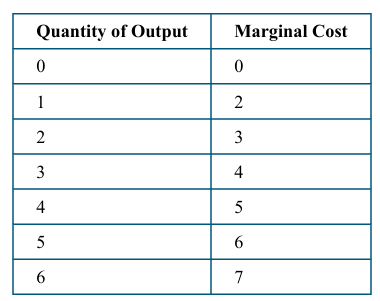
Part A
What is Jasmine’s profit-maximizing quantity of output? Explain.
Part B
Draw a correctly labeled graph for Jasmine, and show Jasmine’s total revenue at the profit-maximizing quantity, shaded completely.
Part C
Now assume consumer demand for T-shirts increases. What will happen to the number of firms in the market in the long run? Explain.
Question 17
Include correctly labeled diagrams, if useful or required, in explaining your answers. A correctly labeled diagram must have all axes and curves clearly labeled and must show directional changes. If the question prompts you to “Calculate,” you must show how you arrived at your final answer.
The table below shows the total variable costs faced by Raskin’s Clothing Store for different quantities of Good D sold.
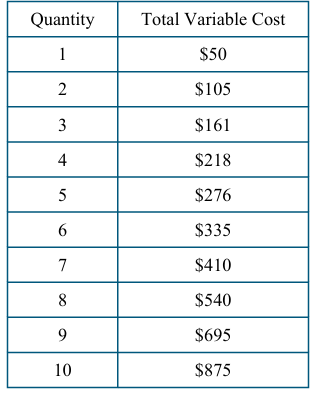
Raskin’s Clothing Store sells Good D in a perfectly competitive market with a downward-sloping demand curve and an upward-sloping supply curve. The market price is $150 per unit, and the total fixed cost is $85.
Part A
Identify the profit-maximizing quantity. Explain using marginal analysis.
Part B
Calculate the economic profit at the profit-maximizing quantity you identified in part (a). Show your work.
Part C
Calculate the average fixed cost of producing 10 units. Show your work.
Part D
Based on your answer to part (b), will the number of firms in the industry increase, decrease, or stay the same in the long run? Explain.
Part E
Based on your answer to part (b), will the market price increase, decrease, or stay the same in the long run? Explain.
Part F
The income elasticity of demand for Good D is 1.2, and the cross-price elasticity of demand for dresses with respect to the price of Good D is 0.2. Based on your answer to part (e), what will happen to the demand for dresses? Explain.
Part G
Now assume that the market in which Raskin’s Clothing Store operates is in long-run equilibrium.
(i) Suppose the market demand for Good D increases. Will the profit-maximizing quantity of Good D for Raskin’s Clothing Store increase, decrease, or stay the same in the short run? Explain.
(ii) Suppose instead the wages that Raskin’s Clothing Store pays its workers decrease. Will the profit-maximizing quantity of Good D for Raskin’s Clothing Store increase, decrease, or stay the same in the short run? Explain.
Question 18
Include correctly labeled diagrams, if useful or required, in explaining your answers. A correctly labeled diagram must have all axes and curves clearly labeled and must show directional changes. If the question prompts you to “Calculate,” you must show how you arrived at your final answer.
The table below shows the total variable costs faced by Saif’s General Store for different quantities of Good C sold.
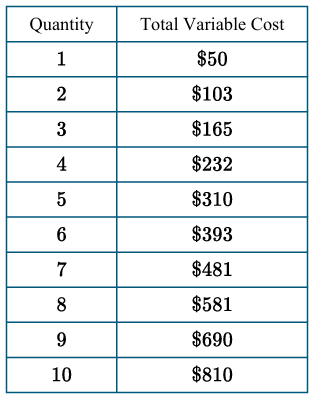
Saif’s General Store sells Good C in a perfectly competitive market with a downward-sloping demand curve and an upward-sloping supply curve. The market price is $90 per unit, and the total fixed cost is $275.
Part A
Identify the profit-maximizing quantity. Explain using marginal analysis.
Part B
Calculate the economic profit at the profit-maximizing quantity you identified in part (a). Show your work.
Part C
Calculate the average fixed cost of producing units. Show your work.
Part D
Based on your answer to part (b), will the number of firms in the industry increase, decrease, or stay the same in the long run? Explain.
Part E
Based on your answer to part (b), will the market price increase, decrease, or stay the same in the long run? Explain.
Part F
The income elasticity of demand for Good C is -1.5, and the cross-price elasticity of demand for hats with respect to the price of Good C is -0.6. Based on your answer to part (e), what will happen to the demand for hats? Explain.
Part G
Now assume that the market in which Saif’s General Store operates is in long-run equilibrium.
(i) Suppose the market demand for Good C decreases. Will the profit-maximizing quantity of Good C for Saif’s General Store increase, decrease, or stay the same in the short run? Explain.
(ii) Suppose instead the wages that Saif’s General Store pays its workers increase. Will the profit-maximizing quantity of Good C for Saif’s General Store increase, decrease, or stay the same in the short run? Explain.
Question 19
Include correctly labeled diagrams, if useful or required, in explaining your answers. A correctly labeled diagram must have all axes and curves clearly labeled and must show directional changes. If the question prompts you to “Calculate,” you must show how you arrived at your final answer.
The table below shows the total costs faced by Sarah’s Tool Store for different quantities of Good J sold.
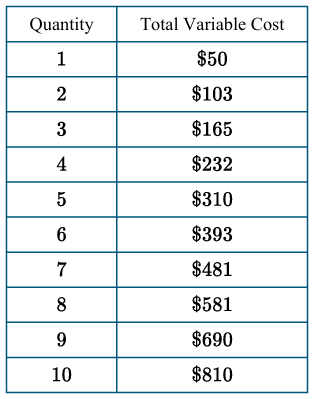
Sarah’s Tool Store sells Good J in a perfectly competitive market with a downward-sloping demand curve and an upward sloping supply curve. The market price is $42 per unit.
Part A
Calculate the average fixed cost of producing 5 units. Show your work.
Part B
Identify the profit-maximizing quantity. Explain using marginal analysis.
Part C
Calculate the economic profit at the profit-maximizing quantity you identified in part (b). Show your work.
Part D
Based on your answer to part (c), will the number of firms in the industry increase, decrease, or stay the same in the long run? Explain.
Part E
Based on your answer to part (c), will the market price increase, decrease, or stay the same in the long run? Explain.
Part F
The income elasticity of demand for Good J is -1.4, and the cross-price elasticity of demand for widgets with respect to the price of Good J is -0.25. Based on your answer to part (e), what will happen to the demand for widgets? Explain.
Part G
Now assume that the market in which Sarah’s Tool Store operates is in long-run equilibrium at a price of $45 per unit.
(i) Suppose the government imposes a price floor at $40 per unit on the market for Good J. Will consumer surplus in the market for Good J increase, decrease, or stay the same in the short run as a result of the price floor? Explain.
(ii) Suppose instead the cost of energy, a variable cost for Sarah’s Tool Store, decreases. Will the profit-maximizing quantity of Good J for Sarah’s Tool Store increase, decrease, or stay the same in the short run? Explain.
Question 20
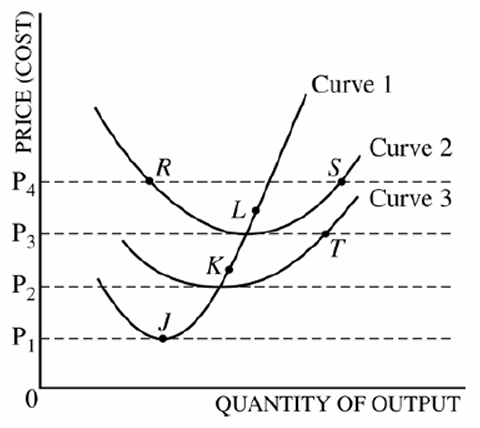
The graph above shows the short-run cost structure of a firm in a perfectly competitive industry.
Part A
Identify the cost curves that are denoted by each of the following labels.
i. Curve 1
ii. Curve 2
iii. Curve 3
Part B
Explain why curve 1 does each of the following as output increases.
i. Initially decreases
ii. Finally increases
Part C
What measure of cost is represented by the vertical distance between curve 2 and curve 3 ?
Part D
Explain why the vertical distance between curve 2 and curve 3 decreases as output increases.
Part E
Using the letters on the graph, identify two points on the firm’s short-run supply curve.
Question 21
Include correctly labeled diagrams, if useful or required, in explaining your answers. A correctly labeled diagram must have all axes and curves clearly labeled and must show directional changes. If the question prompts you to “Calculate,” you must show how you arrived at your final answer.
The table below shows the total costs faced by Sophia’s Lighting Store for different quantities of Good H sold.
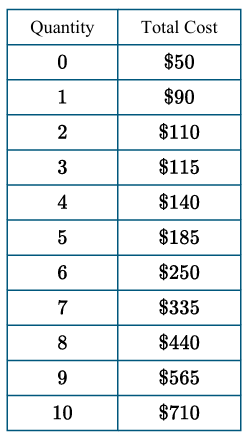
Sophia’s Lighting Store sells Good H in a perfectly competitive market with a downward-sloping demand curve and an upward-sloping supply curve. The market price is $140 per unit.
Part A
Calculate the average fixed cost of producing 2 units. Show your work.
Part B
Identify the profit-maximizing quantity. Explain using marginal analysis.
Part C
Calculate the economic profit at the profit-maximizing quantity you identified in part (b). Show your work.
Part D
Based on your answer to part (c), will the number of firms in the industry increase, decrease, or stay the same in the long run? Explain.
Part E
Based on your answer to part (c), will the market price increase, decrease, or stay the same in the long run? Explain.
Part F
The income elasticity of demand for Good H is 1.3, and the cross-price elasticity of demand for desk lamps with respect to the price of Good H is -0.9. Based on your answer to part (e), what will happen to the demand for desk lamps? Explain.
Part G
Now assume that the market in which Sophia’s Lighting Store operates is in long-run equilibrium at a price of $130 per unit.
(i) Suppose the government imposes a price floor at $150 per unit on the market for Good H. Will consumer surplus in the market for Good H increase, decrease, or stay the same in the short run as a result of the price floor? Explain.
(ii) Suppose instead the cost of energy, a variable cost for Sophia’s Lighting Store, increases. Will the profit-maximizing quantity of Good H for Sophia’s Lighting Store increase, decrease, or stay the same in the short run? Explain.
Question 22
Include correctly labeled diagrams, if useful or required, in explaining your answers. A correctly labeled diagram must have all axes and curves clearly labeled and must show directional changes. If the question prompts you to “Calculate,” you must show how you arrived at your final answer.
The table below shows the total costs faced by Surisitee’s Sporting Goods Store for different quantities of Good Y sold.
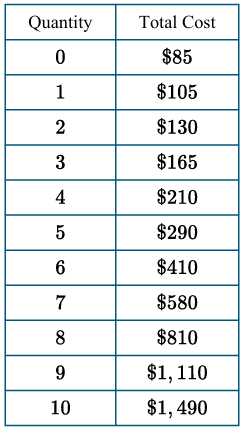
Surisitee’s Sporting Goods Store sells Good Y in a perfectly competitive market with a downward-sloping demand curve and an upward-sloping supply curve. The market price is $40 per unit.
Part A
Calculate the average fixed cost of producing 2 units. Show your work.
Part B
Identify the profit-maximizing quantity. Explain using marginal analysis.
Part C
Calculate the economic profit at the profit-maximizing quantity you identified in part (b). Show your work.
Part D
Based on your answer to part (c), will the number of firms in the industry increase, decrease, or stay the same in the long run? Explain.
Part E
Based on your answer to part (c), will the market price increase, decrease, or stay the same in the long run? Explain.
Part F
The income elasticity of demand for Good Y is -2.5, and the cross-price elasticity of demand for basketballs with respect to the price of Good Y is-0.8 . Based on your answer to part (e), what will happen to the demand for basketballs? Explain.
Part G
Now assume that the market in which Surisitee’s Sporting Goods Store operates is in long-run equilibrium.
(i) Suppose the rent paid by Surisitee’s Sporting Goods Store increases. Will Surisitee’s Sporting Goods Store’s profit maximizing quantity of Good Y increase, decrease, or stay the same in the short run? Explain.
(ii) Instead suppose Surisitee’s Sporting Goods Store hires labor in a perfectly competitive market and the market wage decreases. Will Surisitee’s Sporting Goods Store’s profit-maximizing quantity of Good Y increase, decrease, or stay the same in the short run? Explain.
Question 23
Include correctly labeled diagrams, if useful or required, in explaining your answers. A correctly labeled diagram must have all axes and curves clearly labeled and must show directional changes. If the question prompts you to “Calculate,” you must show how you arrived at your final answer.
The table below shows the total variable costs faced by Steve’s Home Appliances Store for different quantities of Good L sold.
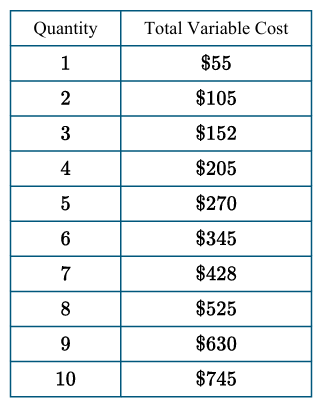
Steve’s Home Appliances Store sells Good L in a perfectly competitive market with a downward-sloping demand curve and an upward-sloping supply curve. The market price is $80 per unit, and the total fixed cost is $145.
Part A
Identify the profit-maximizing quantity. Explain using marginal analysis.
Part B
Calculate the economic profit at the profit-maximizing quantity you identified in part (a). Show your work.
Part C
Calculate the average fixed cost of producing 5 units. Show your work.
Part D
Based on your answer to part (b), will the number of firms in the industry increase, decrease, or stay the same in the long run? Explain.
Part E
Based on your answer to part (b), will the market price increase, decrease, or stay the same in the long run? Explain.
Part F
The income elasticity of demand for Good L is -0.8, and the cross-price elasticity of demand for coffee machines with respect to the price of Good L is 0.25. Based on your answer to part (e), what will happen to the demand for coffee machines? Explain.
Part G
Now assume that the market in which Steve’s Home Appliances Store operates is in long-run equilibrium at a price of $90 per unit.
(i) Suppose annual property taxes for Steve’s Home Appliances Store decrease by $7,000. Will the profit-maximizing quantity of Good L for Steve’s Home Appliances Store increase, decrease, or stay the same in the short run? Explain.
(ii) Instead suppose the government imposes a price floor at $70 on the market for Good L. Will deadweight loss in the market for Good L increase, decrease, or stay the same in the short run as a result of the price floor? Explain.
Question 24
Include correctly labeled diagrams, if useful or required, in explaining your answers. A correctly labeled diagram must have all axes and curves clearly labeled and must show directional changes. If the question prompts you to “Calculate,” you must show how you arrived at your final answer.
The table below shows the total costs faced by Susie’s Diner for different quantities of Good Q sold.
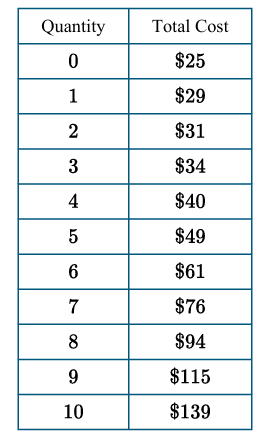
Susie’s Diner sells Good Q in a perfectly competitive market with a downward-sloping demand curve and an upward sloping supply curve. The market price is $8 per unit.
Part A
Calculate the average fixed cost of producing 2 units. Show your work.
Part B
Identify the profit-maximizing quantity. Explain using marginal analysis.
Part C
Calculate the economic profit at the profit-maximizing quantity you identified in part (b). Show your work.
Part D
Based on your answer to part (c), will the number of firms in the industry increase, decrease, or stay the same in the long run? Explain.
Part E
Based on your answer to part (c), will the market price increase, decrease, or stay the same in the long run? Explain.
Part F
The income elasticity of demand for Good Q is -1.3, and the cross-price elasticity of demand for cheeseburgers with respect to the price of Good Q is -0.3. Based on your answer to part (e), what will happen to the demand for cheeseburgers? Explain.
Part G
Now assume that the market in which Susie’s Diner operates is in long-run equilibrium at a price of $10 per unit.
(i) Suppose delivery costs per order for Susie’s Diner decrease. Will the profit-maximizing quantity of Good Q for Susie’s Diner increase, decrease, or stay the same in the short run? Explain.
(ii) Instead suppose the government imposes a price ceiling of $6 on the market for Good Q. Will total economic surplus in the market for Good Q increase, decrease, or stay the same in the short run as a result of the price ceiling? Explain.
Question 25
Include correctly labeled diagrams, if useful or required, in explaining your answers. A correctly labeled diagram must have all axes and curves clearly labeled and must show directional changes. If the question prompts you to “Calculate,” you must show how you arrived at your final answer.
The table below shows the total variable costs faced by Tom’s Toy Store for different quantities of Good B sold.
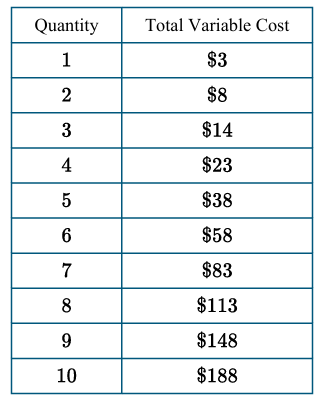
Tom’s Toy Store sells Good B in a perfectly competitive market with a downward-sloping demand curve and an upward sloping supply curve. The market price is $21 per unit, and the total fixed cost is $50.
Part A
Identify the profit-maximizing quantity. Explain using marginal analysis.
Part B
Calculate the economic profit at the profit-maximizing quantity you identified in part (a). Show your work.
Part C
Calculate the average fixed cost of producing 4 units. Show your work.
Part D
Based on your answer to part (b), will the number of firms in the industry increase, decrease, or stay the same in the long run? Explain.
Part E
Based on your answer to part (b), will the market price increase, decrease, or stay the same in the long run? Explain.
Part F
The income elasticity of demand for Good B is 1.5, and the cross-price elasticity of demand for teddy bears with respect to the price of Good B is -0.2. Based on your answer to part (e), what will happen to the demand for teddy bears? Explain.
Part G
Now assume that the market in which Tom’s Toy Store operates is in long-run equilibrium.
(i) Suppose the market demand for Good B increases. Will the profit-maximizing quantity of Good B for Tom’s Toy Store increase, decrease, or stay the same in the short run? Explain.
(ii) Suppose instead the wages that Tom’s Toy Store pays its workers decrease. Will the profit-maximizing quantity of Good B for Tom’s Toy Store increase, decrease, or stay the same in the short run? Explain.
Question 26
Umbrellas are produced by a perfectly competitive, constant-cost industry. In the short run, the equilibrium price is $7 per umbrella and the typical firm is operating with a loss. The typical firm has the total cost function shown in the table below.
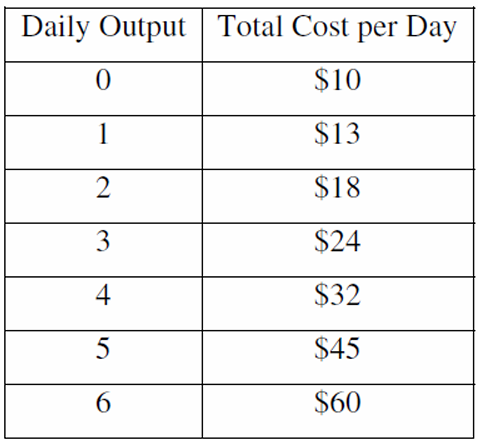
Part A
Using a correctly labeled graph, draw the demand curve for a typical firm in this industry.
Part B
Using the data above, determine each of the following for the typical firm.
i. Total fixed cost
ii. The loss-minimizing level of output
iii. The value of losses at the output level you found in part (b)(ii)
Part C
Explain why the typical firm chooses to operate despite incurring a loss in the short run.
Part D
If the total cost per day remains unchanged in the long run, what is the long-run equilibrium price for umbrellas?
Question 27
For each of the following statements, indicate whether it is true, false, or uncertain and explain why.
Part A
Average total cost is always greater than average variable cost by a constant amount.
Part B
In the short run, a perfectly competitive firm always maximizes profit when average total cost is at minimum.
Part C
If a firm shuts down in the short run, its profits will equal zero.
Question 28
Include correctly labeled diagrams, if useful or required, in explaining your answers. A correctly labeled diagram must have all axes and curves clearly labeled and must show directional changes. If the question prompts you to “Calculate,” you must show how you arrived at your final answer.
The table below shows the total variable costs faced by Waldo’s Electronics Store for different quantities of Good K sold.
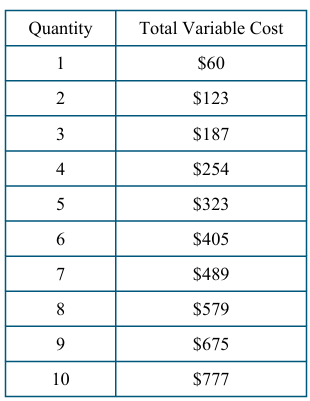
Waldo’s Electronics Store sells Good K in a perfectly competitive market with a downward-sloping demand curve and an upward-sloping supply curve. The market price is $75 per unit, and the total fixed cost is $42.
Part A
Identify the profit-maximizing quantity. Explain using marginal analysis.
Part B
Calculate the economic profit at the profit-maximizing quantity you identified in part (a). Show your work.
Part C
Calculate the average fixed cost of producing 7 units. Show your work.
Part D
Based on your answer to part (b), will the number of firms in the industry increase, decrease, or stay the same in the long run? Explain.
Part E
Based on your answer to part (b), will the market price increase, decrease, or stay the same in the long run? Explain.
Part F
The income elasticity of demand for Good K is 0.5, and the cross-price elasticity of demand for televisions with respect to the price of Good K is 0.3. Based on your answer to part (e), what will happen to the demand for televisions? Explain.
Part G
Now assume that the market in which Waldo’s Electronics Store operates is in long-run equilibrium at a price of $70 per unit.
(i) Suppose annual property taxes for Waldo’s Electronics Store increase by $5,000. Will the profit-maximizing quantity of Good K for Waldo’s Electronics Store increase, decrease, or stay the same in the short run? Explain.
(ii) Instead suppose the government imposes a price floor at $90 on the market for Good K. Will deadweight loss in the market for Good K increase, decrease, or stay the same in the short run as a result of the price floor? Explain.
Question 29
Include correctly labeled diagrams, if useful or required, in explaining your answers. A correctly labeled diagram must have all axes and curves clearly labeled and must show directional changes. If the question prompts you to “Calculate,” you must show how you arrived at your final answer.
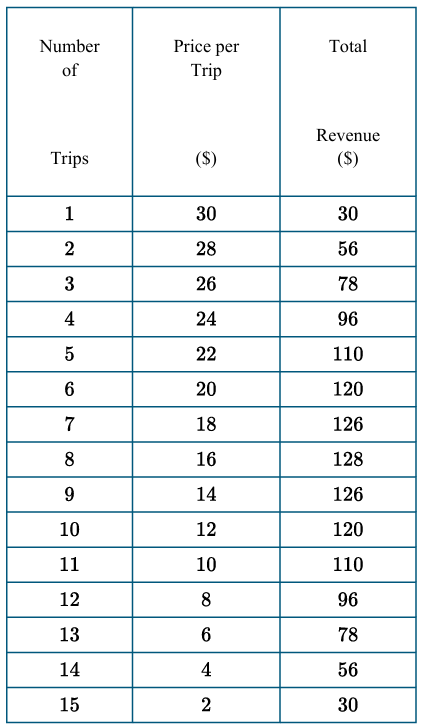
Wrightway has a local monopoly on transportation services from Burginville’s city center to its airport. Wrightway’s average variable cost and marginal cost for each trip are constant at $8. Wrightway incurs a $20 cost each day regardless of the number of trips it provides. The table above shows the price per trip that Wrightway can charge for different numbers of trips provided in a day.
Part A
Calculate the profit-maximizing number of trips for Wrightway to provide each day. Show your work.
Part B
What is the allocatively efficient number of trips per day?
Part C
Suppose the Burginville City Council is considering two proposals to get Wrightway to reduce deadweight loss from the provision of rides.
• Proposal I: Grant a $35 daily subsidy to Wrightway
• Proposal II: Grant a $5 per trip subsidy to Wrightway
(i) How many trips would Wrightway provide each day under Proposal I?
(ii) How many trips would Wrightway provide each day under Proposal II?
(iii) Which of the two proposals is preferable to the Burginville City Council? Explain.
Question 30
Include correctly labeled diagrams, if useful or required, in explaining your answers. A correctly labeled diagram must have all axes and curves clearly labeled and must show directional changes. If the question prompts you to “Calculate,” you must show how you arrived at your final answer.
The table below shows the total costs faced by Yotti’s Craft Store for different quantities of Good R sold.
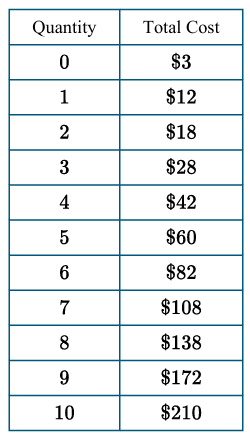
Yotti’s Craft Store sells Good R in a perfectly competitive market with a downward-sloping demand curve and an upward-sloping supply curve. The market price is $12 per unit.
Part A
Calculate the average fixed cost of producing 4 units. Show your work.
Part B
Identify the profit-maximizing quantity. Explain using marginal analysis.
Part C
Calculate the economic profit at the profit-maximizing quantity you identified in part (b). Show your work.
Part D
Based on your answer to part (c), will the number of firms in the industry increase, decrease, or stay the same in the long run? Explain.
Part E
Based on your answer to part (c), will the market price increase, decrease, or stay the same in the long run? Explain.
Part F
The income elasticity of demand for Good R is 0.8, and the cross-price elasticity of demand for balls of yarn with respect to the price of Good R is -0.1. Based on your answer to part (e), what will happen to the demand for balls of yarn? Explain.
Part G
Now assume that the market in which Yotti’s Craft Store operates is in long-run equilibrium at a price of $10 per unit.
(i) Suppose shipping costs per order for Yotti’s Craft Store increase. Will the profit-maximizing quantity of Good R for Yotti’s Craft Store increase, decrease, or stay the same in the short run? Explain.
(ii) Instead suppose the government imposes a price ceiling of $15 on the market for Good R. Will total economic surplus in the market for Good R increase, decrease, or stay the same in the short run as a result of the price ceiling? Explain.
Multiple-choice answer key
Answers reproduced from the website. No FRQ scoring guide was provided in the question pages.
1: E | 2: C | 3: B | 4: C | 5: D
6: C | 7: C | 8: A | 9: E | 10: D
11: E | 12: C | 13: C | 14: C | 15: A
16: C | 17: D | 18: B | 19: B | 20: C
21: D | 22: C | 23: C | 24: E | 25: C
26: C | 27: C | 28: E | 29: A | 30: B
31: D | 32: C | 33: A | 34: B | 35: D
36: C | 37: B | 38: B | 39: E | 40: C
41: C | 42: A | 43: D | 44: B | 45: D
46: C | 47: C | 48: A | 49: D | 50: C
51: B | 52: C | 53: C | 54: B | 55: C
56: C | 57: B | 58: E | 59: B | 60: C
61: D | 62: A | 63: A | 64: C | 65: D
66: A | 67: D | 68: B | 69: A | 70: C
71: D | 72: B | 73: C | 74: A | 75: B
76: A | 77: C | 78: D | 79: A | 80: D
81: C | 82: D | 83: B | 84: C | 85: A
86: E | 87: C | 88: A | 89: D | 90: D
91: B | 92: C | 93: C | 94: B | 95: C
96: A | 97: C | 98: A | 99: A | 100: B
101: B | 102: C | 103: B