Unit 3 Marginial analysis&consumer choice
Shanmao online question bank | Archived 2026-10-25
Section I - Multiple Choice (49 questions)
Question 1
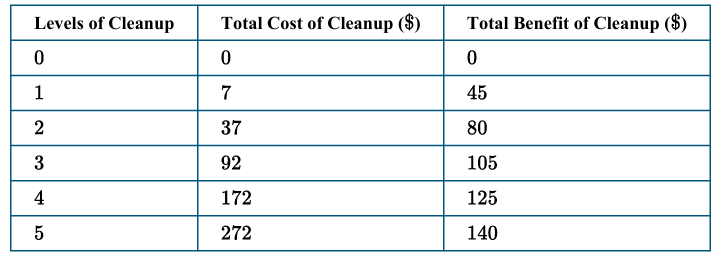
The table above shows the total cost and the total benefit of cleaning up pollution in a community. Which of the following cleanup levels is socially optimal?
A. 1
B. 2
C. 3
D. 4
E. 5
Question 2
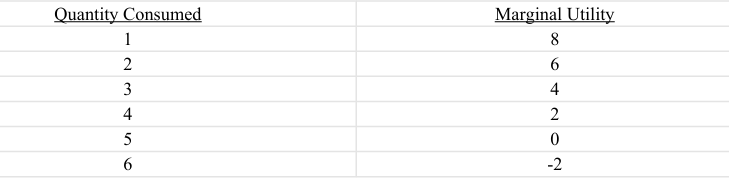
Assume the following utility schedule for Aaliyah’s ice cream consumption. If she consumes 6 units, what is the value of her total utility from consuming ice cream?
A. 22
B. 20
C. 18
D. 0
E. -2
Question 3
The additional satisfaction received from consuming an additional unit of a good is called the
A. marginal utility
B. marginal product
C. average product
D. average utility
E. total utility
Question 4
Which of the following is true if consuming one unit of a good yields 100 utils and consuming the second unit of the good increases satisfaction by 20 utils?
A. The marginal utility of the first unit is 20.
B. The marginal utility of the second unit is 80.
C. The marginal utility of the second unit is 120.
D. The total utility of consuming two units is 120.
E. The total utility of consuming one unit is greater than the total utility of consuming two units.
Question 5
Carlos has a van with 20 seats and charges $10 per person per ride to the airport from downtown. Carlos’ cost of the trip is $140 for any number of passengers. On one trip, Carlos has 19 seats filled when a person offers him $5 for the last seat. Should Carlos accept the offer?
A. No, since the $5 fare offered is below his average cost of $7.
B. No, since the average variable cost is greater than $5.
C. No, since it is illegal to charge different prices for the same service.
D. Yes, since the marginal benefit exceeds the marginal cost.
E. Yes, since his total revenue exceeds his total cost by $5.
Question 6
All of the following are included in computing the opportunity cost of attending college EXCEPT
A. interest paid on student loans
B. wages the student gave up to attend college
C. money spent on college tuition
D. money spent on clothing expenses
E. money spent on books and supplies
Question 7
If a good is available free of charge, an individual will consume it until
A. marginal utility is zero
B. average utility is zero
C. total utility is zero
D. marginal utility equals average utility
E. marginal utility equals total utility
Question 8
Marginal analysis suggests that an individual will consume one additional unit of a good if the
A. sunk cost can be recovered
B. total benefit is less than the total cost
C. total benefit is greater than the total cost
D. additional benefit is less than the additional cost
E. additional benefit is greater than the additional cost
Question 9
To maximize utility, a consumer with a fixed budget will purchase quantites of goods so that the ratios of the marginal utility of each good to its
A. total utility are the greatest
B. total utility are the same
C. price are the greatest
D. price are equal to one
E. price are equal
Question 10
According to the law of diminishing marginal utility, which of the following is true?
A. Total satisfaction decreases as more units of a good are consumed.
B. The additional satisfaction received from consuming extra units of a good decreases as consumption of the good increases.
C. The additional satisfaction received from consuming extra units of a good decreases as consumption of the good decreases.
D. The additional satisfaction received from consuming extra units of a good increases as consumption of the good increases.
E. When marginal utility is decreasing, total utility is decreasing.
Question 11
Using cost-benefit analysis, a local government would decide to build a new bridge if
A. The additional tax paid by an individual resident is greater than the additional benefit of building the bridge for all residents.
B. The toll paid by an individual resident crossing the bridge is less than the resident’s benefit from crossing the bridge.
C. The total costs of building the bridge are less than the total benefits from building the bridge.
D. The total costs of building the bridge are greater than the total benefits from building the bridge.
E. Total costs are at a minimum and total benefits are at a maximum.
Question 12
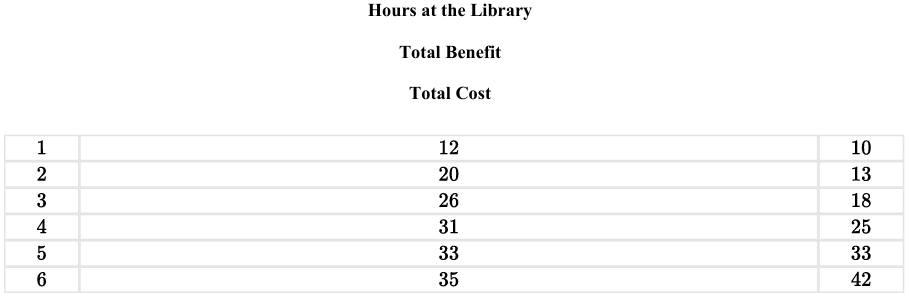
The table provided shows the total benefits and costs of studying at the library. If the student is rational, the optimal number of hours to spend at the library is
A. 2
B. 3
C. 4
D. 5
E. 6
Question 13
Suppose that a consumer purchases two goods X and Y and that the marginal utility of X is MUx, the total utility of X is TUx, the marginal utility of Y is MUy, and the total utility of Y is TUy. If the prices of X and Y are Px and Py, respectively, which of the following expressions defines consumer equilibrium?
A. TUx= TUy
B. MUx= MUy
C. TUx/Px = TUy/Py
D. MUx/Px = MUy/Py
E. (MUx)(Px) + (MUy)(Py) = 1
Question 14
The opportunity cost of owning a business is equal to which of the following?
I. The economic profits earned in the business
II. The accounting profits earned in the business
III. The profits that could be earned in another business using the same amount of resources
A. I only
B. II only
C. III only
D. I and III only
E. I, II, and III
Question 15
Which of the following best describes how a consumer maximizes total utility from the consumption of a bundle of goods and services?
A. By choosing the quantity of each good such that the quantity demanded of each good is equal to the quantity supplied
B. By choosing the quantity of each good such that the marginal utility from each good is equal to zero
C. By choosing the quantity of each good such that the price is equal to the marginal revenue
D. By choosing the level of output where marginal revenue is equal to marginal cost
E. By choosing the combination of goods such that the marginal utility per dollar spent on the last unit of each good is equal
Question 16
Which of the following best defines opportunity cost?
A. It is the cost of producing those goods most desired by a given economy.
B. It is the cost of the input mix that will lead to the greatest rate of growth for a given company.
C. It is the amount of one product that must be given up in order to produce an additional unit of another product.
D. It is the use of the least-cost method of production.
E. It is the cost of labor used in the production process.
Question 17
At her current level of consumption, a consumer is willing to pay up to $1.50 for a bottle of water and up to $1,500 for a diamond ring because the
A. total utility of diamond rings is greater than the total utility of water
B. total utility of water is less than the marginal utility of a diamond ring
C. marginal utility of a bottle of water is less than the marginal utility of a diamond ring
D. marginal utility of a bottle of water is greater than the marginal utility of a diamond ring
E. consumer is irrational and does not understand that water is more important than a diamond
Question 18
In a given time period, a person consumes more and more of a good or service and, as a result, enjoys each additional unit less and is willing to pay less for each additional unit. This behavior is consistent with the law of
A. diminishing returns
B. diminishing marginal product
C. diminishing marginal utility
D. increasing costs
E. scarce resources
Question 19
Garcia is currently spending his entire lunch budget on 3 sodas and 4 hot dogs. At his current level of consumption, Garcia’s marginal utility for sodas is 5 utils and his marginal utility for hot dogs is 10 utils. In order to maximize his total utility, Garcia should
A. consume more sodas and fewer hot dogs regardless of the prices
B. consume more hot dogs and fewer sodas regardless of the prices
C. maintain his current level of consumption of sodas and hot dogs regardless of the prices
D. maintain his current level of consumption if the price of a soda is $1 and the price of a hot dog is $2
E. maintain his current level of consumption if the price of a soda is $2 and the price of a hot dog is $1
Question 20
Assume a consumer is spending all her income on two goods: X and Y. At the current consumption combination of the two goods, if the marginal utility per dollar spent on the last unit of good X exceeds that of the marginal utility per dollar spent on the last unit of good Y, what should the consumer do to maximize utility?
A. Purchase more units of X and more units of Y.
B. Decrease the price of good X.
C. Purchase more units of X and less units of Y.
D. Increase income to buy more of both good Y and good X.
E. Nothing; utility is maximized at current consumption bundles.
Question 21
An opportunity cost is entailed in which of the following situations?
I. A student decides to attend college full-time.
II. A family uses its $20,000 savings to purchase an automobile.
III. A farmer decides to grow more wheat and less corn.
A. I only
B. II only
C. III only
D. I and III only
E. I, II, and III
Question 22
Assume that a consumer spends all her income on the purchase of two goods. If the consumer’s income doubles and the prices of the two goods also double, the quantity of the two goods purchased will
A. also double
B. more than double
C. increase, but it will be less than double
D. not change
E. depend on the slope of the demand curve
Question 23
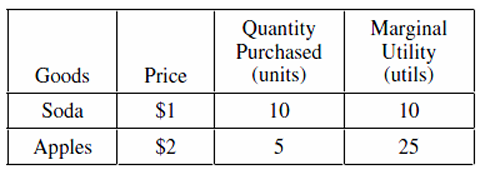
Jane spends all her weekly allowance to buy only two goods: soda and apples. According to the table above, if her preferences are characterized by the law of diminishing marginal utility, then which of the following statements is correct?
A. Jane is maximizing her utility.
B. Jane can buy more apples and less soda to maximize her utility.
C. Jane can buy more soda and fewer apples to maximize her utility.
D. Jane can buy more apples and the same amount of soda to maximize her utility.
E. Jane can buy more soda and the same amount of apples to maximize her utility.
Question 24
Assume that Clark spends his entire income on the purchase of two goods, X and Y. If his income and the prices of good X and Y all double, Clark will
A. double the purchase of goods X and Y
B. buy more of good X and less of good Y
C. buy less of good X and more of good Y
D. buy less of both goods X and Y
E. buy the same amounts of goods X and Y
Question 25
The following chart shows the total utility that Juan receives from consuming various amounts of chocolate candy bars each day.
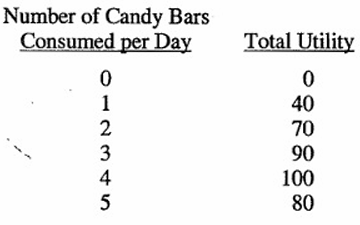
Which of the following statements about Juan's marginal utility is correct?
A. His marginal utility from the first candy bar is greater than his marginal utility from the second candy bar.
B. His marginal utility from the fourth candy bar is greater than his marginal utility from the third candy bar.
C. His marginal utility increases at a constant rate.
D. He first experiences diminishing marginal utility with the consumption of the fifth candy bar.
E. His greatest marginal utility comes from his consumption of the fourth candy bar.
Question 26
The table below shows the per-unit prices and marginal utility for the last unit of video games and comic books that Kyle purchased.
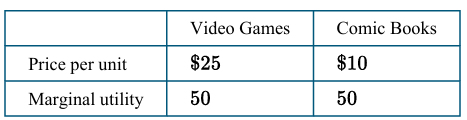
Kyle spent all of his allocated budget on video games and comic books. To maximize his utility, Kyle should have purchased
A. more video games and fewer comic books
B. fewer video games and more comic books
C. fewer of both goods
D. equal amounts of both goods
E. more of both goods
Question 27
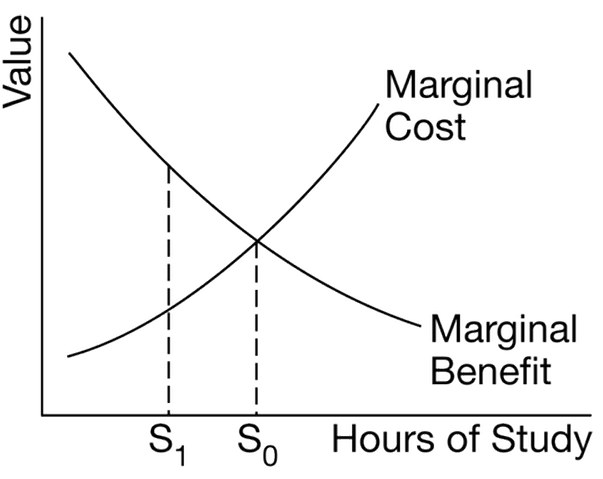
The graph above shows the marginal benefit that a student receives from additional hours of study, and the marginal cost the student will incur from additional hours of study. Which of the following is true?
A. Beyond S0 hours of study, there is no further benefit from devoting additional hours to study.
B. At S1 hours of study, the extra cost of study time exceeds the extra benefit of study time.
C. The optimal number of hours that the student should study is S0 hours.
D. The rational individual should study more than S0 hours.
E. The marginal cost of studying decreases as more time is spent studying.
Question 28
An art student spends all of her income on pencils and drawing pads. The student currently buys 30 pencils at $1 each and 10 pads at $5 each. If the marginal utility of the 30th pencil is 100 utils and the marginal utility of the 10th pad is 400 utils, to maximize utility the student should change her purchases of pencils and pads in which of the following ways?
A.
| Pencils |
Pads |
| Not change |
Buy more |
B.
| Pencils |
Pads |
| Buy more |
Buy more |
C.
| Pencils |
Pads |
| Buy more |
Buy less |
D.
| Pencils |
Pads |
| Buy less |
Buy more |
E.
| Pencils |
Pads |
| Buy less |
Buy less |
Question 29
Assume that Larry spends his entire allowance on the purchase of pretzels and ice-cream cones. The price of a bag of pretzels is $1, and the price of an ice-cream cone is $2. At his current consumption combination, the marginal utility of pretzels is 20 and of ice-cream cones is 60. To maximize his utility, Larry should
A. buy more of both goods
B. buy less of both goods
C. buy more pretzels and fewer ice-cream cones
D. buy fewer pretzels and more ice-cream cones
E. maintain his current consumption level
Question 30
Mickey has a $20 gift card that she is planning to use to download 10 songs and 5 games. The download price for each song is $1 and the download price for each game is $2. Her marginal utility from the tenth song is 30, and her marginal utility from the fifth game is 70. Based on this information, which of the following statements is true?
A. Mickey’s plan will maximize her utility.
B. Mickey can increase utility by buying more songs and fewer games.
C. Mickey can increase utility by buying more games and fewer songs.
D. Since games are twice as expensive as songs, Mickey should buy twice as many songs.
E. Since games are twice as expensive as songs, Mickey should buy twice as many games.
Question 31
Mr. Carpenter devotes his working time to producing tables and chairs. An increase in the demand for chairs will result in
A. an increase in the amount of time he devotes to producing tables
B. an increase in his opportunity cost of producing tables
C. a decrease in the price of lumber
D. a decrease in the price of chairs
E. a decrease in his total revenue
Question 32
When marginal utility is falling but positive, total utility will
A. decrease at an increasing rate
B. decrease at a decreasing rate
C. remain constant
D. increase at an increasing rate
E. increase at a decreasing rate
Question 33
According to the theory of consumer behavior, which of the following decreases first as additional units of a product are consumed?
A. Total utility
B. Average utility
C. Marginal utility
D. Marginal physical product
E. Total physical product
Question 34
The information below shows the marginal utilities a student receives from the consumption of pizza and pens. Assume that the marginal utility of each good is independent of the quantity of the other good consumed.
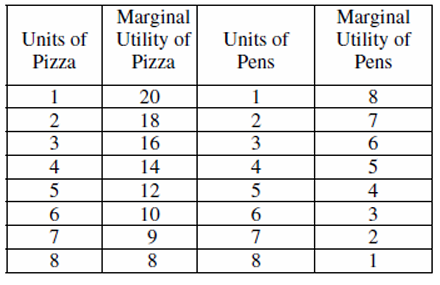
If the student purchases 2 units of pizza and 2 units of pens, the student’s total utility will be
A. 4 utils
B. 25 utils
C. 28 utils
D. 50 utils
E. 53 utils
Question 35
Opportunity cost is defined as
A. excess demand for a good
B. unlimited resources and unlimited wants
C. a comparative advantage in the production of a good
D. the value of the next best alternative that is forgone when an activity is pursued
E. the value of all other possible alternatives that are forgone when an activity is pursued
Question 36
After graduating from high school, Maria chose to go to college, while Omar chose to work full- time. Which of the following best describes the opportunity costs for these decisions?
A. Maria’s opportunity cost includes the salary she could have earned if she had gone to work.
B. Maria’s opportunity cost is her living expenses while attending college.
C. Omar’s opportunity cost is the salary he will earn from working.
D. Omar’s opportunity cost is the tuition and expenses he would have paid for college.
E. Omar’s opportunity cost is definitely greater than Maria’s.
Question 37
Oscar spent his entire income on only two goods: good X and good Y. At his current consumption of the two goods, the marginal utility of X is 8 and the marginal utility of Y is 2. If the price of X is $4.00 and the price of Y is $0.50, then to maximize his total utility, Oscar should have
A. bought more X and more Y
B. bought more X and less Y
C. bought less X and more Y
D. bought less X and less Y
E. maintained his current consumption
Question 38
Assume Pat spends all of her allowance to purchase 4 apples and 4 candy bars. Pat’s marginal utility of the fourth apple is 20 utils, and her marginal utility of the fourth candy bar is 40 utils. If an apple costs $1.00 and a candy bar $0.50, to maximize utility Pat should
A. purchase more apples and more candy bars
B. maintain the current purchase of 4 apples and 4 candy bars
C. purchase more apples and fewer candy bars
D. purchase fewer apples and more candy bars
E. purchase fewer apples and fewer candy bars
Question 39
After graduating from high school, Peggy Smith decided to enroll in a two-year program at the local community college rather than to accept a job that offered a salary of $12,000 per year. If the annual tuition and fees are $4,600, the annual opportunity cost of attending the community college is
A. $4,600
B. $7,400
C. $12,000
D. $16,600
E. $24,000
Question 40
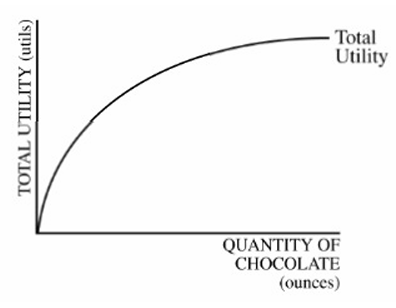
The diagram above shows Sally’s utility function for chocolate. Her utility function illustrates the principle of
A. trade-offs when making choices
B. diminishing marginal utility
C. income and substitution effects
D. increasing opportunity cost
E. constrained utility maximization
Question 41
Assume a worker can either cut grass or wash windows in a given day. It takes 5 hours to mow a one-acre lawn and 2.5 hours to wash all the windows in a house. When a worker chooses to wash the windows of four houses in a neighborhood, what is the opportunity cost of this decision?
A. The pay the worker receives for washing the windows in the four houses
B. The pay the worker would receive for cutting one lawn
C. Cutting the grass at the same four houses
D. The pay the worker would have received from cutting the grass at two houses
E. The pay the worker would receive for cutting .25 lawns
Question 42
The amount of product Z that must be forgone in order to obtain some amount of product Y is called
A. factor payments
B. opportunity cost
C. marginal product
D. income effect
E. substitution effect
Question 43
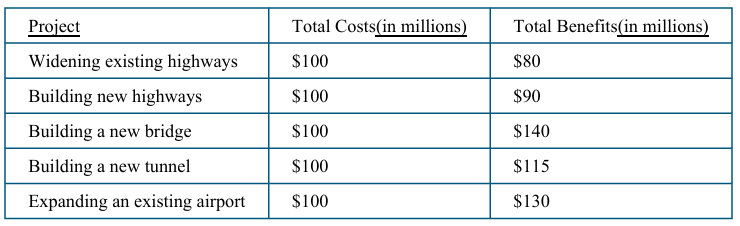
The table above shows the costs and benefits for new construction projects the government is considering. Based on these costs and benefits, which of the construction projects should the government undertake?
A. Widening existing highways
B. Building new highways
C. Building a new bridge
D. Building a new tunnel
E. Expanding an existing airport
Question 44
When total utility is at its maximum, marginal utility is
A. increasing
B. negative
C. equal to zero
D. at a maximum
E. at minimum
Question 45
Which of the following is a key assumption of consumer choice theory?
A. Consumers buy goods as long as implicit costs are greater than explicit costs.
B. Consumers maximize their utility.
C. As income rises, consumers buy more of all goods.
D. Marginal utility is always increasing.
E. As more inputs are used, consumers get less and less additional output.
Question 46
Josephine is buying candy and gum. If she is maximizing her utility for the combination of candy and gum she buys, which of the following must hold?
A. Marginal utility of candy ÷ price of candy = marginal utility of gum ÷ price of gum
B. Total utility of candy price ÷ of candy = total utility of gum ÷ price of gum
C. Marginal utility of candy ÷ total utility of candy = marginal utility of gum ÷ total utility of gum
D. Marginal utility of candy × price of candy = marginal utility of gum × price of gum
E. Total utility of candy × price of candy = total utility of gum × price of gum
Question 47
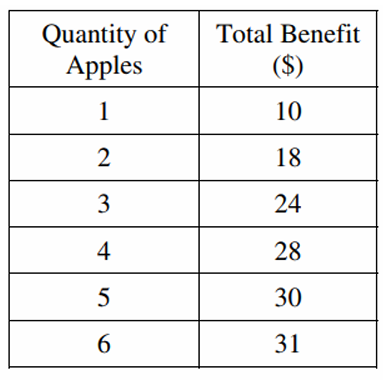
The table above shows the total benefit Tony gets from eating different quantities of apples. If apples cost $3 each, how many should he buy to maximize his consumer surplus?
A. 1
B. 2
C. 3
D. 4
E. 5
Question 48
Assume the price of a candy bar is $2 and the price of a bag of chips is $3. Assume Lilly’s marginal utility from consuming an additional candy bar is 10 utils and her marginal utility from consuming an additional bag of chips is 12 utils. If Lilly is spending her fixed weekly allowance on candy bars and bags of chips, which of the following actions will maximize Lilly’s total utility?
A. Buying more candy bars and bags of chips
B. Buying more candy bars and fewer bags of chips
C. Buying fewer candy bars and more bags of chips
D. Buying fewer candy bars and bags of chips
E. Buying the same number of candy bars and bags of chips
Question 49
Let MUs be the marginal utility of a sandwich, MUh be the marginal utility of a hot dog, Ps be the price of a sandwich, and Ph be the price of a hot dog. When the price of the goods is zero, Pat eats a sandwich. When Pat has to pay, she eats a hot dog. When Pat has to pay, which of the following is necessarily true?
A. MUs= MUh= Ps = Ph
B. (MUs/ Ps ) > (MUh / Ph)
C. Ps < Ph
D. Ps > Ph
E. MUs= 0
Multiple-choice answer key
Answers reproduced from the website. No FRQ scoring guide was provided in the question pages.
1: B | 2: C | 3: A | 4: D | 5: D
6: D | 7: A | 8: E | 9: E | 10: B
11: C | 12: B | 13: D | 14: C | 15: E
16: C | 17: C | 18: C | 19: D | 20: C
21: E | 22: D | 23: B | 24: E | 25: A
26: B | 27: C | 28: C | 29: D | 30: C
31: B | 32: E | 33: C | 34: E | 35: D
36: A | 37: C | 38: D | 39: D | 40: B
41: D | 42: B | 43: C | 44: C | 45: B
46: A | 47: D | 48: B | 49: D