Unit 2 Supply&demand
Shanmao online question bank | Archived 2026-10-25
Section I - Multiple Choice (215 questions)
Question 1
The demand curve for a normal good slopes down for which of the following reasons?
I. An increase in the price of the good induces consumers to purchase substitute products.
II. An increase in the price of the goods reduces consumers' purchasing power.
III. An increase in the price of the good increases consumers' utility from consuming that good.
A. I only
B. II only
C. III only
D. I and II only
E. I and III only
Question 2
After the government imposed a $0.20 per gallon tax on gasoline, the price of a gallon of gasoline increased from
$1.00 to $1.15. Which of the following statements is true?
A. Consumers bear the entire burden of the tax, since producers can pass the tax along to consumers.
B. Consumers and producers share the tax burden equally.
C. Consumers bear most, but not all, of the tax burden.
D. Producers bear the entire burden of the tax, since the tax was levied on producers, not consumers.
E. There is no tax burden, since gasoline is a normal good.
Question 3
Following a prolonged power outage, the price of flashlights normally increases significantly. If cities had passed laws prohibiting price increases for flashlights, during power outages such laws would most likely
A. make flashlights more available
B. create a shortage of flashlights
C. shift the demand curve for flashlights to the right
D. shift the supply curve for flashlights to the left
E. have no effect on the availability of flashlights
Question 4
Assume that the government imposes a binding price ceiling on a market for an inferior good. Which of the following is most likely to occur in the market if consumers’ incomes increase?
A. The market demand will shift to the right.
B. The market supply will shift to the right.
C. The shortage in the market will decrease.
D. The surplus in the market will increase.
E. The market price will increase.
Question 5
Assume that demand for bottled water is relatively price elastic. An increase in supply of bottled water will result in which of the following?
A. A decrease in price, leading to an increase in total revenue
B. A decrease in price, leading to a decrease in total revenue
C. An excess supply of bottled water
D. An excess demand for bottled water
E. A relatively small decrease in price and no change in equilibrium quantity
Question 6
The equilibrium price for a good with a vertical supply curve and a downward-sloping demand curve is . If a binding price floor is set, which of the following will occur?
A. There will be a shortage of the good.
B. The sum of consumer and producer surpluses will decrease.
C. The equilibrium price of the good will decrease.
D. The quantity sold of the good will remain unchanged.
E. Demand for substitutes for the good will decrease.
Question 7
If the price elasticity of supply for pickles is 2 and the price of pickles increases by 10 percent, then the quantity supplied of pickles will increase by
A. 0.2%
B. 5%
C. 8%
D. 12%
E. 20%
Question 8
If a 10 percent increase in the price of good X results in a 20 percent decrease in the quantity of good Y demanded, which of the following is true?
A. Good X and good Y are complementary goods, and the cross-price elasticity is -0.5.
B. Good X and good Y are substitute goods, and the income elasticity is +2.
C. Good X and good Y are complementary goods, and the cross-price elasticity is -2.
D. Good X and good Y are normal goods, and the income elasticity is +2.
E. Good X and good Y are substitute goods, and the cross-price elasticity is -2.
Question 10
If a 10 percent increase in the price of a good leads to a 25 percent decrease in the quantity demanded of the good, demand is
A. relatively inelastic
B. relatively elastic
C. unit elastic
D. perfectly elastic
E. perfectly inelastic
Question 11
A change in which of the following will cause a change in the supply of personal computers (PC’s) in the short run?
A. Technology
B. Demand for PC’s
C. Price of disks, which are a complement to PC’s
D. Price of PC’s
E. Consumers’ incomes
Question 12
Which of the following changes in the demand for and the supply of a good will necessarily result in an increase in both the equilibrium price and quantity of the good in a market?
A.
| Demand |
Supply |
| Increase |
Increase |
B.
| Demand |
Supply |
| Increase |
No change |
C.
| Demand |
Supply |
| No change |
Increase |
D.
| Demand |
Supply |
| Decrease |
Increase |
E.
| Demand |
Supply |
| No change |
Decrease |
Question 13
Which of the following situations best illustrates the law of demand?
A. As real incomes of United States citizens have decreased over the past year, the demand for housing has also decreased.
B. Recent decreases in the price of imported wine have led to an increase in the consumption of domestic wine.
C. In the past several months, as the price of compact disc players has decreased, the quantity of compact disc players sold has increased
D. The increase in the price of quality health foods has increased the revenues of firms producing these goods.
E. As the demand for computers has increased, the number of workers in the computer industry has increased.
Question 14
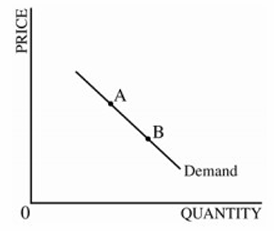
The graph above shows the market demand for good X. A movement from point A to point B would most likely be caused by
A. an increase in the price of good Z, a substitute
B. an increase in consumers' income
C. a decrease in consumers' income
D. a decrease in production costs for good X
E. a decrease in the supply of good X
Question 15
Which of the following will cause the demand for a normal good to increase?
A. A decrease in consumers’ income
B. A decrease in the price of a complementary good
C. A decrease in the price of a substitute good
D. A decrease in the price of the good
E. A decrease in the number of consumers
Question 16
In a perfectly competitive market, a change in which of the following could cause a shift in the supply curve?
A. The incomes of consumers
B. The number of buyers
C. Technology
D. The price of the product
E. Tastes and preferences
Question 17
Moving from left to right along a downward- sloping linear demand curve, price elasticity varies in which of the following ways?
A. First unit elastic, then inelastic throughout
B. First unit elastic, then elastic throughout
C. First inelastic, then unit elastic throughout
D. First elastic, then unit elastic, and finally inelastic
E. First inelastic, then unit elastic, and finally elastic
Question 18
Which of the following is most likely to occur when a competitive market adjusts from one equilibrium to another?
A. A decrease in demand will cause the equilibrium price, equilibrium quantity, and total surplus to increase.
B. An increase in demand will cause the equilibrium price, equilibrium quantity, and producer surplus to increase.
C. A decrease in supply will cause the equilibrium price to decrease, the equilibrium quantity to increase, and consumer surplus to decrease.
D. An increase in supply will cause the equilibrium price to increase, the equilibrium quantity to decrease, and consumer surplus to increase.
E. A decrease in supply and increase in demand will cause the equilibrium quantity to decrease but the equilibrium price to be indeterminate.
Question 19
If the supply of fish increases, there will be
A. an increase in the demand for chicken, a substitute good
B. an increase in the demand for fish
C. an increase in the price of fish tacos
D. a decrease in the price of fish
E. a decrease in the supply of potatoes, a complementary good
Question 20
What will happen to the price and quantity of footballs as a result of an increase in the price of leather used to make footballs?
A. Price will increase, and quantity will increase.
B. Price will increase, and quantity will decrease.
C. Price will decrease, and quantity will increase.
D. Price will decrease, and quantity will decrease.
E. Price will not change, and quantity will not change.
Question 21
Suppose hot dogs and hamburgers are substitutes in consumption. If the supply of hot dogs decreases, which of the following will happen in the market for hamburgers?
A. The supply curve for hamburgers will shift to the right.
B. The supply curve for hamburgers will shift to the left.
C. The demand curve for hamburgers will shift to the right.
D. The demand curve for hamburgers will shift to the left.
E. Both the demand curve and supply curve for hamburgers will shift to the left.
Question 22
Which of the following will shift the supply curve for apples to the right?
A. An increase in consumers’ income
B. An increase in the price of apples
C. An increase in the wages of apple pickers
D. A decrease in the rental price for apple harvesting equipment
E. A decrease in the demand for oranges, a substitute in consumption
Question 23
If an unusually cold summer destroyed a large portion of the bee population, the equilibrium price and quantity of honey produced by bees will most likely change in which of the following ways?
A.
| Price |
Quantity |
| Increase |
Increase |
B.
| Price |
Quantity |
| Increase |
Decrease |
C.
| Price |
Quantity |
| Increase |
No change |
D.
| Price |
Quantity |
| Decrease |
Decrease |
E.
| Price |
Quantity |
| No change |
Decrease |
Question 24
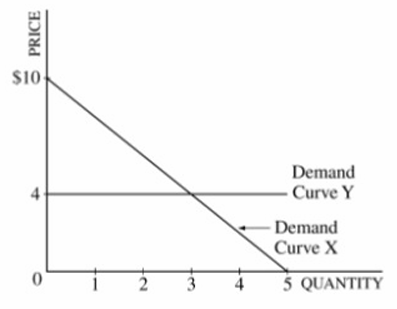
The demand curves X and Y are shown in the graph above. Which of the following offers the most accurate comparison of the price elasticities of demand curves X and Y at a price of $4?
A.
| Demand Curve X |
Demand Curve Y |
| Perfectly elastic |
Perfectly inelastic |
B.
| Demand Curve X |
Demand Curve Y |
| Perfectly inelastic |
Perfectly elastic |
C.
| Demand Curve X |
Demand Curve Y |
| Perfectly inelastic |
Relatively elastic |
D.
| Demand Curve X |
Demand Curve Y |
| Relatively inelastic |
Perfectly elastic |
E.
| Demand Curve X |
Demand Curve Y |
| Relatively elastic |
Relatively inelastic |
Question 25
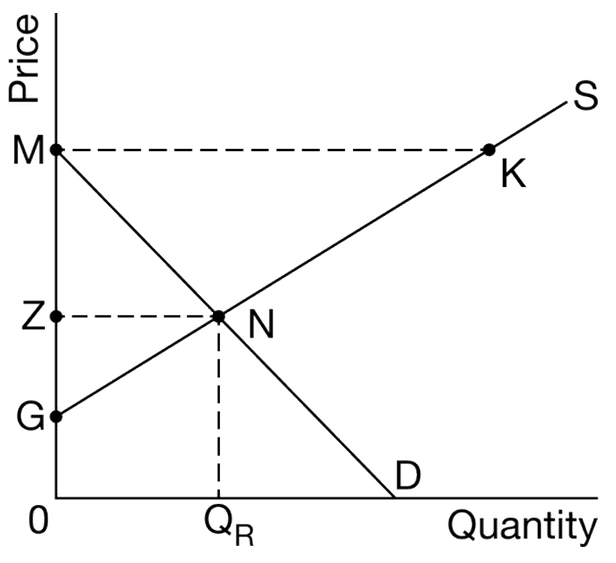
Based on the graph above, the consumer surplus at the market equilibrium price and quantity is shown by which area?
A. GMK
B. GMN
C. GZN
D. ZMN
E. MNK
Question 26
The difference between the price a consumer would be willing to pay for a cone of ice cream and the actual market price that she pays gives a measure of her
A. consumer surplus
B. producer surplus
C. marginal utility
D. marginal cost
E. ability to pay
Question 27
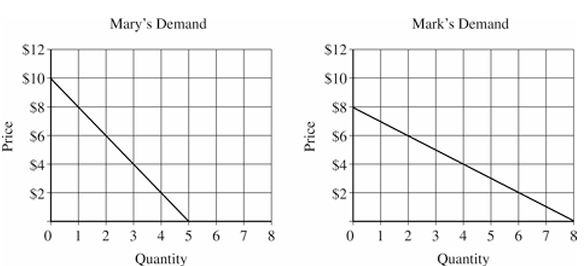
The graphs above show Mary’s demand for hamburgers and Mark’s demand for hamburgers. Suppose Mary and Mark are the only two consumers in the market. Which of the following is a point on the market demand curve for hamburgers?
Question 28
The following questions refer to the graph below. The market is currently in equilibrium
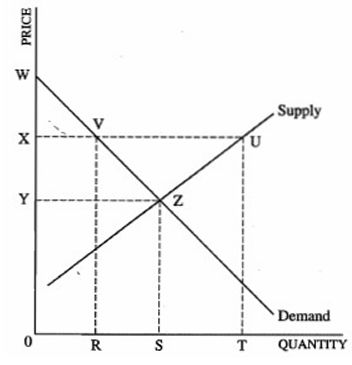
In a competition equilibrium consumer surplus is the area of
A. UVZ
B. WYZ
C. RVUT
D. XVZY
E. 0YZS
Question 29
If a price floor is set at X, the quantity demanded will
A. increase from 0R to 0S
B. increase from 0R to 0T
C. decrease from 0S to 0R
D. decrease from 0T to 0R
E. not change
Question 30
If growing corn becomes more profitable than growing wheat, which of the following will occur?
A. The supply of corn will decrease.
B. The price of wheat will decrease.
C. The price of corn will decrease.
D. The demand for wheat will increase.
E. The demand for corn will increase.
Question 31
Assume that a 2 percent increase in the price of bologna causes a 5 percent decrease in the demand for cheese. What is the cross-price elasticity of demand between the two goods, and how are these goods related?
A. Cross-price elasticity of demand equals -0.4, and these goods are complements.
B. Cross-price elasticity of demand equals +0.4, and these goods are substitutes.
C. Cross-price elasticity of demand equals -2.5, and these goods are complements.
D. Cross-price elasticity of demand equals +2.5, and these goods are substitutes.
E. Cross-price elasticity of demand equals -0.4, and these goods are substitutes.
Question 32
The cross-price elasticity of demand between goods J and K is -3. A 20 percent decrease in the price of good K
will result in a
A. 3 percent decrease in the quantity demanded of good K
B. 15 percent decrease in the quantity demanded of good K
C. 6 percent increase in the quantity demanded of good J
D. 12 percent increase in the quantity demanded of good J
E. 60 percent increase in the quantity demanded of good J
Question 33
Which of the following is true of the cross-price elasticity of demand?
A. It can indicate if a good is a necessity or a luxury.
B. It is greater than zero for two goods that are substitutes.
C. It is close to zero if the two goods are closely related.
D. It is always negative because demand curves are downward sloping.
E. It increases as income increases.
Question 34
To determine whether two goods are complements, one would calculate the
A. price elasticity of demand
B. price elasticity of supply
C. income elasticity of demand
D. cross-price elasticity of demand
E. input-price elasticity of supply
Question 35
All of the following cause a rightward shift in the demand schedule for a normal good EXCEPT
A. a decrease in the price of the good
B. a decrease in the price of a complementary good
C. an increase in the price of a substitute good
D. an increase in consumers’ income
E. an increase in consumers’ preference for the good
Question 36
A decrease in raw material prices will change the equilibrium price and quantity in a market in which of the following ways?
A.
| Price |
Quantity |
| Increase |
Increase |
B.
| Price |
Quantity |
| Increase |
Decrease |
C.
| Price |
Quantity |
| Decrease |
Increase |
D.
| Price |
Quantity |
| Decrease |
Decrease |
E.
| Price |
Quantity |
| No change |
Increase |
Question 37
In the short run, a decrease in production costs of a product will shift
A. both the demand curve and the supply curve to the right
B. the demand curve to the left and the supply curve to the right
C. only the supply curve to the right
D. only the supply curve to the left
E. only the demand curve to the left
Question 38
Assume that consumers consider popcorn and pretzels to be substitutes. A significant decrease in the supply of popcorn will affect the pretzel market by
A. increasing the demand for pretzels and therefore the supply of pretzels
B. increasing the demand for pretzels and therefore the price of pretzels
C. decreasing the demand for pretzels and therefore the price of pretzels
D. increasing the supply of pretzels and therefore the price of pretzels
E. decreasing the supply of pretzels and therefore the price of pretzels
Question 39
The cross-price elasticity of demand between good X and good Z measures the percentage change in the quantity demanded of good X in response to a percentage change in
A. the price of good X
B. income
C. the price of good Z
D. the supply of good Z
E. total expenditures on good Z
Question 40
If the increase in the price of one good decreases the demand for another, then the two goods are
A. inferior goods
B. luxury goods
C. normal goods
D. substitute goods
E. complementary goods
Question 41
Consumer surplus exists because of the
A. surplus of money that wealthy consumers hold
B. surplus in marginal product that firms get when they hire an additional worker
C. willingness of some consumers to pay a price higher than the market price for some units of a good
D. additional utility that households obtain when the prices of substitutes fall
E. increase in the availability of goods when income rises
Question 42
If the market demand for a good is inelastic and the supply is elastic, which of the following is true when there is an increase in sales tax?
A. Consumers will bear most of the burden of the tax.
B. Producers will bear all of the burden of the tax.
C. Producers will bear most of the burden of the tax or risk losing sales.
D. Both consumers and producers will share the burden of the tax equally.
E. The price of the good will not change.
Question 43
In relation to tacos, the cross-price elasticity of demand for Good X is negative. What would be the result if the price of tacos increases?
A. There will be a movement up the demand curve for Good X because it is a complement to tacos.
B. There will be a movement down the demand curve for Good X because it is a complement to tacos.
C. The demand for Good X will increase because it is a substitute for tacos.
D. The demand for Good X will decrease because it is a complement to tacos.
E. The demand for Good X will increase because tacos and Good X are normal goods.
Question 44
Which of the following statements about the price elasticity of demand is true?
A. When demand is price inelastic, total revenue will decrease as price increases.
B. When demand is price elastic, an increase in price will increase total revenue.
C. Demand tends to be more elastic in the short run compared to the long run.
D. As more close substitutes become available, demand tends to be more price elastic.
E. As a good becomes viewed as a necessity, demand becomes more price elastic.
Question 45
The following questions are based on the diagram below, which shows the effect of a unit tax placed on a good.
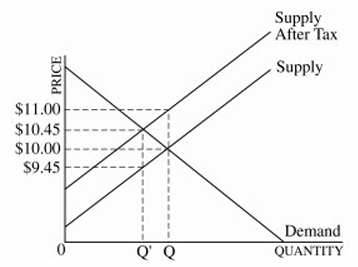
According to the diagram, what is the dollar amount of the unit tax?
A. $0.00
B. $0.45
C. $0.55
D. $1.00
E. $1.45
Question 46
What is the price paid by consumers and the net price received by producers after the tax is paid?
A.
| Paid by Consumers |
Received by Producers |
| $11.00 |
$10.45 |
B.
| Paid by Consumers |
Received by Producers |
| $11.00 |
$10.00 |
C.
| Paid by Consumers |
Received by Producers |
| $10.45 |
$10.00 |
D.
| Paid by Consumers |
Received by Producers |
| $10.45 |
$9.45 |
E.
| Paid by Consumers |
Received by Producers |
| $10.00 |
$9.45 |
Question 47
The difference between what consumers are willing to pay for units of a good and the price consumers actually pay for units of the good is called
A. marginal utility
B. producer surplus
C. consumer surplus
D. economic rent
E. a positive externality
Question 48
Assume that the government increases the unit excise tax on gasoline suppliers and also that people commute longer distances to work as more houses are built in city suburbs. As a result, the equilibrium price and quantity of gasoline will most likely change in which of the following ways?
A.
| Price |
Quantity |
| Decrease |
Decrease |
B.
| Price |
Quantity |
| Increase |
Decrease |
C.
| Price |
Quantity |
| Increase |
Increase |
D.
| Price |
Quantity |
| Increase |
Indeterminate |
E.
| Price |
Quantity |
| Indeterminate |
Increase |
Question 49
If a severe drought destroys a significant portion of the peanut crop and peanut farmers' revenues increase, which of the following is true over the observed range of prices?
A. The demand for peanuts must be unit price elastic.
B. The demand for peanuts must be price elastic.
C. The demand for peanuts must be unit price inelastic.
D. The supply ofpeanuts must be price inelastic.
E. The supply ofpeanuts must be price elastic.
Question 50
If the government eliminates an effective minimum wage in a competitive labor market, which of the following is true?
A. Minimum wage workers will experience no change in hourly pay.
B. Minimum wage workers will experience a decrease in hourly pay.
C. The number of people employed will decrease because people do not want to work for low wages.
D. There will be an excess demand for workers.
E. There will be an increase in the supply of workers.
Question 51
In the absence of market failures, a perfectly competitive market equilibrium is efficient for which of the following
reasons?
A. Consumer surplus is maximized and consumers are better off relative to producers.
B. Producer surplus is maximized and producers are better off relative to consumers.
C. Total economic surplus is maximized and all mutually beneficial transactions are exhausted.
D. Total economic surplus is distributed equally between producers and consumers.
E. The quantity of output is produced at a constant cost so that every consumer pays the same price.
Question 52
Assume that the market demand for a good is perfectly inelastic, the market supply for the good is perfectly elastic, and the market is in equilibrium. If there is a decrease in the price of a key input used in the production of the good, which of the following will occur?
A. There will be a decrease in the equilibrium quantity.
B. There will be no change in the producer surplus.
C. There will be a decrease in the producer surplus.
D. There will be a decrease in the consumer surplus.
E. There will be an increase in the equilibrium price.
Question 53
Assume that the price elasticity of demand for good X is constant and equal to -0.5 and the price elasticity of demand for good Y is constant and equal to -2. Assume that goods X and Y have identical upward-sloping elastic supply curves. If a per-unit excise tax of the same amount is levied on good X and on good Y, which of the following would be true?
A. The percentage decrease in the quantity of good X demanded would be greater than the percentage decrease in the quantity of good Y demanded.
B. The tax share paid by consumers of good X would be relatively higher than that paid by consumers of good Y.
C. The tax share paid by consumers of good Y would be relatively higher than that paid by consumers of good X.
D. The tax share paid by sellers of good Y would be relatively lower than that paid by sellers of good X.
E. The tax share paid by sellers of goods X and Y would be the same.
Question 54
Assume that the supply of corn is relatively price inelastic, while the demand for corn is relatively price elastic. If the government imposes a per-unit excise tax on the production of corn, the incidence of the tax will fall
A. entirely on buyers
B. more on buyers than on sellers
C. entirely on sellers
D. more on sellers than on buyers
E. equally on both buyers and sellers
Question 55
Assume that the price of orange juice increases by 40 percent following a crop failure. If the quantity demanded falls by 10 percent, which of the following is true?
A. The demand for orange juice is elastic.
B. The price of grapefruit juice, a substitute good, will fall.
C. The absolute value of the price elasticity of demand for orange juice is 4.
D. The absolute value of the price elasticity of demand for orange juice is 0.25.
E. The absolute value of the price elasticity of demand for orange juice is 10.
Question 56
The price elasticity of demand for a product is 0.5. If the price of the product increases by 20 percent, which of the following will occur?
A. The quantity demanded of the good will increase by 10%.
B. The quantity demanded of the good will increase by 20%.
C. The quantity demanded of the good will increase by 40%.
D. The quantity demanded of the good will decrease by 10%.
E. The quantity demanded of the good will decrease by 40%.
Question 57
Assume that the price elasticity of supply for good Y is 0.5. If the price of good Y decreases by 30 percent, the quantity supplied of good Y will
A. decrease by 60 percent
B. decrease by 30 percent
C. decrease by 15 percent
D. increase by 0.5 percent
E. increase by 0.15 percent
Question 58
Assume a 10 percent increase in price increased the market quantity supplied by 20 percent. Which of the following is true?
A. The value of the price elasticity of supply is 2.
B. The value of the price elasticity of supply is 0.5.
C. Supply is price inelastic.
D. Demand is price elastic.
E. This price-quantity combination violates the law of supply.
Question 59
Assume that more corn is used to produce ethanol. Simultaneously, more effective control of pests and weeds occurs in farming. Which of the following will definitely occur in the corn market?
A. The price of corn will increase.
B. The quantity of corn will decrease.
C. The price of corn will decrease.
D. The quantity of corn will increase.
E. The supply of corn will decrease.
Question 60
If the value of the price elasticity of supply is 3, which of the following is true?
A. Supply is inelastic.
B. A percentage increase in price will lead to a relatively smaller percentage increase in quantity supplied.
C. The supply curve is downward sloping with respect to the price of output.
D. A 10 percent decrease in price will decrease the quantity supplied by 30 percent.
E. A 3 percent increase in price will decrease the quantity supplied by 10 percent.
Question 61
Which of the following would shift the short-run supply curve for strawberries?
A. A decrease in the consumption of strawberries
B. An increase in the price of strawberries
C. A strike by all farmworkers
D. An increase in household incomes
E. An announcement of a study that shows the health benefits of eating strawberries
Question 62
If the minimum wage for teenagers increased to a rate higher than their market equilibrium wage, what would be the effect on their wage and employment?
A.
| Wage |
Employment |
| Increase |
No effect |
B.
| Wage |
Employment |
| Increase |
Increase |
C.
| Wage |
Employment |
| Increase |
Decrease |
D.
| Wage |
Employment |
| Decrease |
Increase |
E.
| Wage |
Employment |
| Decrease |
Decrease |
Question 63
Assume that people like onions on their hamburgers. If the supply of hamburgers decreases,the demand for onions will most likely
A. remain unchanged because hamburgers and onions are different goods
B. increase because hamburgers and onions are substitutes
C. increase because hamburgers and onions are complements
D. decrease because hamburgers and onions are complements
E. decrease because hamburgers and onions are substitutes
Question 64
Which of the following describes how a market will respond when the scarcity of a good increases?
A. Consumers will increase their demand for the good
B. Consumers will decrease their demand for the good.
C. The price of the good will increase.
D. The price of the good will decrease.
E. Producers will increase the supply of the good.
Question 66
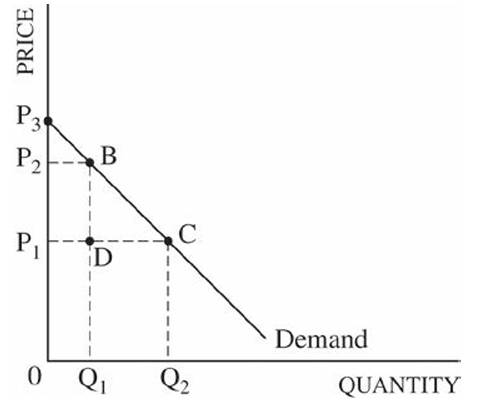
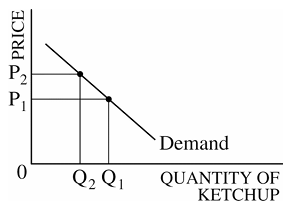
The diagram above shows the demand curve for a good. If the price increases from P
1 to P
2, and quantity consumed decreases from Q
2 to Q
1 , consumer surplus decreases by the area
A. BDC
B. P1P2BC
C. P1P2BD
D. Q1DCQ2
E. P2P3B
Question 67
If the imposition of a per-unit tax on a good reduces the total consumer surplus by more than the reduction of total producer surplus in a competitive market, then which of the following must be true?
A. The price sellers receive decreases by more than the amount of the tax.
B. The price buyers pay increases by more than the amount of the tax.
C. Demand is less elastic than supply.
D. Demand is more elastic than supply.
E. Demand and supply are both unit elastic.
Question 68
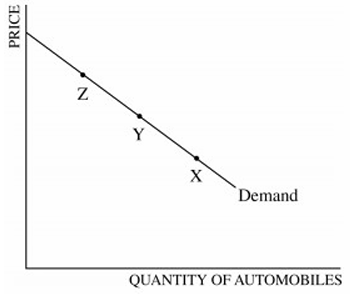
In the figure above, at which of the given points is demand most elastic?
A. X
B. Y
C. Z
D. The elasticity is the same for all points.
E. The relative elasticity cannot be determined with the given information.
Question 69
The supply curve for automobiles will shift to the left in response to
A. an increase in the efficiency of robot technology
B. an increse in wages in the automobile industry
C. a decrease in the number of consumers purchasing automobiles
D. a decrease in the interest rates for automobile loans
E. a decrease in consumers' income
Question 70
If a normal good is produced in a competitive market, which of the following combination of events could cause the
price of the good to increase and the quantity to decrease?
A. An increase in the average income of consumers and an increase in the number of producing firms
B. An increase in the average income of consumers and an increase in the price of a variable input
C. An increase in the price of a substitute good an an increase in the number of producing firms
D. A decrease in the number of consumers and a decrease in the price of a variable input
E. A decrease in the average income of consumers and an increase in the number of producing firms
Question 71
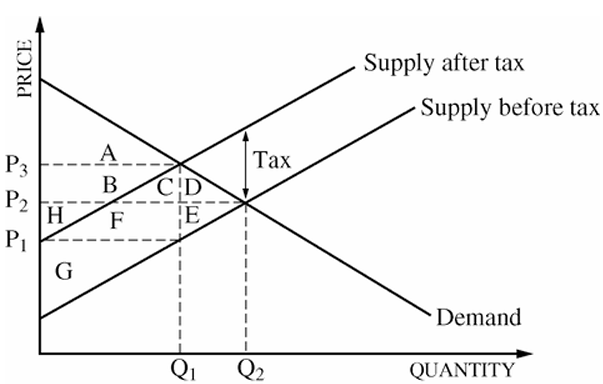
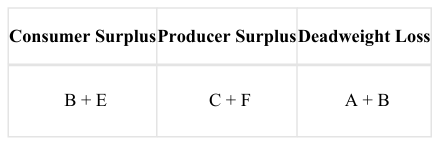
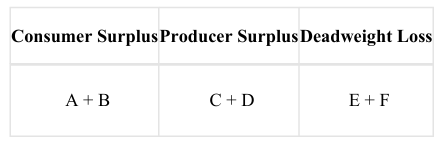
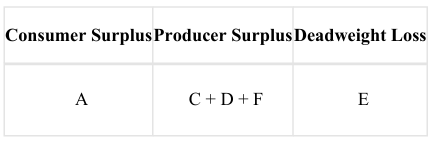
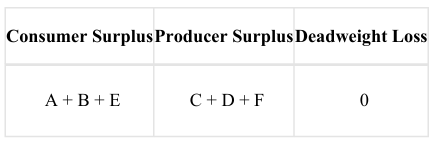
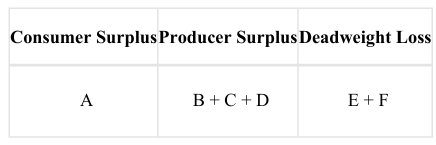
The graph above shows the market for good X The letters in the graph denote the enclosed areas If the government imposes an excise tax of t dollars on each unit of good X, which of the following represents the consumer surplus, producer surplus, and deadweight loss after the imposition of the tax?
A. Consumer Surplus: A
Producer Surplus: G
Deadweight Loss: D+E
B. Consumer Surplus: A
Producer Surplus: F+E
Deadweight Loss: D+E
C. Consumer Surplus: A+B
Producer Surplus: G+F+E
Deadweight Loss: C+D
D. Consumer Surplus: A+B+H
Producer Surplus: G+F
Deadweight Loss: D+E
E. Consumer Surplus: A+B+H
Producer Surplus: G+F+C
Deadweight Loss: E
Question 72
If a hurricane reduced the crab population, the price of crabs and quantity sold would change in which of the following ways?
A.
| Price |
Quantity |
| Increase |
Increase |
B.
| Price |
Quantity |
| Increase |
Decrease |
C.
| Price |
Quantity |
| Decrease |
Increase |
D.
| Price |
Quantity |
| Decrease |
Decrease |
E.
| Price |
Quantity |
| No change |
Decrease |
Question 73
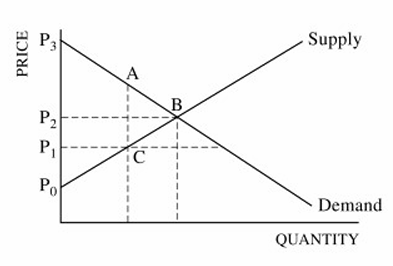
In the diagram above, if there is a price ceiling set at P
1, consumer surplus will be represented by the area
A. ABC
B. P2BP0
C. P3BP2
D. P3ACP1
E. P3BCP1
Question 74
Assume that the original supply and demand curves of a commodity are S and D, respectively. Also assume that the government imposes an excise tax (per unit tax) of t dollars on the commodity, which shifts the supply curve to S
1.
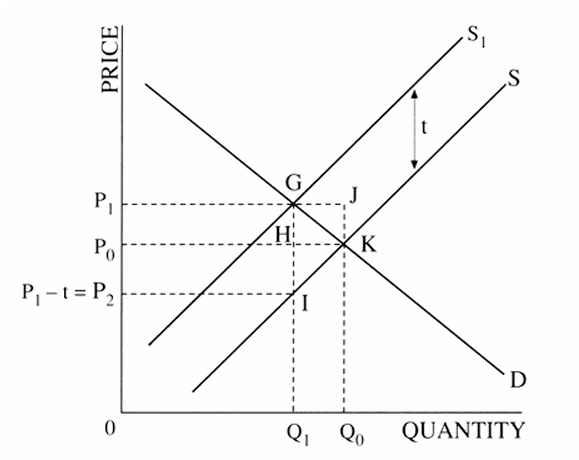
The deadweight loss created by the tax is equal to
A. P1GHP0
B. P1GKP0
C. GHK
D. GKI
E. zero
Question 75
Which of the following bears the total tax burden?
A. The consumers bear it.
B. The producers bear it.
C. The consumers and the producers each bear a part of it.
D. The group that legally pays the tax bears it.
E. The government bears it.
Question 76
The total amount of tax collected by the government is equal to
A. P1GQ10
B. P1GIP2
C. P0P1JK
D. P0P1GH
E. P0P2IH
Question 77
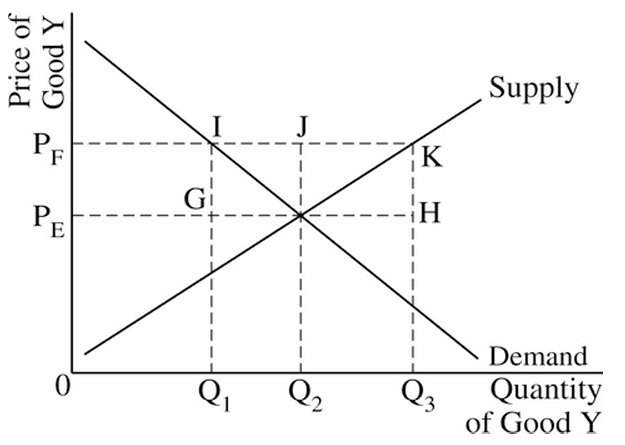
The diagram above depicts the demand and supply curves for good Y. The perfectly competitive market is initially in equilibrium, but the government decides to institute a price floor program by setting the price of good Y at P
F and agrees to purchase all unsold units of good Y from the producers. The cost of this program to the government is represented by which of the following areas?
A. 0PFJQ2
B. 0PFKQ3
C. GIKH
D. Q1IJQ2
E. Q1IKQ3
Question 78
Consumer surplus in a market for a good exists because
A. binding price floors encourage producers to increase the supply of the good
B. some consumers would be willing to pay more than the equilibrium price of the good
C. when the price of the good decreases, most consumers increase their demand for the good
D. producers do not have market power to set their own price
E. some producers charge different prices for the good in different markets
Question 79
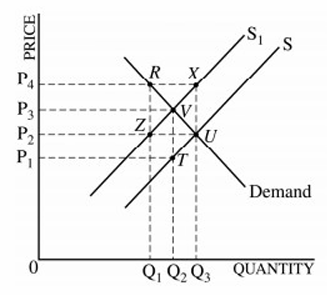
In the graph above, S is the original supply curve, and S
1 is the supply curve including an excise tax. The area representing the tax revenue to the government is
A. P1P3VT
B. P2P4RZ
C. P2P4XU
D. P2UQ30
E. P3VQ20
Question 80
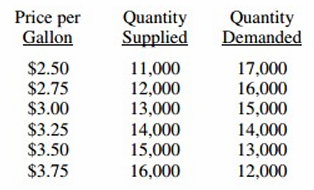
The table above shows the quantity of gasoline supplied and demanded at various prices in a country. If the government sets a price floor of $2.75 on a gallon of gasoline, what is the price per gallon?
A. $2.75
B. $3.00
C. $3.25
D. $3.50
E. $3.75
Question 82
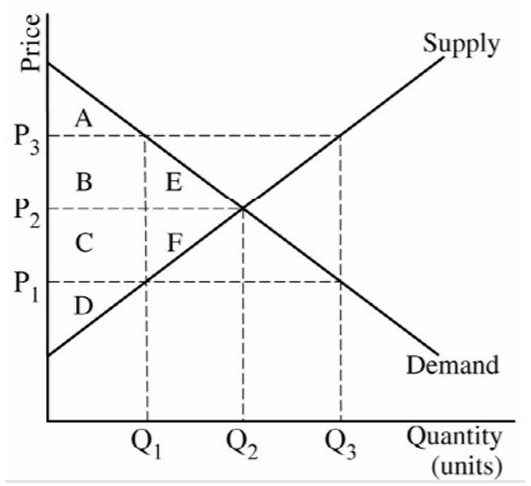
Total economic surplus will be maximized at which of the following price and quantity combinations?
A. P3 and Q3
B. P3 and Q1
C. P2 and Q2
D. P1 and Q1
E. P1 and Q3
Question 83
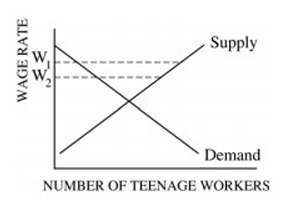
The graph above illustrates the labor market for teenage workers. The current minimum wage for all workers is W
1. If Congress introduces a sub-minimum wage, W
2 that applies only to teenagers, what is the most likely effect on teenage employment?
A. Teenage employment will increase because firms will want to hire more teenagers at W2 than at W1.
B. Teenage employment will increase because more teenagers will want to work at W2 than at W1.
C. Teenage employment will decrease because fewer teenagers will want to work at W2 than at W1.
D. Teenage employment will decrease because firms will want to hire fewer teenagers at W2 than at W1.
E. Teenage employment will stay the same because the market-clearing wage is lower than W1 and W2.
Question 84
Given an increase in the price of material K— which is an input used to produce good X— and an increase in the price of good Y— which is a substitute for good X— which of the following will definitely occur?
A. The equilibrium price of good X will decrease.
B. The equilibrium price of good X will increase.
C. The equilibrium quantity of good X will be unaffected.
D. The equilibrium quantity of good X will increase.
E. The equilibrium quantity of good X will decrease.
Question 85
If cotton is used to produce towels, an increase in the price of cotton will result in which of the following changes in the towel market?
A. A decrease in the demand for towels, which leads to a shortage of towels followed by upward pressure on the price of towels
B. A decrease in the demand for towels, which leads to a surplus of towels followed by downward pressure on the price of towels
C. A decrease in the supply of towels, which leads to a shortage of towels followed by upward pressure on the price of towels
D. An increase in the supply of towels, which leads to a surplus of towels followed by downward pressure on the price of towels
E. An increase in both the demand and supply of towels, which leads to a surplus of towels followed by upward pressure on the price of towels
Question 86
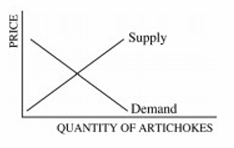
The graph above shows the supply and demand curves for artichokes. The surgeon general announces that eating an artichoke a day dramatically reduces one’s likelihood of developing cancer. Simultaneously an infestation of the artichoke weevil severely damages the crop. Which of the following will definitely occur as a result?
A. The supply of artichokes will increase.
B. The price of artichokes will increase.
C. The demand for artichokes will decrease.
D. The quantity of artichokes grown will decrease.
E. The profits of farmers who specialize in growing artichokes will decrease.
Question 87
Suppose that the demand for vegetables is price elastic. If the price of vegetables increases by 5 percent, the quantity of vegetables demanded would
A. increase by 5 percent
B. increase by more than 5 percent
C. increase by less than 5 percent
D. decrease by more than 5 percent
E. decrease by less than 5 percent
Question 88
If the demand for insulin is price inelastic, a 5 percent increase in the price of insulin will
A. have no effect on the total revenue of insulin producers
B. increase the total revenue of insulin producers
C. decrease the total revenue of insulin producers
D. decrease the total spending on insulin by consumers
E. cause the demand for insulin to be less elastic
Question 89
If the demand for product X is perfectly elastic and the supply of product X decreases, which of the following will occur in the market for X ?
A. Total revenue will increase.
B. Total revenue will decrease.
C. Total revenue will remain the same.
D. Quantity demanded will exceed quantity supplied.
E. Quantity supplied will exceed quantity demanded.
Question 90
Which of the following statements relating to income elasticity is true?
A. A positive value for the income elasticity coefficient indicates an inferior good.
B. If good X and good Y have negative income elasticities, then both goods are substitutes.
C. With an income elasticity coefficient of 0.6, the demand is inelastic and the good is an inferior good.
D. With an income elasticity coefficient of 5, a 10 percent increase in income will lead to a 50 percent increase in the quantity demanded of the good.
E. With an income elasticity coefficient of -1.2, a 10 percent increase in income will lead to a 12 percent decrease in the price of the good.
Question 91
Which of the following provides a possible explanation for a simultaneous increase in the equilibrium price and the quantity of blueberries in a market?
A. An increase in the price of strawberries, a substitute
B. An increase in the supply of strawberries, a substitute
C. An increase in the price of farmland used to grow blueberries
D. A decrease in the price of blueberry harvesting equipment
E. Imposition of a price floor in the market for blueberries
Question 92
For a normal good, the income effect of a price change refers to the change in the consumption of the good that occurs because of the change in
A. consumers’ purchasing power
B. the demand for a substitute good
C. the supply of the good
D. relative price
E. marginal utility
Question 93
Assume the income elasticity of demand for good Z equals . Which of the following is true?
A. Good Z is a normal good.
B. Good Z must have an inelastic demand.
C. An increase in income will lead to a decrease in demand.
D. An increase in income will lead to an increase in demand.
E. The income effect of a price increase will be a decrease in quantity demanded at every price.
Question 94
Which of the following helps explain why the demand curve for a normal good is downward sloping?
A. The income and substitution effects move the quantity demanded in the same direction.
B. The income effect moves the quantity demanded in the opposite direction of the substitution effect.
C. The income effect dominates the substitution effect.
D. The substitution effect dominates the income effect.
E. With an increase in income, the consumer decreases consumption of the good.
Question 95
A 10 percent increase in Sandra’s income causes Sandra’s consumption of milk to decrease from 10 cartons to 6 cartons. Sandra’s income elasticity of demand for milk is
A. greater than zero and therefore milk is a necessity
B. greater than zero and therefore milk is a normal good
C. less than zero and therefore milk is a normal good
D. less than zero and therefore milk is an inferior good
E. greater than one and therefore milk is a necessity
Question 96
Which of the following changes will lead to an increase in the supply of good X?
A. An increase in the price of good X
B. An increase in the wages of labor used to produce good X
C. A decrease in the price of energy, a key input to the production of good X
D. An increase in the demand for good X
E. A decrease in the number of sellers of good X
Question 97
The market for goldfish is perfectly competitive. From year 1 to year 2, both the price and the quantity of goldfish sold increase. This is most likely caused by
A. an increase in the supply
B. a decrease in the supply
C. an increase in the demand
D. a decrease in the demand
E. a decrease in both the demand and the supply
Question 98
Carmen consumes both entertainment and medical care. For Carmen, entertainment is a normal good, and the income elasticity of her demand for medical care is zero. If Carmen’s income increases, which of the following will be the immediate impact on her consumption?
Entertainment: Increase; Medical care: Increase
A.
| Entertainment |
Medical care |
| Increase |
Increase |
B.
| Entertainment |
Medical care |
| Increase |
No change |
C.
| Entertainment |
Medical care |
| No change |
Increase |
D.
| Entertainment |
Medical care |
| Increase |
Decrease |
E.
| Entertainment |
Medical care |
| Decrease |
Increase |
Question 99
For an inferior good, an increase in consumer income will cause
A. the demand curve to shift to the left
B. the demand curve to shift to the right
C. the short-run supply curve to shift to the right
D. the long-run supply curve to shift to the right
E. new firms to enter the market in the long run
Question 100
If bologna is an inferior good, which of the following must be true?
A. The demand curve for bologna is vertical.
B. The demand curve for bologna is horizontal.
C. An increase in the price of bologna will decrease the supply of bologna.
D. An increase in consumer income will decrease the demand of bologna.
E. A decrease in consumer income will decrease the supply of bologna.
Question 101
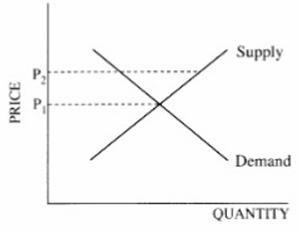
The diagram above shows the demand and supply curves for a normal good. The equilibrium price could rise from P
1 to P
2 if
A. consumers’ incomes increased
B. P2 were set as a legal maximum
C. subsidies on the product increased
D. the price of a complementary product increased
E. costs of production were substantially lowered
Question 102
Which of the following will increase the demand for pizza, a normal good?
A. An increase in the cost of producing pizza
B. A decrease in the price of pizza
C. An increase in the price of a complementary product
D. An increase in consumers’ income
E. An increase in the number of restaurants selling pizza
Question 103
Which of the following will decrease the demand for beef?
A. An increase in the price of pork, if pork and beef are substitute goods
B. An increase in the price of potatoes, if potatoes and beef are complementary goods
C. A decrease in the cost of transporting beef to consumers
D. An increase in the income levels of most consumers, if beef is a normal good
E. Research showing beef is better for your health than chicken
Question 104
Which of the following will cause the supply curve for shoes to shift to the right?
A. An increase in the price of socks, assuming that shoes and socks are complements
B. A decrease in the price of sandals, assuming that shoes and sandals are substitutes
C. An increase in the wages of shoe workers
D. An increase in the number of firms producing shoes
E. A decrease in the income of consumers, assuming that shoes are normal goods
Question 106
Which of the following will cause the demand curve for good X to shift to the right?
A. An increase in the price of good Z, a complement to good X
B. An increase in the price of good Y, a substitute for good X
C. An increase in the consumer’s income, if good X is an inferior good
D. A decrease in the price of good X
E. An increase in the supply of good X
Question 107
Assuming a downward-sloping demand curve and an upward-sloping supply curve, which of the following will occur as a result of an increase in the sales tax on a good?
A. Supply will increase.
B. Demand will increase.
C. Quantity supplied will increase.
D. Quantity demanded will decrease.
E. The price paid by consumers will decrease
Question 108
Which of the following would cause the equilibrium price of good X to increase?
A. Producers of good X find a new technology that reduces the cost of producing X.
B. The price of an essential input in the production of good X increases.
C. Goods X and Y are complements, and the government imposes a tax on good Y.
D. Good X is a normal good, and the government increases income taxes by 3%.
E. Good X is an inferior good, and the government decreases income taxes by 10%.
Question 109
To alleviate a financial crisis, a university increases student fees. This action will increase university revenues if the price elasticity of demand for university education is
A. inelastic
B. unit elastic
C. elastic
D. equal to the price elasticity of supply
E. equal to one
Question 110
Assume that the demand for a certain good is perfectly inelastic and the supply curve of the good is upward sloping. Which of the following occurs in the market for the good if the price of an input used to produce the good increases?
A. A decrease in both the quantity supplied and the equilibrium amount consumed
B. A decrease in the quantity supplied and an increase in the equilibrium price
C. A decrease in the supply and an increase in the equilibrium price
D. A decrease in both the demand and the equilibrium amount consumed
E. A decrease in both the quantity demanded and the equilibrium price
Question 111
An effective minimum wage policy in a competitive market will increase unemployment and increase the total earnings of labor only if the demand for labor is
A. relatively inelastic
B. relatively elastic
C. unit elastic
D. greater than the supply
E. positively related to the wage rate
Question 112
Which of the following best describes the law of demand?
A. When income increases, the demand for goods increases.
B. When the price of a good decreases, the demand for the good increases.
C. When the price of a good decreases, the quantity demanded of the good decreases.
D. When the price of a good increases, the quantity demanded of the good decreases.
E. When the demand for a good increases, consumers’ willingness and ability to buy the good increases.
Question 113
Which of the following best describes the law of demand?
A. The price of a good increases when the demand for the good increases.
B. The price of a good decreases when the supply of the good decreases.
C. When the price of a good increases, its demand decreases.
D. When the price of a good decreases, its quantity demanded increases.
E. Demand creates its own supply.
Question 114
Leather and beef are jointly produced such that an increase in the production of one results in an equal increase in the production of the other. An increase in the demand for leather will most likely cause
A. a decrease in the price of leather
B. a decrease in the price of beef
C. a decrease in the equilibrium quantity of beef sold
D. an increase in the demand for beef in the short run
E. an increase in the supply of leather
Question 115
Assume that the market for lemonade is perfectly competitive and currently in equilibrium. Lemons are key ingredients in lemonade. If the price of lemons decreases, how will the lemonade market be affected?
A. Supply will shift leftward, increasing the equilibrium price and decreasing the equilibrium quantity of lemonade.
B. Supply will shift rightward, increasing the equilibrium price and increasing the equilibrium quantity of lemonade.
C. Supply will shift rightward, decreasing the equilibrium price and increasing the equilibrium quantity of lemonade.
D. Demand will shift leftward, decreasing the equilibrium price and decreasing the equilibrium quantity of lemonade.
E. Demand will shift rightward, increasing the equilibrium price and increasing the equilibrium quantity of lemonade.
Question 116
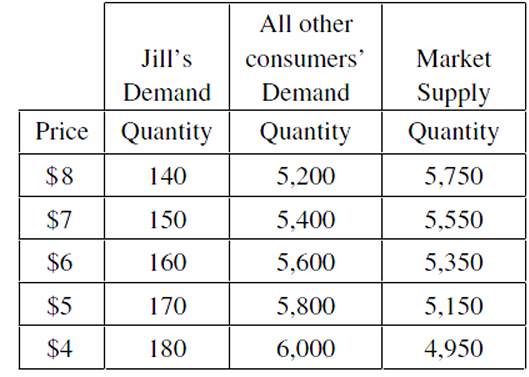
The table above shows the demand schedules for Jill and for all other consumers, as well as the market supply schedule for the same good. The equilibrium price in this market is
A. $8
B. $7
C. $6
D. $5
E. $4
Question 117
An increase in the supply of coffee could be caused by
A. a decrease in the price of cream, which is a complement to coffee
B. a decrease in the cost of labor used to produce coffee
C. an increase in consumer income
D. an increase in the demand for coffee
E. an increase in the price of coffee
Question 118
Which of the following explains why a decrease in the price of a normal good will lead to an increase in the quantity demanded of the good?
A. A lower price will increase consumers’ purchasing power.
B. A lower price will increase consumers’ marginal utility.
C. A lower price will increase demand for the good.
D. A lower price will increase demand for substitute goods.
E. A lower price will decrease demand for complementary goods.
Question 119
Which of the following is true in the elastic range of a firm's demand curve?
A. The firm should expand output to increase economic profits.
B. An increase in price will also lead to an increase in total cost.
C. A decrease in price will likely lead to an increase in total revenue.
D. Marginal revenue is negative.
E. The firm is maximizing total revenue.
Question 120
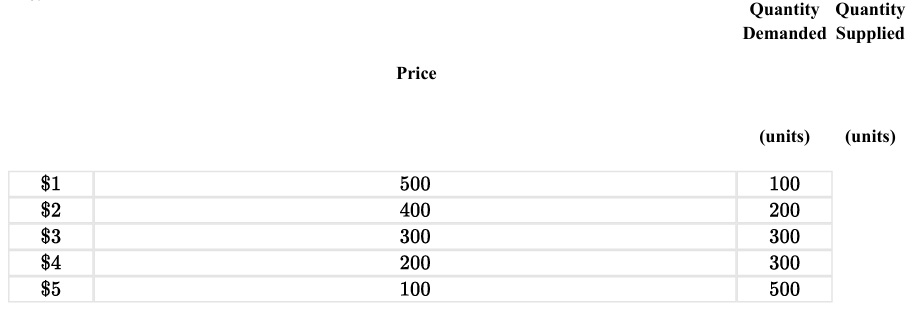
The table provided shows the market demand and supply schedules for wheat. Which of the following is true?
A. At a price of 1$, there is excess supply of wheat and the price will decrease.
B. At a price of 2$, there is excess demand for wheat and the price will decrease.
C. At a price of 3$, there is excess demand for wheat and the price will increase.
D. At a price of 4$, there is excess supply of wheat and the price will decrease.
E. At a price of $5, there is excess demand for wheat and the price will increase.
Question 121
Assume that the government imposes an excise tax on the consumption of a good. The tax will have the least impact on the market equilibrium quantity for which of the following combinations of the price elasticities of demand and supply?
A.
| Absolute Value of Elasticity of Demand |
Elasticity of Supply |
| 4 |
4 |
B.
| Absolute Value of Elasticity of Demand |
Elasticity of Supply |
| 4 |
0.50 |
C.
| Absolute Value of Elasticity of Demand |
Elasticity of Supply |
| 1 |
1 |
D.
| Absolute Value of Elasticity of Demand |
Elasticity of Supply |
| 0.50 |
4 |
E.
| Absolute Value of Elasticity of Demand |
Elasticity of Supply |
| 0.50 |
0.50 |
Question 122
Assume the market for a good is in equilibrium. An increase in the market supply of the good will result in
A. a shortage at the original price of the good, which causes the market price to decrease
B. a shortage at the original price of the good, which causes the market price to increase
C. a surplus at the original price of the good, which causes the market price to decrease
D. a surplus at the original price of the good, which causes the market price to increase
E. neither a surplus nor a shortage
Question 123
Which of the following occurs if the price of oranges is below the equilibrium price?
A. There is a surplus of oranges.
B. The quantity supplied of oranges is greater than the quantity demanded.
C. The quantity supplied of oranges is greater than the quantity sold.
D. The quantity purchased of oranges is greater than the quantity sold.
E. The quantity demanded of oranges is greater than the quantity supplied.
Question 124
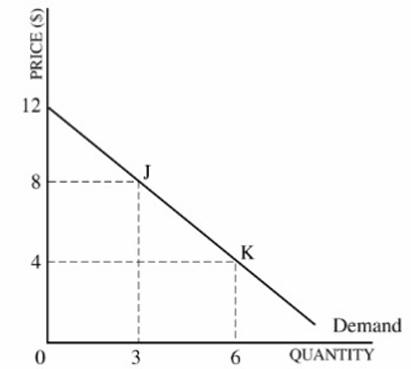
Given the demand curve above, if price decreases from $8 to $4 per unit, total consumer surplus will
A. increase by $4
B. increase by $8
C. increase by $12
D. increase by $18
E. remain constant at $24
Question 125
A monopolist produces two unrelated goods, X and Y. The demand for X is currently price elastic and the demand for Y is currently price inelastic. To increase its total revenue, the firm should change the price of X and Y in which of the following ways?
A.
| Price of X |
Price of Y |
| Increase |
No change |
B.
| Price of X |
Price of Y |
| Increase |
Decrease |
C.
| Price of X |
Price of Y |
| Increase |
Increase |
D.
| Price of X |
Price of Y |
| Decrease |
Increase |
E.
| Price of X |
Price of Y |
| Decrease |
Decrease |
Question 126
Which of the following would cause the supply curve for notebook computers to shift to the right?
A. An increase in the price of notebook computers
B. An increase in the number of firms producing notebook computers
C. An increase in the wages of workers in the notebook-computer industry
D. A decrease in the price of notebook computers
E. A decrease in the supply of notebook computers
Question 127
Which of the following will tend to make the demand for a product more elastic?
A. New firms which produce similar products enter the industry.
B. A change in taste and preferences makes the product more desirable.
C. The product is necessary for use with a complement.
D. Production of the product is protected by a patent.
E. Production cost of the product decreases.
Question 128
If a 5 percent wage increase in a particular labor market results in a 10 percent decrease in employment, the demand for labor is
A. perfectly elastic
B. relatively elastic
C. unit elastic
D. relatively inelastic
E. perfectly inelastic
Question 129
Which of the following statements about the market supply curve is true?
A. An increase in input prices will shift the market supply curve to the right.
B. At each price, a horizontal summation of the quantity supplied by each firm will yield the market supply curve.
C. At each quantity supplied, a vertical summation of the price set by each firm will yield the market supply curve.
D. A decrease in the price will shift the market supply curve to the left.
E. The law of supply states that the market supply curve may shift right, shift left, or remain the same as the price increases.
Question 130
Suppose that the market for low-wage labor is perfectly competitive and initially in equilibrium. If the government establishes an effective minimum wage, which of the following will occur?
A. Employment of low-wage workers will decrease and unemployment will increase.
B. The quantity of low-wage workers supplied will be less than the quantity demanded.
C. The total wage payment received by all low-wage workers will increase.
D. Economic efficiency will increase, since firms were paying workers less than the value of their marginal revenue product.
E. Low-wage workers will be motivated to form a union.
Question 131
Assume that a monopolist is producing in the inelastic portion of its demand curve. Which of the following will occur if the monopolist decreases its price?
A. Marginal revenue will decrease, but profits will increase.
B. Marginal revenue will increase, but profits will decrease.
C. Total revenue will decrease, but profits will increase.
D. Both total revenue and profits will decrease.
E. Both total revenue and profits will increase.
Question 132
Which of the following would most likely result in a decrease in the equilibrium price of oranges?
A. The weather during this orange-growing season is not as good as it was last year.
B. The price of apples, a substitute for oranges, is higher this year than last year.
C. New studies suggest that oranges contain traces of cancer-causing substances due to pesticide residue.
D. A tree-killing fungus spreads through orange orchards across the country.
E. Firms in the orange industry launch an effective advertising campaign.
Question 133
Following a decrease in the supply of oranges, the price of orange juice increased by 20 percent, which resulted in a 10 percent increase in the quantity of apple juice consumed. This implies that the cross elasticity of demand between orange juice and apple juice is
A. 0
B. 0.5
C. 1
D. 2
E. indeterminate
Question 134
A decrease in the supply of oranges raised the price of oranges in the market. The substitution effect of the price increase will motivate consumers to
A. raise their real income to offset the price effect
B. decrease their demand for oranges
C. demand that the government set a price ceiling for oranges
D. increase the quantity of other fruits demanded and decrease the quantity of oranges demanded
E. decrease the quantity of other fruits demanded and increase the quantity of oranges demanded
Question 135
Which of the following events will cause the demand curve for hamburgers to shift to the right?
A. An increase in the price of pizza, a substitute for hamburgers
B. An increase in the price of a french fries, a complement to hamburgers
C. An increase in the price of hamburgers
D. A decrease in the price of hamburgers
E. A decrease in the cost of producing hamburgers
Question 136
Assume that both the supply of and the demand for a good are relatively price elastic. The imposition of a per-unit excise tax on the sale of the good would cause the equilibrium price and quantity to change in which of the following ways?
A.
| Price |
Quantity |
| Increase |
Increase |
B.
| Price |
Quantity |
| Increase |
No change |
C.
| Price |
Quantity |
| Increase |
Decrease |
D.
| Price |
Quantity |
| Decrease |
No change |
E.
| Price |
Quantity |
| Decrease |
Decrease |
Question 137
At a price of $10, the quantity demanded of pizzas is 100 and the quantity supplied is 150. Which of the following statements must be true?
A. There is a shortage of pizza at a price of $10.
B. The equilibrium price of pizza is below $10.
C. The quantity of pizzas sold will be 150.
D. At equilibrium, fewer than 100 pizzas will be sold.
E. The pizza market is in equilibrium.
Question 138
The absolute value of the price elasticity of demand for a good increases when
A. the good has fewer substitutes
B. the good becomes a necessity
C. consumers spend greater portion of their budget on the good
D. the price of an input used to produce the good increases
E. the good must be purchased immediately
Question 139
If the demand for potatoes increases whenever a person's income increases, then potatoes are an example of
A. an inferior good
B. a free good
C. a Giffen good
D. a normal good
E. a public good
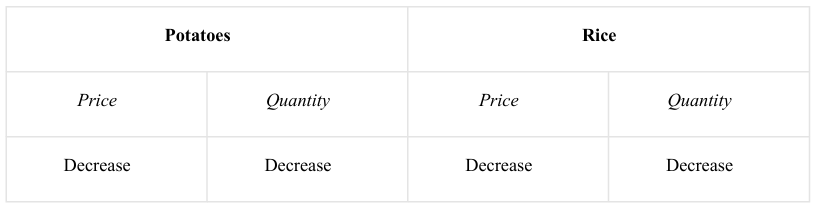
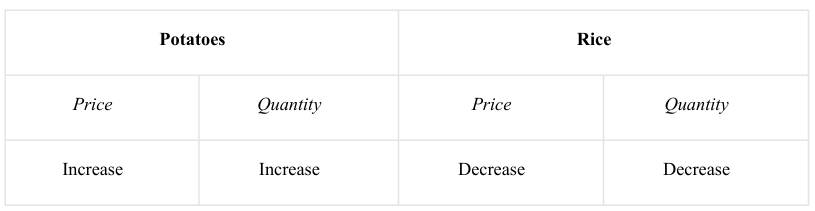
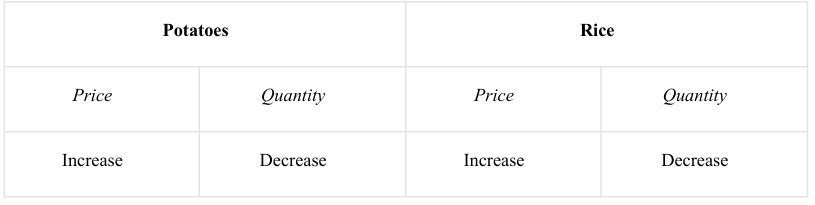
Question 141
In the rental housing market, what would be the effect of a rent control that was set at the market equilibrium rental price?
A. It would increase the number of housing units available, creating a surplus.
B. It would decrease the number of housing units available, creating a shortage.
C. It would have no impact on the number of housing units available.
D. It would increase the consumer surplus and decrease the producer surplus.
E. It would decrease the consumer surplus and increase the producer surplus.
Question 142
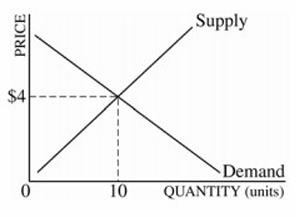
In the market shown in the graph above, at a price of $5, there will be
A. a surplus and the price will eventually fall
B. a surplus generating a decrease in demand
C. a shortage and the price will eventually rise
D. a shortage generating an increase in supply
E. an increase in supply and a decrease in demand
Question 143
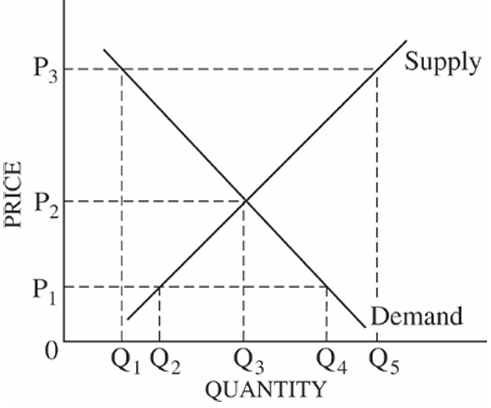
If the market depicted in the diagram above is initially in equilibrium, which of the following will result from the government’s setting a price ceiling at P3?
A. Quantity demanded will exceed quantity supplied.
B. Quantity supplied will exceed quantity demanded.
C. Market price will increase.
D. Market price will be unaffected.
E. Market price will decrease.
Question 144
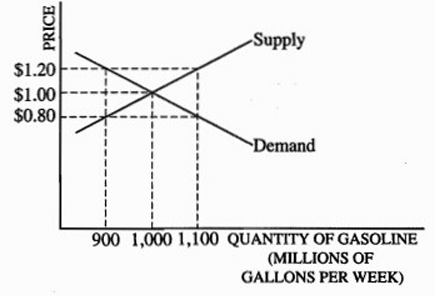
The graph above shows the supply and demand curves for gasoline. Which of the following will occur if the government establishes a price ceiling of $1.20 per gallon?
A. A shortage of 900 million gallons
B. A shortage of 200 million gallons
C. A shortage of 100 million gallons
D. A surplus of 100 million gallons
E. Neither a surplus nor a shortage
Question 145
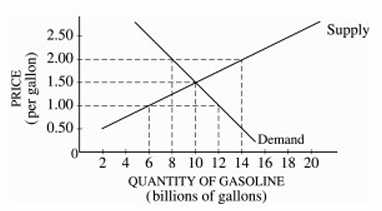
In the market depicted in the diagram above, if the government imposes a price ceiling of $1.00 per gallon on gasoline, which of the following will result?
A. A surplus of 6 billion gallons
B. A shortage of 6 billion gallons
C. A surplus of 12 billion gallons
D. A shortage of 12 billion gallons
E. Neither a surplus nor a shortage, because the price ceiling would not be effective
Question 147
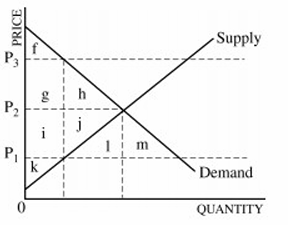
When the market is in equilibrium, the total economic surplus is equal to area
A. f + k
B. f + g + i + k
C. g + h + i + j
D. f + g + h + i + j + k
E. f + g + h + i + j + k + l + m
Question 148
Which of the following will occur if the government imposes a price ceiling below the equilibrium price of a good?
A. The quantity sold will exceed the equilibrium quantity.
B. Firms’ total revenues will increase if demand is price elastic.
C. There will be a shortage in the market.
D. All firms will shut down, since price is below the equilibrium price.
E. Price will exceed the marginal cost of producing the last unit sold.
Question 149
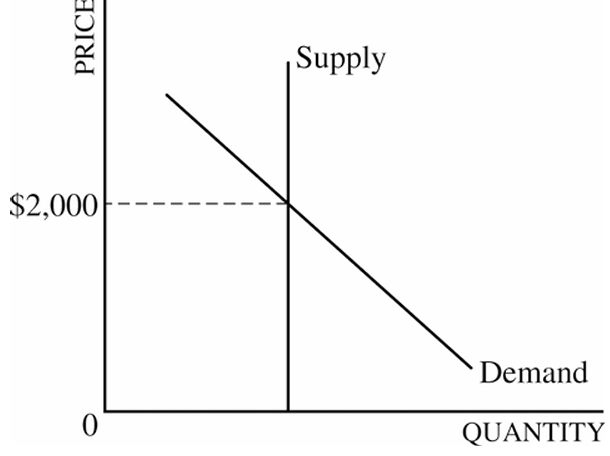
The diagram above depicts demand and supply curves in a city’s rental housing market. If a price ceiling of $1,000 is imposed on the market, which of the following will occur?
A. There will be a surplus of rental housing in the city.
B. The demand curve for housing will shift to the right.
C. The supply curve for housing will shift to the right.
D. The quantity of rental housing supplied will decrease.
E. The quantity of rental housing demanded will increase.
Question 150
Assume that the current market equilibrium price for milk is $2.80 per gallon and that 5 million gallons are sold per day. If the government sets a price ceiling of $2.00 per gallon, which of the following is true?
A. The demand for milk will increase.
B. The supply of milk will decrease.
C. There will be an excess supply of milk in the market.
D. More than 5 million gallons of milk will be sold.
E. Less than 5 million gallons of milk will be sold.
Question 151
One reason consumers typically increase the quantity of a good they purchase when the price of the good decreases is that
A. the marginal utility of the good increases
B. consumers’ purchasing power increases
C. consumers increase their purchases of substitute items
D. consumers increase their purchases of complementary items
E. the demand for the good increases
Question 152
If a government eliminated an effective price floor in a market, all of the following would occur EXCEPT:
A. The surplus would be eliminated.
B. The price would decrease.
C. The quantity supplied would decrease.
D. The quantity demanded would increase.
E. The supply of the good would increase.
Question 153
If the absolute value of the price elasticity of demand for Good X is 0.5, then a 10 percent decrease in the price of Good X will result in which of the following?
A. A 5% decrease in the quantity demanded of Good X
B. A 5% increase in the quantity demanded of Good X
C. A 5% increase in revenues from the sale of Good X
D. A 10% decrease in revenues from the sale of Good X
E. A 10% increase in revenues from the sale of Good X
Question 154
The quantity of peanuts supplied increased from 40 tons per week to 60 tons per week when the price of peanuts increased from $4 per ton to $5 per ton. The price elasticity of supply for peanuts over this price range is
A. elastic
B. inelastic
C. unit elastic
D. perfectly elastic
E. perfectly inelastic
Question 155
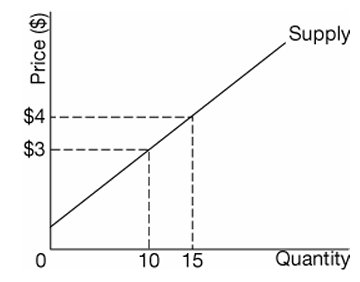
What is the price elasticity of supply between $3 and $4 in the graph above?
A. It is greater than 1, and the supply is relatively inelastic.
B. It is greater than 1, and the supply is relatively elastic.
C. It is equal to 1, and the supply is unit elastic.
D. It is less than 1, and the supply is relatively elastic.
E. It is less than 1, and the supply is relatively inelastic.
Question 157
Assume a consumer finds that his total expenditure on compact discs stays the same after the price of compact discs declines. Which of the following is true for this price change?
A. Compact discs are inferior goods to this consumer.
B. The consumer’s demand for compact discs increased in response to the price change.
C. The consumer’s demand for compact discs is perfectly price elastic.
D. The consumer’s demand for compact discs is perfectly price inelastic.
E. The consumer’s demand for compact discs is unit price elastic.
Question 158
Assume the government imposes a price floor above the current equilibrium price in the market for a good. Which of the following will occur?
A. Since the price floor is set above the equilibrium price, nothing will change because the price floor is not binding.
B. There will be a shortage of the good.
C. Compared to the equilibrium price, there will be an increase in the quantity exchanged.
D. There will be an excess supply of the good.
E. At the quantity sold, the marginal cost of production will exceed the marginal benefit to consumers.
Question 159
Which of the following is true in the market for a certain product if producers consistently are willing to sell more at the going price than consumers are willing to buy?
A. Demand is highly inelastic
B. Supply is highly elastic.
C. The product is inferior.
D. There is a price ceiling on the product.
E. There is a price floor on the product.
Question 160
An increase in which of the following will most likely result in a long-run surplus of a product?
A. The number of suppliers of the product
B. A price is set by law above the equilibrium price
C. The demand for the product
D. The costs of resources used to produce the product
E. The future expected price of the product
Question 161
Which of the following is true of a price floor?
A. The intention of the government in creating the price floor is to assist the producers of the good.
B. To have an impact in the market for the good, the price floor should be set below the existing market price of the good.
C. An effective price floor will increase the quantity demanded of the good.
D. The price floor would tend to create a shortage of the good in the market.
E. The creation of the price floor would not change the quantity supplied of the good if the supply curve were upward-sloping to the right.
Question 162
According to the law of demand, an increase in the price of grape juice will result in
A. a rightward shift in the demand curve for grape juice
B. a leftward shift in the demand curve for grape juice
C. a decrease in the demand for orange juice, a substitute
D. a decrease in the quantity of grape juice demanded
E. an increase in the quantity of grape juice supplied
Question 163
If a store raises its prices by 20 percent and its total revenue increases by 10 percent, the demand it faces in this price range must be
A. inelastic
B. elastic
C. unit elastic
D. perfectly elastic
E. perfectly inelastic
Question 164
A city transit authority increases the price of sub- way and bus tickets from $1.25 to $1.50. If the demand for these tickets is price inelastic, the number of people riding buses and subways and the city’s revenues will most likely change in which of the following ways?
A.
| Number of People Riding |
City's Revenues |
| Increase |
Increase |
B.
| Number of People Riding |
City's Revenues |
| Decrease |
Increase |
C.
| Number of People Riding |
City's Revenues |
| Decrease |
Decrease |
D.
| Number of People Riding |
City's Revenues |
| Decrease |
Remain constant |
E.
| Number of People Riding |
City's Revenues |
| Remain constant |
Increase |
Question 165
Which of the following must be true if the revenues of wheat farmers increase when the price of wheat increase?
A. The supply of wheat is price elastic.
B. The supply of wheat is income elastic.
C. The supply of wheat is income inelastic.
D. The demand for wheat is price elastic.
E. The demand for wheat is price inelastic.
Question 166
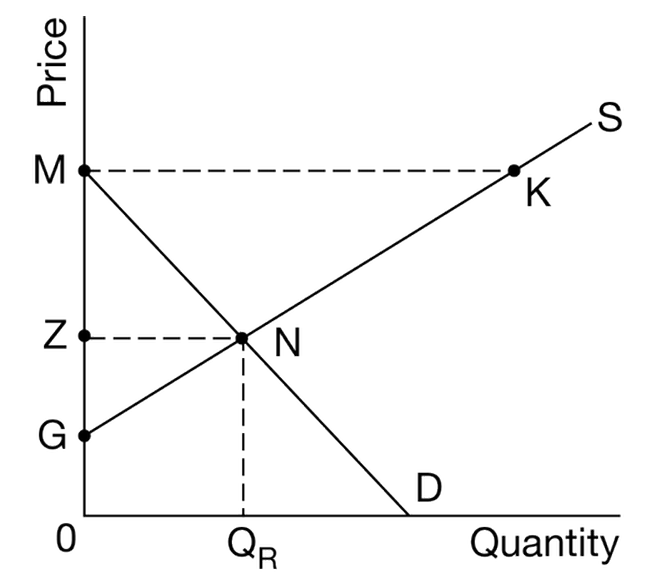
Based on the graph above, the producer surplus at the market equilibrium price and quantity is shown by which area?
A. GMK
B. GMN
C. GZN
D. ZMN
E. MNK
Question 167
Assume that popcorn and movie attendance are complements and that Salty Concession grows corn suitable for popping. Mr Concession will most likely sell a greater quantity of popping corn at a higher price if which of the following occurs?
A. The wages of farm workers and movie theater employees increase.
B. A technological improvement results in less expensive and more efficient harvesting of corn.
C. The introduction of new fat-free potato chips provides new competition in the snack-food market.
D. The release of three summer movies sets records for movie attendance
E. New government regulations force movie theaters to hire more security guards at each theater.
Question 168
If the demand for good Y increases as the price of good X decreases, it can be concluded that
A. X and Y are substitute goods
B. X and Y are complementary goods
C. X is an inferior good and Y is a superior good
D. X is a superior good and Y is an inferior good
E. both X and Y are inferior goods
Question 169
Which of the following will result in the short run if the government imposes a binding quota?
A. A decrease in the price paid by consumers
B. A rightward shift in the supply curve
C. A leftward shift in the demand curve
D. An increase in consumer surplus
E. A deadweight loss
Question 170
Which of the following will most likely happen in the market for good X if the price of good X decreases?
A. The supply of good X will decrease.
B. The demand for good X will increase.
C. The quantity demanded for good X will increase.
D. The demand will decrease and the supply will increase.
E. The quantity supplied for good X will increase.
Question 171
If an effective rent ceiling is eliminated, which of the following is most likely to occur in the rental housing market?
A. An increase in the demand for housing, resulting in a decrease in the quantity of housing supplied
B. An increase in rents, resulting in an increase in the quantity of housing supplied
C. An increase in the demand for housing, resulting in an increase in the quantity of housing demanded
D. A decrease in rents, resulting in an increase in the quantity of housing supplied
E. A decrease in the demand for housing, resulting in an increase in the quantity of housing supplied
Question 173
An increase in the supply of good X resulted in an increase in the price and quantity of good Y. It can be concluded that good Y is
A. an inferior good
B. a luxury good
C. a normal good
D. a substitute for good X
E. a complement for good X
Question 174
If the demand for a good is perfectly price inelastic in the short run and the supply curve is upward sloping, imposing a sales tax on the good will
A. leave the price paid by consumers unchanged
B. decrease the after-tax revenues received by suppliers
C. increase the after-tax revenues received by suppliers
D. not change the after-tax revenues received by suppliers
E. not change the total expenditures by consumers on the good
Question 175
If both supply and demand for wheat increase, the equilibrium price and quantity of wheat will most likely change in which of the following ways?
A.
| Price |
Quantity |
| Decrease |
Decrease |
B.
| Price |
Quantity |
| Decrease |
Increase |
C.
| Price |
Quantity |
| Indeterminate |
Increase |
D.
| Price |
Quantity |
| Increase |
Decrease |
E.
| Price |
Quantity |
| Increase |
Indeterminate |
Question 176
If shirts and ties are complements and if the price of shirts increases due to an increase in the price of cotton, which of the following is most likely to occur in the market for ties in the short run?
A. The equilibrium price and quantity of ties will increase.
B. The equilibrium price and quantity of ties will decrease.
C. The equilibrium price of ties will increase and the equilibrium quantity will decrease
D. The supply of ties will increase.
E. The demand for ties will increase.
Question 177
Assume that good X is a normal good. If the price of good X increases, what will happen?
A. The substitution and income effects will both lead to more of good X being purchased.
B. The substitution and income effects will both lead to less of good X being purchased.
C. The substitution effect will lead to more of good X being purchased, while the income effect will lead to less of good X being purchased.
D. The substitution effect will lead to less of good X being purchased, while the income effect will lead to more of good X being purchased.
E. There will be no income effect because only the price of good X has changed.
Question 178
Which of the following occurs as a result of the substitution effect of an increase in the price of a normal good?
A. The demand for the good decreases.
B. The demand for the complementary good increases.
C. The demand for the good becomes more elastic.
D. The quantity demanded of the substitute good decreases.
E. The quantity demanded of the good decreases.
Question 179
Assume that good X is a normal good. Which of the following helps to explain why a decrease in the price of good X increases the quantity demanded of good X?
A. Good X becomes relatively less expensive than its substitutes, so consumers buy more of good X and fewer of the substitutes
B. The marginal utility of consuming good X increases as more of good X is consumed.
C. The lower price of good X decreases the marginal utility per dollar; therefore, consumers buy more of good X.
D. The demand curve for good X shifts to the left.
E. The supply curve for good X shifts to the right.
Question 180
Which of the following is true of the substitution effect of an increase in the price of a normal good?
A. It works to offset the income effect.
B. It works to reinforce the income effect.
C. It is less than the income effect.
D. It causes an increase in the quantity demanded of the good.
E. It causes an increase in the demand for the good.
Question 181
Assume that ice cream is a normal good. If the price of ice cream decreases, the substitution effect and the income effect will lead to which of the following changes in ice cream consumption?
A.
| Substitution Effect |
Income Effect |
| Increase |
Decrease |
B.
| Substitution Effect |
Income Effect |
| Increase |
Increase |
C.
| Substitution Effect |
Income Effect |
| Increase |
No change |
D.
| Substitution Effect |
Income Effect |
| Decrease |
Increase |
E.
| Substitution Effect |
Income Effect |
| Decrease |
No change |
Question 182
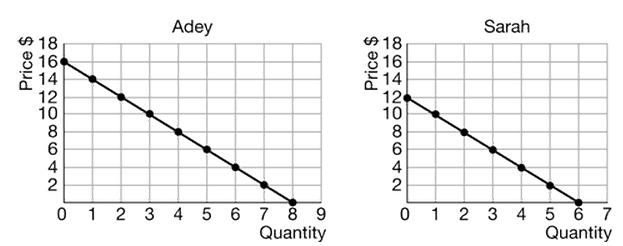
The graphs above show the individual demand curves for the only two consumers, Adey and Sarah, in the market for popcorn. As the price of popcorn decreases from $12 to $6, how does the quantity demanded change along the market demand curve?
A. It increases from 2 to 4 units.
B. It increases from 2 to 5 units.
C. It increases from 2 to 8 units.
D. It increases from 0 to 14 units.
E. It increases from 8 to 14 units.
Question 183
Which of the following statements relating to supply is true?
A. An increase in an input price will lead to an increase in supply.
B. An increase in the price of a good will lead to an increase in the supply of the good.
C. A decrease in consumers’ income will lead to a decrease in the supply of the good.
D. A decrease in the price of a good will lead to a decrease in the quantity supplied of the good.
E. A decrease in the price of a substitute good in production will lead to a decrease in the supply of another substitute good.
Question 184
Last year 17 million tons of beans were sold for $300 per ton. This year 17 million tons of beans were sold for $285 per ton. Which of the following changes in demand and supply could have caused this outcome?
A.
| Demand |
Supply |
| Increase |
Increase |
B.
| Demand |
Supply |
| Increase |
Decrease |
C.
| Demand |
Supply |
| Decrease |
Increase |
D.
| Demand |
Supply |
| Decrease |
Decrease |
E.
| Demand |
Supply |
| Increase |
No change |
Question 185
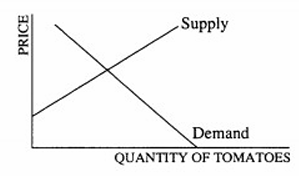
On the basis of the graph above, which of the following statements concerning changes in the demand for and supply of tomatoes is correct?
A. If both the demand and supply increase, the price of tomatoes will definitely increase.
B. If both the demand and supply decrease, the quantity of tomatoes sold will definitely increase.
C. If the demand decreases while the supply increases, the price of tomatoes sold will definiftely increase
D. If the demand decreases while the supply increases, the quantity of tomatoes sold will definitely decrease.
E. If the demand increases while the supply decreases, the price of tomatoes will definitely increase.
Question 186
Country Z is both a producer and an importer of cloth. Which of the following will happen if the government of Country Z imposes a tariff on cloth and the country continues to import some cloth from abroad?
A. There will be a decrease in domestic producer surplus.
B. There will be an increase in the quantity demanded for cloth.
C. As the country produces more cloth, there will be an efficiency gain for the economy.
D. There will be a decrease in consumer surplus for domestic consumers.
E. The domestic consumption of cloth will increase.
Question 187
Suppose that the government imposes a per-unit tax on the producers of a good that has a perfectly inelastic demand. After the tax, the price and quantity of the good sold would change in which of the following ways?
A.
| Price |
Quantity |
| Increase |
Increase |
B.
| Price |
Quantity |
| Increase |
Decrease |
C.
| Price |
Quantity |
| Increase |
Not change |
D.
| Price |
Quantity |
| Not change |
Increase |
E.
| Price |
Quantity |
| Decrease |
Not change |
Question 188
If the government imposes a per-unit tax on personal computers, consumer surplus in the personal computer market will
A. decrease, because the price paid by consumers for personal computers will have increased
B. decrease, because there will be more personal computers on the market
C. increase, because personal computer manufacturers will pass the tax on to consumers
D. increase, because consumers will buy more imported personal computers
E. not change because the demand is unit elastic
Question 189
According to the law of demand, which of the following occurs when the price of a good increases?
A. The demand for the good decreases.
B. The quantity demanded of a substitute good decreases.
C. The quantity demanded of a complementary good increases.
D. The quantity demanded of the good increases.
E. The quantity demanded of the good decreases.
Question 190
If the government imposes a tax on the production of cars, which of the following will occur in the market for cars?
A. There will be a movement to the right along the supply curve.
B. There will be a movement to the right along the demand curve.
C. The supply curve will shift to the right.
D. The supply curve will shift to the left.
E. The demand curve will shift to the right.
Question 191
Following the imposition of a $4 per-unit tax in a competitive market, the seller’s after-tax price falls from the original equilibrium price of $12 to $11. Which of the following statements relating to the imposition of the tax is true?
A. The seller bears 75 percent of the tax burden.
B. The new after-tax equilibrium price is $16.
C. There is no deadweight loss from this tax.
D. The new after-tax equilibrium price is $15.
E. The buyer bears 25 percent of the tax burden.
Question 192
Assume that in a competitive equilibrium, 1,000 units are sold at $20 per unit. Following the imposition of a $4.00 per unit tax, the new consumer price is $23, and the new equilibrium quantity is 950 units. What are the values of the tax revenue collected and the deadweight loss?
A. Tax revenue $4,000; Deadweight loss $3,000
B. Tax revenue $3,800; Deadweight loss $200
C. Tax revenue $3,800; Deadweight loss $100
D. Tax revenue $3,000; Deadweight loss $100
E. Tax revenue $200; Deadweight loss $200
Question 193
A market supply curve is more elastic in the long run than in the short run because
A. producers’ marginal costs are increasing
B. the quantity demanded increases at a steady rate
C. there are no fixed inputs in the long run
D. of constant returns to scale in production
E. of diseconomies of scale in production
Question 195
The economic concept of total consumer surplus refers to which of the following?
A. The difference between the quantity of a good or service that people purchase and the amount that they actually consume
B. The overproduction of goods and services relative to the socially optimal level of output
C. The sum of the differences between the prices that consumers are willing to pay for a good or service and the price they actually pay
D. The sum of the differences between the prices that consumers are willing to pay for a good or service and the minimum prices that sellers must receive to offer that quantity
E. The difference between the quantity demanded and the quantity supplied of a product at a given price
Question 196
Which of the following best illustrates the concept of consumer surplus?
A. A thirsty athlete pays $0.85 for a cold drink when she would have gladly paid $1.50 for the drink.
B. An individual who is willing to accept a job at $7.50 per hour is offered $7.00 per hour.
C. An individual pays the sale price of $15.00 for the same shirt that the individual refused to purchase earlier at $18.00.
D. An individual finds that the price of artichokes, a food she dislikes, has been reduced by 50 percent.
E. A wood-carver has a marginal cost of $5.00 for a unit of output, but sells that unit at $6.00.
Question 197
Assume that the market for tomatoes is in equilibrium at a price of $35 per bushel. If the demand for tomatoes decreases, which of the following will occur?
A. A shortage at $35, creating an increase in price, leading to an increase in quantity supplied
B. A shortage at $35, leading to an increase in supply and a decrease in price
C. A surplus at $35, leading to a decrease in price and in quantity supplied
D. A surplus at $35, leading to a decrease in supply and an increase in price
E. A surplus at $35, leading to an increase in price and a decrease in quantity demanded
Question 198
Assume that the government imposes an effective minimum wage in a perfectly competitive labor market. What will happen to employment and total wage payments?
A.
| Employment |
Total Wage Payments |
| Decrease |
Increase |
B.
| Employment |
Total Wage Payments |
| Decrease |
Decrease |
C.
| Employment |
Total Wage Payments |
| Decrease |
Indeterminate |
D.
| Employment |
Total Wage Payments |
| Increase |
Increase |
E.
| Employment |
Total Wage Payments |
| Increase |
Indeterminate |
Question 199
Assume that the price of good X decreases from $10 to $9 per unit and that the quantity demanded of good X increases from 25 to 30 units. In this price range,the demand for good X is
A. inelastic
B. elastic
C. unit elastic
D. perfectly inelastic
E. perfectly elastic
Question 200
Which of the following situations would necessarily lead to an increase in the price of peaches?
A. The wage paid to peach farm workers rises at the same time that medical researchers find that eating peaches reduces the chances of a person’s developing cancer.
B. While the wages of peach farm workers fall drastically, the peach industry launches a highly successful advertising campaign for peaches.
C. A breakthrough in technology enables peach farmers to use the same amount of resources as before to produce more peaches per acre.
D. The prices of apples and oranges fall.
E. Weather during the growing season is ideal for peach production.
Question 201
If the income elasticity of demand for good X is negative and the cross-price elasticity of demand between good X and good Y is negative, which of the following must be true of good X?
A. X is a normal good and is a substitute for Y.
B. X is a normal good and is a complement to Y.
C. X is an inferior good and is a substitute for Y.
D. X is an inferior good and is a complement to Y.
E. X is a normal good and Y is an inferior good.
Question 202
In which of the following cases would a firm’s total revenue increase?
A. Price increases and demand is elastic.
B. Price decreases and supply is inelastic.
C. Price decreases and demand is elastic.
D. Price decreases and supply is elastic.
E. Price decreases and demand is inelastic.
Question 203
Which of the following changes in the demand for and the supply of a good would necessarily lead to a decrease in the equilibrium quantity of the good in the market in the short run?
A.
| Demand |
Supply |
| Increase |
Decrease |
B.
| Demand |
Supply |
| Increase |
No change |
C.
| Demand |
Supply |
| Decrease |
Increase |
D.
| Demand |
Supply |
| Decrease |
Decrease |
E.
| Demand |
Supply |
| No change |
Increase |
Question 204
If the government imposes a tariff on imports of cheese, the price and quantity of imported cheese will most likely change in which of the following ways?
A.
| Price |
Quantity |
| Decrease |
Decrease |
B.
| Price |
Quantity |
| Decrease |
Increase |
C.
| Price |
Quantity |
| Increase |
Not change |
D.
| Price |
Quantity |
| Increase |
Decrease |
E.
| Price |
Quantity |
| Increase |
Increase |
Question 206
Country Z is both a producer and an importer of green tea. If country Z imposes a tariff on imports of green tea, which of the following will occur in the domestic market of green tea?
A. Consumer surplus will increase.
B. Domestic production will increase.
C. Total consumption of green tea will increase.
D. Producer surplus will decrease.
E. The price paid by domestic consumers will decrease.
Question 207
Consumer surplus is defined as
A. opportunity cost minus total revenue
B. total revenue minus opportunity cost
C. the difference between the resource costs and the price that consumers pay
D. the difference between the value that consumers place on a good and the price they pay
E. the sum of external costs and benefits
Question 208
The American Heart Association has just issued a report warning consumers about the negative health effects of eating beef. Which of the following changes in the beef market is most likely to occur as a result?
A. The supply curve will shift to the left, increasing the price of beef.
B. The demand curve will shift to the left, decreasing the price of beef.
C. The demand curve will shift to the right, increasing the price of beef.
D. Neither the supply nor demand curve will shift; only quantity will increase as price decreases.
E. Neither the supply nor demand curve will shift; only quantity will decrease as prices increases.
Question 209
A leftward shift in the supply curve of watches could be caused by
A. an increase in the price of watches
B. an increase in wages paid to workers who produce watches
C. an improvement in the technology associated with watchmaking
D. a decrease in the price of parts used in the production of watches
E. an increase in population
Question 210
Assume that apple juice and grape juice are substitutes. Which of the following will cause an increase in the quantity of apple juice supplied?
A. A decrease in subsidies to apple juice producers
B. A decrease in the price of grape juice
C. An increase in the price of apple juice
D. An increase in the price of insecticides used on apple trees
E. The imposition of a price ceiling in the market for apple juice
Question 211
Assume that the market for beef is perfectly competitive and in equilibrium. Which of the following would most likely result in an increase in both the equilibrium price and the equilibrium quantity of beef?
A. An increase in the supply of chicken, a substitute good
B. A decrease in consumers’ income, assuming that beef is a normal good
C. An increase in the supply of potatoes, a complementary good
D. An increase in the price of corn, an input in the production of beef
E. An announcement by the medical community that consumption of beef increases the risk of heart disease
Question 212
In a perfectly competitive market, which of the following shifts in the supply and demand curves will definitely cause both equilibrium price and quantity to decrease?
A.
| Supply Curve |
Demand Curve |
| Shifts to the left |
Shifts to the left |
B.
| Supply Curve |
Demand Curve |
| Shifts to the left |
No shift |
C.
| Supply Curve |
Demand Curve |
| Shifts to the right |
Shifts to the right |
D.
| Supply Curve |
Demand Curve |
| No shift |
Shifts to the right |
E.
| Supply Curve |
Demand Curve |
| No shift |
Shifts to the left |
Question 213
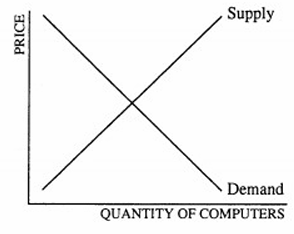
The graph above shows the supply and demand curves for a particular brand of computers. In 1988, 10,000 computers were sold for $1,000 each, but in 1989, 9,000 computers were sold for $1,000 each. Which of the following changes in the supply and demand curves could most likely have caused this change?
A.
| Demand Curve |
Supply Curve |
| Shift right |
Shift right |
B.
| Demand Curve |
Supply Curve |
| Shift right |
Shift left |
C.
| Demand Curve |
Supply Curve |
| No change |
Shift left |
D.
| Demand Curve |
Supply Curve |
| Shift left |
Shift left |
E.
| Demand Curve |
Supply Curve |
| Shift left |
No change |
Question 214
Suppose that the demand for soft drinks is price elastic and the supply is price inelastic. If the government imposes a sales tax on soft drinks, which of the following will occur in the short run?
A. The tax burden will fall equally on both consumers and producers.
B. The tax burden will fall more on producers.
C. The tax burden will fall more on consumers.
D. The percentage increase in the price of soft drinks will be greater than the percentage increase in the quantity demanded.
E. The percentage decrease in total revenue will be greater than the percentage decrease in the quantity demanded.
Question 215
Country Z has a downward sloping domestic demand curve and an upward sloping domestic supply curve for widgets. In the absence of trade, the domestic price of widgets is P0. Now the country engages in trade, and the price for widgets, Pw, is below the domestic price, P0. Which of the following will occur?
A. Country Z will begin exporting widgets.
B. Consumer surplus will decrease in Country Z.
C. Domestic producer surplus will decrease in country Z.
D. Domestic production of widgets in Country Z will increase.
E. The price of widgets received by domestic producers will increase.
Multiple-choice answer key
Answers reproduced from the website. No FRQ scoring guide was provided in the question pages.
1: D | 2: C | 3: B | 4: C | 5: A
6: B | 7: E | 8: C | 9: B | 10: B
11: A | 12: B | 13: C | 14: D | 15: B
16: C | 17: D | 18: B | 19: D | 20: B
21: C | 22: D | 23: B | 24: D | 25: D
26: A | 27: B | 28: B | 29: C | 30: C
31: C | 32: E | 33: B | 34: D | 35: A
36: C | 37: C | 38: B | 39: C | 40: E
41: C | 42: A | 43: D | 44: D | 45: D
46: D | 47: C | 48: D | 49: C | 50: B
51: C | 52: B | 53: B | 54: D | 55: D
56: D | 57: C | 58: A | 59: D | 60: D
61: C | 62: C | 63: D | 64: C | 65: A
66: B | 67: C | 68: C | 69: B | 70: B
71: A | 72: B | 73: D | 74: D | 75: C
76: B | 77: E | 78: B | 79: A | 80: C
81: E | 82: C | 83: A | 84: B | 85: C
86: B | 87: D | 88: B | 89: B | 90: D
91: A | 92: A | 93: C | 94: A | 95: D
96: C | 97: C | 98: B | 99: A | 100: D
101: A | 102: D | 103: B | 104: D | 105: C
106: B | 107: D | 108: B | 109: A | 110: C
111: A | 112: D | 113: D | 114: B | 115: C
116: B | 117: B | 118: A | 119: C | 120: D
121: E | 122: C | 123: E | 124: D | 125: D
126: B | 127: A | 128: B | 129: B | 130: A
131: D | 132: C | 133: B | 134: D | 135: A
136: C | 137: B | 138: C | 139: D | 140: A
141: C | 142: A | 143: D | 144: E | 145: B
146: D | 147: D | 148: C | 149: E | 150: E
151: B | 152: E | 153: B | 154: A | 155: B
156: E | 157: E | 158: D | 159: E | 160: B
161: A | 162: D | 163: A | 164: B | 165: E
166: C | 167: D | 168: B | 169: E | 170: C
171: B | 172: A | 173: E | 174: D | 175: C
176: B | 177: B | 178: E | 179: A | 180: B
181: B | 182: C | 183: D | 184: C | 185: E
186: D | 187: C | 188: A | 189: E | 190: D
191: D | 192: C | 193: C | 194: D | 195: C
196: A | 197: C | 198: C | 199: B | 200: A
201: D | 202: C | 203: D | 204: D | 205: A
206: B | 207: D | 208: B | 209: B | 210: C
211: C | 212: E | 213: D | 214: B | 215: C