Unit 1 PPC
Shanmao online question bank | Archived 2026-10-25
Section I - Multiple Choice (52 questions)
Question 1
A country produces computers and rice. If resources are fully employed and there is technological progress only in the production of rice, the opportunity costs of producing computers and rice will change in which of the following ways?
A.
| Opportunity Cost of Computers |
Opportunity Cost of Rice |
| Increase |
Increase |
B.
| Opportunity Cost of Computers |
Opportunity Cost of Rice |
| Increase |
Decrease |
C.
| Opportunity Cost of Computers |
Opportunity Cost of Rice |
| No change |
Decrease |
D.
| Opportunity Cost of Computers |
Opportunity Cost of Rice |
| Decrease |
Increase |
E.
| Opportunity Cost of Computers |
Opportunity Cost of Rice |
| Decrease |
Decrease |
Question 2
Cindy and Martin both sew t-shirts in a small factory. Using the same resources, Martin can sew twelve t-shirts and Cindy can sew nine t-shirts in one day. Which of the following can be concluded from the given information?
A. Martin has a higher opportunity cost of sewing t-shirts than Cindy does.
B. Cindy has a comparative advantage in sewing t-shirts.
C. Martin has a comparative advantage in sewing t-shirts.
D. Martin has an absolute advantage in sewing t-shirts.
E. Cindy has an absolute advantage in sewing t-shirts.
Question 3
Both Amy and Brad produce and consume apple pie and ice cream. In one hour, Brad makes five apple pies or ten
gallons of ice cream while Amy makes fifteen apple pies or fifteen gallons of ice cream. Based on the above
information, one can correctly conclude that
A. Brad has an absolute advantage in making ice cream and will sell ice cream to Amy
B. Brad has a comparative advantage in making ice cream and will sell ice cream to Amy
C. Brad does not have a comparative advantage in making either good and will not trade with Amy
D. Brad has an absolute advantage in making apple pies but a comparative advantage in making ice cream
E. Brad’s opportunity cost of making ice cream is higher than Amy’s
Question 4
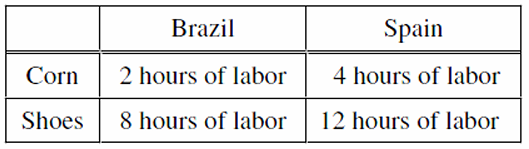
The table above shows the amount of labor required to produce a unit of corn and a unit of shoes in Brazil and Spain. If both countries have equal numbers of workers, what pattern of international trade between Brazil and Spain is most likely to emerge?
A. Brazil will export both corn and shoes.
B. Spain will export both corn and shoes.
C. No mutually beneficial trade can occur.
D. Brazil will export corn and import shoes.
E. Brazil will import corn and export shoes.
Question 5
The table provided shows the number of labor hours required to produce a cell phone or a unit of lumber in Estonia and in Finland.
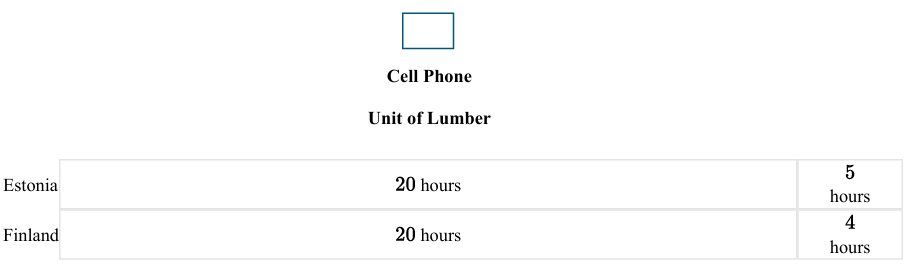
Based on the information in the table, which of the following is true?
A. Estonia has a comparative advantage in producing lumber.
B. Finland has a comparative advantage in producing cell phones.
C. Finland has an absolute advantage in producing lumber.
D. Estonia has both the absolute and comparative advantages in producing lumber.
E. Neither country has a comparative advantage in producing cell phones.
Question 6
A professor hires two aides, assigning them the tasks of reading student papers and of typing lecture notes on a computer. One of the aides, Ben, can read 1 page of a student paper per minute or type 50 words of lecture notes per minute, and the other aide, Ann, can read 3 pages of a student paper per minute or type 60 words of lecture notes per minute.
Which of the following statements is true?
A. Ann has a comparative advantage in reading student papers, and Ben has a comparative advantage in
B. typing lecture notes.
C. Ann has an absolute advantage in reading student papers, and Ben has an absolute advantage in typing
D. lecture notes.
E. Ben has a comparative advantage in reading student papers, and Ann has a comparative advantage in
Question 7
A linear production possibilities curve indicates which of the following?
A. Constant opportunity costs
B. Decreasing opportunity costs
C. Increasing opportunity costs
D. Diminishing marginal returns
E. Labor-intensive production
Question 8
A farmer in Country A can harvest 20 bushels of wheat or 10 bushels of corn in a day, while a farmer in Country B can harvest 8 bushels of wheat or 8 bushels of corn in a day. If Country A and Country B specialize and trade, Country A will
A. export wheat and import corn
B. export corn and import wheat
C. export both wheat and corn
D. import both wheat and corn
E. benefit more from trade than will Country B
Question 9
| Country |
Opportunity Cost of 1 Ton of Apples |
Opportunity Cost of 1 Ton of Oranges |
| X |
1 ton of oranges |
1 ton of apples |
| Y |
2 tons of oranges |
0.5 ton of apples |
The table above shows the opportunity costs of producing apples and oranges in Countries X and Y. Which of the following can be concluded based on the data given in the table?
A. Country Y has an absolute advantage in producing both goods.
B. Country Y has a comparative advantage in producing both goods.
C. Country X has an absolute advantage in producing both goods.
D. Country X has a comparative advantage in producing oranges.
E. Country X has a comparative advantage in producing apples.
Question 10
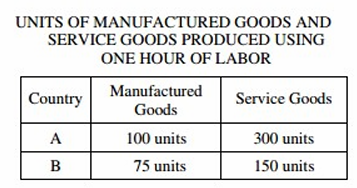
According to the information in the table above, which of the following statements is true if both countries have the same number of workers?
A. Country A has both an absolute and a comparative advantage in manufactured goods.
B. Country A has an absolute advantage in manufactured goods but a comparative advantage in service goods.
C. Country B has a comparative advantage in service goods but no absolute advantage in either good.
D. Country A has an absolute advantage in service goods but a comparative advantage in manufactured goods.
E. Country B has an absolute advantage in manufactured goods, but without more information, it is not possible to tell in which product it has a comparative advantage.
Question 12
Dana and Robin produce smoothies and pizza. In one hour Dana can make 20 smoothies or 10 pizzas. In one hour Robin can make 18 smoothies or 6 pizzas. Which of the following statements is true?
A. Robin has an absolute advantage in making smoothies and a comparative advantage in making pizzas.
B. Robin has both an absolute advantage and a comparative advantage in making pizzas.
C. Dana has a comparative advantage in making both smoothies and pizzas.
D. Dana has a comparative advantage in making pizzas, and Robin has a comparative advantage in making smoothies.
E. Dana has a comparative advantage in making smoothies, and Robin has a comparative advantage in making pizzas.
Question 13
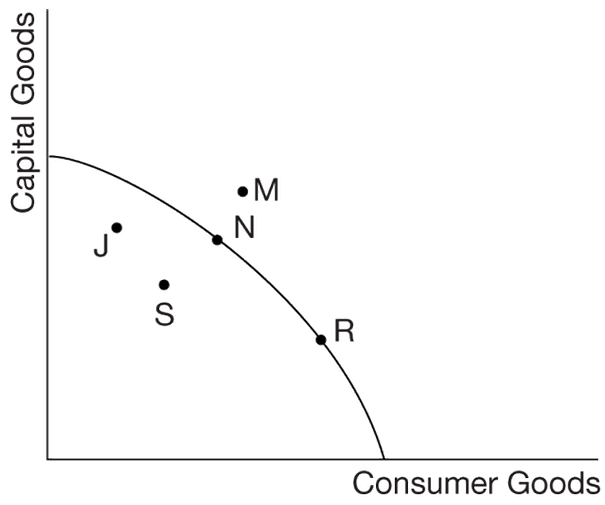
Of the feasible and efficient points on the production possibilities curve (
PPC)above, producing at which point will lead to the most economic growth in the future?
A. Point M
B. Point N
C. Point R
D. Point J
E. Point S
Question 14
Where on a graph of a production possibilities curve would a point showing that an economy is using its resources efficiently be located?
A. On the production possibilities curve
B. Inside the production possibilities curve
C. Beyond the production possibilities curve
D. On the y-axis and below the production possibilities curve
E. On the x-axis and below the production possibilities curve
Question 15
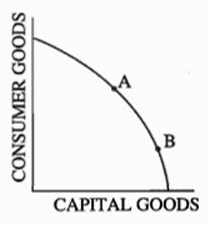
The diagram above shows an economy's current production possibilities curve for capital goods and consumer goods. If society chooses point B over point A, society is choosing
A. more future consumption in exchange for less current consumption
B. more current capital goods in exchange for less future consumption
C. more future and current consumption
D. less future consumption in exchange for more current consumption
E. less current capital goods in exchange for greater future consumption
Question 16
The chart below shows the number of resource units the countries Gamma and Omega must use to produce one unit of food or one unit of clothing.
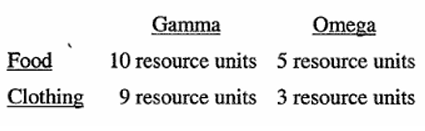
Which of the following statements is true according to the chart above?
A. Trade should take place, with Gamma specializing in clothing production and Omega specializing in food production.
B. Trade should take place, with Gamma specializing in food production and Omega specializing in clothing production.
C. Each country should devote half of its resources to food production and half to clothing production and not trade.
D. Since Omega can produce both food and clothing using fewer resources than Gamma, it cannot benefit from trade with Gamma
E. Since Gamma can produce both food and clothing using fewer resources than Omega, it cannot benefit trade with Omega.
Question 17
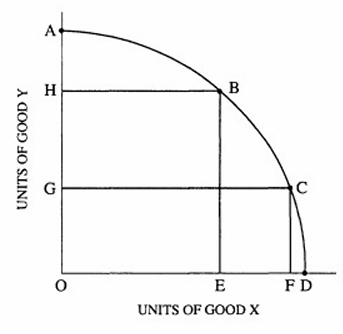
The graph above shows an economy's production possibilities frontier for the production of two goods, X and Y. Assume that the economy is currently at point B. The opportunity cost of moving from point B to point C is
A. AH units of good Y
B. HG units of good Y
C. OG units of good Y
D. EF units of good X
E. OF units good X
Question 18
Improvements in technology for producing all goods must result in
A. an inward shift in the production possibilities curve
B. an outward shift in the production possibilities curve
C. a flatter production possibilities curve
D. a steeper production possibilities curve
E. greater unemployment of labor
Question 19
Which of the following statements regarding specialization and trade is true?
A. With specialization and trade, a country’s production possibilities curve shifts out, showing an increase in productive capacity.
B. With specialization and trade, a country will produce a combination of goods beyond its production possibilities curve.
C. To gain from trade, countries specialize in producing goods and services in which they have an absolute advantage.
D. With specialization and trade, a country can consume beyond its production possibilities curve.
E. A country must have both the comparative and the absolute advantage in a product to specialize and gain from trade.
Question 20
An outward shift in the production possibilities curve of an economy can be caused be an increase in
A. unemployment
B. the labor force
C. inflation
D. output
E. demand
Question 21
Which of the following explains why a production possibilities curve is often represented as concave (bowed out) from the origin?
A. The law of demand
B. The law of supply
C. Constant returns to scale
D. Decreasing opportunity cost
E. Increasing opportunity cost
Question 22
Assume both Italy and Greece produce only two goods: wine and olive oil. If Italy holds a comparative advantage in
the production of wine, then which of the following statements is NOT true?
A. Italy must hold an absolute advantage in the production of wine.
B. Greece holds a comparative advantage in the production of olive oil.
C. Italy's opportunity cost of producing one additional unit of wine is lower than Greece's.
D. Greece's opportunity cost of producing one additional unit of olive oil is lower than Italy's.
E. If trade is open between them, these countries have an incentive to trade.
Question 23
Using the same amount of time and resources, Jack can assemble either 10 bikes or 5 computers, whereas Sam can assemble either 5 bikes or 5 computers. Based on the data, which of the following statements is correct?
A. Sam has an absolute advantage in assembling bikes.
B. Sam has an absolute advantage in assembling computers.
C. Sam has a comparative advantage in assembling bikes.
D. Jack has a comparative advantage in assembling bikes.
E. Jack has a comparative advantage in assembling both bikes and computers.
Question 24
The table below shows the number of hours it takes for Kim to install a computer or to paint a garage and for Maria to install a computer or to paint a garage.
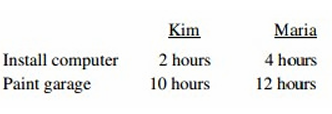
If tasks are assigned according to comparative advantage, which of the following is true?
A. Kim should perform both tasks.
B. Maria should perform both tasks.
C. Kim should install computers and Maria should paint garages.
D. Kim should paint garages and Maria should install computers.
E. Kim and Maria should both install computers.
Question 25
Assume that an economy produces televisions and shoes. Which of the following would cause the production possibilities curve for this economy to shift outward?
A. An increase in the labor force
B. An increase in the prices of both goods
C. An increase in the prices of resources used to produce both goods
D. A decrease in the demand for shoes
E. A change in consumers’ tastes in favor of televisions
Question 26
An economy produces two goods: X and Y. Its production possibilities curve is linear with the intercept on the Y axis at 1,000 units and the intercept on the X axis at 100 units. Which of the following statements is correct?
A. There is an increasing opportunity cost of producing good X, beginning with 1 unit of X costing 0.1 unit of Y.
B. There is an increasing opportunity cost of producing good Y but not of producing good X, which has a constant opportunity cost.
C. There is a constant opportunity cost with each unit of good X costing 10 units of good Y.
D. There is a constant opportunity cost with 10 units of good X costing 1 unit of good Y.
E. With a linear production possibilities curve, total production of goods X and Y will be the same at each point on the curve.
Question 27
| Good X (units) |
Good Y (units) |
| 0 |
100 |
| 20 |
95 |
| 40 |
85 |
| 60 |
65 |
| 80 |
35 |
| 100 |
0 |
The table above shows the maximum possible output combinations of good X and good Y that Microland can produce by using all of its available resources and technology. As the production of good X increases, what happens to the opportunity cost of producing good X?
A. It decreases, because the production of good Y decreases by greater amounts.
B. It decreases, because the production of good Y increases by smaller amounts.
C. It remains constant, because the production of good X increases by the same amount.
D. It increases, because the production of good Y decreases by greater amounts.
E. It increases, because the production of good Y increases by smaller amounts.
Question 28
Movement along a production possibilities curve shows which of the following?
A. The trade-offs society faces
B. The total amount of available resources
C. The combination of inputs required for a given output
D. The relationship between the price of an input and the quantity demanded
E. The decrease in efficiency
Question 29
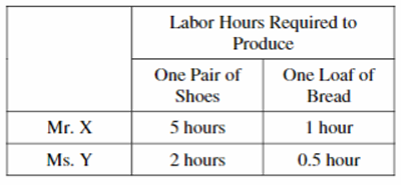
According to the data above, if Mr. X and Ms. Y have the opportunity to trade, which of the following will be mutually beneficial?
A. Ms. Y sells shoes to and buys bread from Mr. X.
B. Ms. Y sells bread to and buys shoes from Mr. X.
C. Ms. Y sells both bread and shoes to Mr. X.
D. Ms. Y buys both bread and shoes from Mr. X.
E. Ms. Y and Mr. X do not trade with each other.
Question 30
A production possibilities curve can shift inward if there is
A. an increase in productivity
B. an increase in unemployment
C. an increase in the price of raw materials
D. a misallocation of resources
E. a natural disaster
Question 31
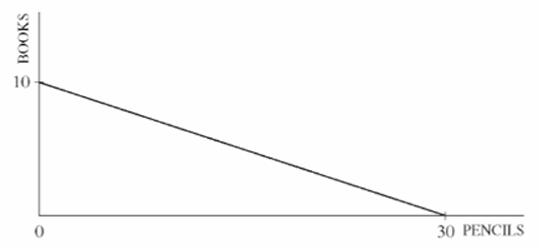
Based on the production possibilities curve for books and pencils shown above, what is the opportunity cost of producing a book?
A. 30 pencils
B. 10 pencils
C. 3 pencils
D. 1/3 of a pencil
E. 1/10 of a pencil
Question 32
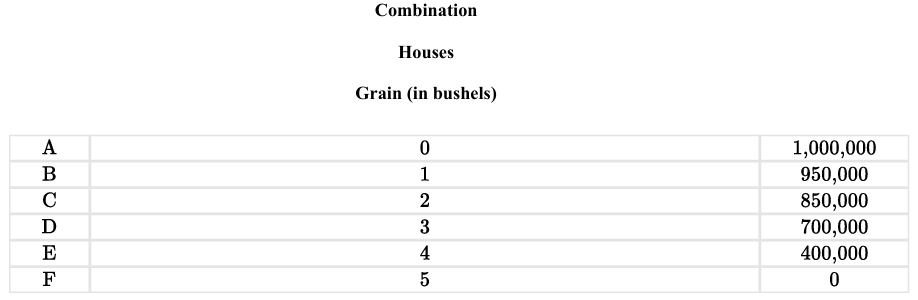
The table above shows six possible combinations of houses and grain that a country can produce in a year using all currently available resources and technology. The opportunity cost of changing production from combination B to combination C is
A. 1 house
B. 2 houses
C. 100,000 bushels of grain
D. 850,000 bushels of grain
E. 950,000 bushels of grain
Question 33
Two alternative production possibility frontiers for apples and wheat are shown in the figures below.
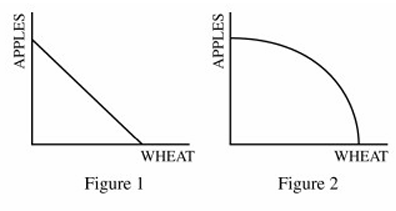
As more wheat is produced, how will the opportunity cost of producing wheat, as represented in Figures 1 and 2, be affected?
A.
| Figure 1 |
Figure 2 |
| Decrease |
Increase |
B.
| Figure 1 |
Figure 2 |
| Increase |
Decrease |
C.
| Figure 1 |
Figure 2 |
| No change |
Increase |
D.
| Figure 1 |
Figure 2 |
| No change |
Decrease |
E.
| Figure 1 |
Figure 2 |
| Increase |
No change |
Question 34
The table below represents points on an economy's current production possibilities curve.
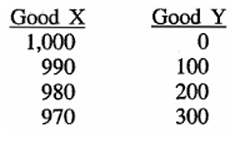
The opportunity cost of increasing the production of good Y from 0 to 200 is
A. 1,000 units of X
B. 980 units of X
C. 200 units of X
D. 20 units of X
E. 5 units of X
Question 35
An outward shift of a production possibilities curve can be caused by
A. planting a more profitable farm crop
B. improving technology
C. using idle resources
D. changing consumer preferences
E. increasing the minimum wage
Question 36
Which country has an absolute advantage in sugar production?
A. Neither Spain nor Portugal, because both require fewer labor hours to produce a unit of gold than to produce a unit of sugar.
B. Spain, because the opportunity cost of sugar in terms of gold is lower.
C. Spain, because it requires fewer total labor hours than Portugal to produce a unit of sugar.
D. Portugal, because it requires more total labor hours than Spain to produce a unit of sugar.
E. Portugal, because it takes only a quarter of an hour to produce a unit of sugar.
Question 37
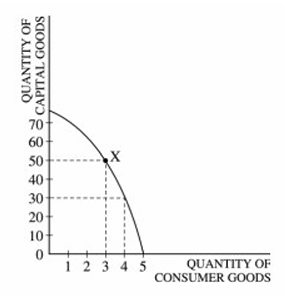
According to the graph above, if a country is currently producing at point X, the opportunity cost of producing another consumer good is
A. 20 capital goods
B. more than 20 capital goods
C. fewer than 20 capital goods
D. 20 consumer goods
E. fewer than 20 consumer goods
Question 38
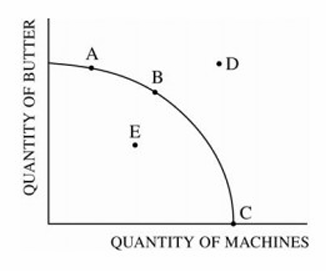
The diagram above shows the production possibilities curve for Country Y. Which of the following statements is true?
A. If Country Y is producing at point C, it is using all its resources efficiently.
B. The opportunity cost of producing more machines is constant.
C. Producing at point C is the most preferable, because butter is a nondurable good.
D. Country Y cannot produce at point E.
E. The economy is not producing at its potential, since it is not producing at point D.
Question 39
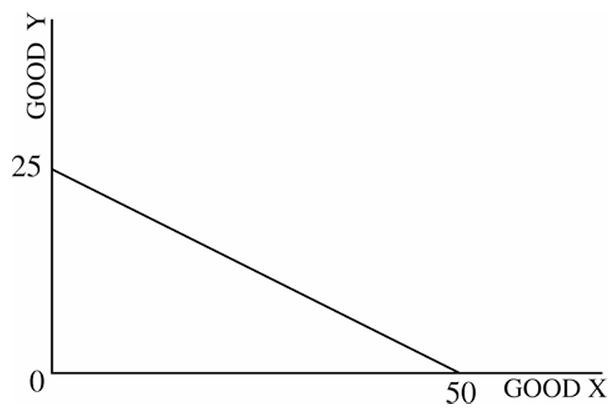
According to the production possibilities curve above, which of the following is true?
A. The opportunity cost of producing another unit of good Y in terms of good X increases as more of good Y is produced.
B. The opportunity cost of producing another unit of good Y in terms of good X decreases as more of good Y is produced.
C. The opportunity cost of producing another unit of good X in terms of good Y increases as more of good X is produced.
D. The opportunity cost of producing another unit of good X in terms of good Y decreases as more of good X is produced.
E. The opportunity cost of producing another unit of either good remains constant as the production of the other good increases.
Question 40
The following questions are based on the production possibilities curve depicted below.
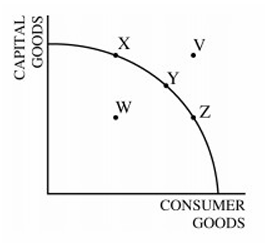
Based on a comparison of points X, Y, and Z, the opportunity cost of an additional consumer good is
A. highest at point X
B. highest at point Y
C. highest at point Z
D. lowest at point Y
E. the same at points X, Y, and Z
Question 41
Given the production possibilities curve above, which of the following represents a movement from efficiency to
inefficiency?
A. Point X to point W
B. Point X to point Z
C. Point Y to point Z
D. Point W to point Z
E. Point V to point Y
Question 42
Economic growth can be depicted using a production possibilities curve by which of the following?
A. A rightward shift of the curve
B. A movement upward on an existing curve
C. A movement downward on an existing curve
D. A movement from a point outside the curve to a point on the curve
E. A movement from a point on the curve to a point inside the curve
Question 43
Which of the following is true of an economy’s production possibilities curve?
A. It shows the combinations of any two resources that can be used to produce an efficient level of output.
B. It shows the alternative combinations of goods that can be produced by fully employing scarce resources.
C. It must be a straight line when all resources are fully employed.
D. It is bowed in (convex to the origin) because of changing levels of technology.
E. It is bowed out (concave to the origin) when marginal opportunity costs are constant.
Question 44
A production possibilities curve is bowed out, indicating increasing opportunity cost because of
A. the law of demand
B. the law of diminishing marginal utility
C. the existence of unemployment
D. differences in consumer tastes
E. imperfect adaptability of resources to alternative uses
Question 45
If resources were perfectly substitutable in all activities, which of the following would be true?
A. Output of all goods could be increased at zero opportunity cost.
B. The production possibilities curve would be a straight line.
C. Specialization and mutually beneficial trade would be impossible.
D. No country or individual would have a comparative advantage in any activity.
E. Scarcity of resources would be eliminated.
Question 46
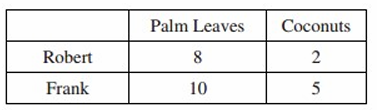
The table above shows the maximum number of palm leaves or coconuts that Robert and Frank can pick respectively in a single day. Which of the following is true?
A. Robert has a comparative advantage in picking coconuts.
B. Frank has a comparative advantage in picking palm leaves.
C. Robert and Frank can both benefit from trade with each other if 1 coconut is traded for 1 palm leaf.
D. Robert and Frank can both benefit from trade with each other if 1 coconut is traded for 3 palm leaves.
E. Robert and Frank can both benefit from trade with each other if 1 coconut is traded for 5 palm leaves.
Question 47
Suppose that in one week Sam can knit 5 sweaters or make 4 blankets and Rob can knit 10 sweaters or make 6
blankets. Which of the following is true?
A. Sam has an absolute advantage in making blankets.
B. Sam has an absolute advantage in knitting sweaters.
C. Sam has a comparative advantage in making blankets.
D. Sam has a comparative advantage in knitting sweaters.
E. Sam has neither a comparative nor an absolute advantage in knitting sweaters or making blankets.
Question 48
Assume an economy uses one input, labor, to produce two goods, X and Y, with constant opportunity cost. Which of the following would cause a parallel shift to the right of the production possibilities curve ?
A. An increase in the productivity of labor with respect to producing good X
B. An increase in the amount of labor available for production
C. A reduction in the unemployment of labor
D. An increase in the demand for good X and good Y
E. A change in consumer tastes from good Y to good X
Question 49
If nations specialize according to their comparative advantage and engage in international trade with each other, each nation can
A. produce outside its production possibilities curve
B. consume outside its production possibilities curve
C. shift its production possibilities curve to the right
D. become more self-sufficient
E. produce more of all goods
Question 50
A country can consume beyond its present production possibilities curve when it
A. trades with other countries, thus taking advantages of different opportunity costs
B. reduces unemployment, thus increasing output
C. experiences decreasing opportunity costs.
D. faces an upward-sloping production possibilities curve
E. faces a downward-sloping production possibilities curve
Question 51
For an economy with a straight-line production possibilities curve, which of the following must be true?
I. The opportunity cost of producing another unit is constant.
II. Resources are completely adaptable to alternative uses.
III. Resources are used efficiently.
A. I only
B. II only
C. III only
D. I and II
E. II and III
Question 52
In the country Beta it takes two hours of labor to produce a unit of tea and four hours of labor to produce a unit of bread. In the country Zeta it takes three hours of labor to produce a unit of tea and nine hours of labor to produce a unit of bread. Which of the following is true?
A. Country Zeta has an absolute advantage in producing both tea and bread.
B. Country Zeta has an absolute advantage and a comparative advantage in producing tea.
C. Country Beta has an absolute advantage and a comparative advantage in producing tea.
D. Country Beta has the lower opportunity cost in producing bread and therefore a comparative advantage in producing bread.
E. Country Beta, with trade, will export both tea and bread to country Zeta.
Question 53
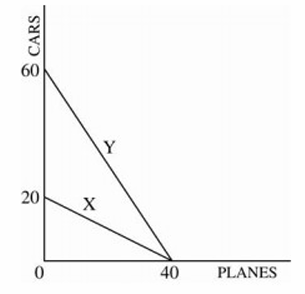
The diagram above shows the production possibilities curves for two countries, Country X and Country Y. Assume that both countries use equal amounts of resources in production. If the two countries engage in trade, both would be better off under which of the following conditions?
A. Country X produced both cars and planes, because it has an absolute advantage in the production of both goods.
B. Country Y produced both cars and planes, because it has a comparative advantage in the production of both goods.
C. Country X specialized in the production of cars, because it has an absolute advantage in the production of cars.
D. Country X specialized in the production of cars, because it has a comparative advantage in the production of cars.
E. Country Y specialized in the production of cars, because it has a comparative advantage in the production of cars.
Multiple-choice answer key
Answers reproduced from the website. No FRQ scoring guide was provided in the question pages.
1: B | 2: D | 3: B | 4: D | 5: C
6: A | 7: A | 8: A | 9: E | 10: B
12: D | 13: B | 14: A | 15: A | 16: B
17: B | 18: B | 19: D | 20: B | 21: E
22: A | 23: D | 24: C | 25: A | 26: C
27: D | 28: A | 29: A | 30: E | 31: C
32: C | 33: C | 34: D | 35: B | 36: C
37: A | 38: A | 39: E | 40: C | 41: A
42: A | 43: B | 44: E | 45: B | 46: D
47: C | 48: B | 49: B | 50: A | 51: D
52: D | 53: E