AP Micro 2024
Shanmao online question bank | Archived 2026-10-25
Section I - Multiple Choice (60 questions)
Question 1
Economists assume that rational individuals make choices by comparing the marginal benefit of an activity to its
A. marginal utility
B. marginal revenue
C. marginal cost
D. average total cost
E. average revenue
Question 2
Which of the following is consistent with a pure command economy?
A. Firms rely on the price system to allocate resources.
B. The government makes the major decisions concerning resource use.
C. Private individuals and firms own the productive resources.
D. Business owners determine how many workers to employ.
E. Entrepreneurs can make substantial economic profit.
Question 3
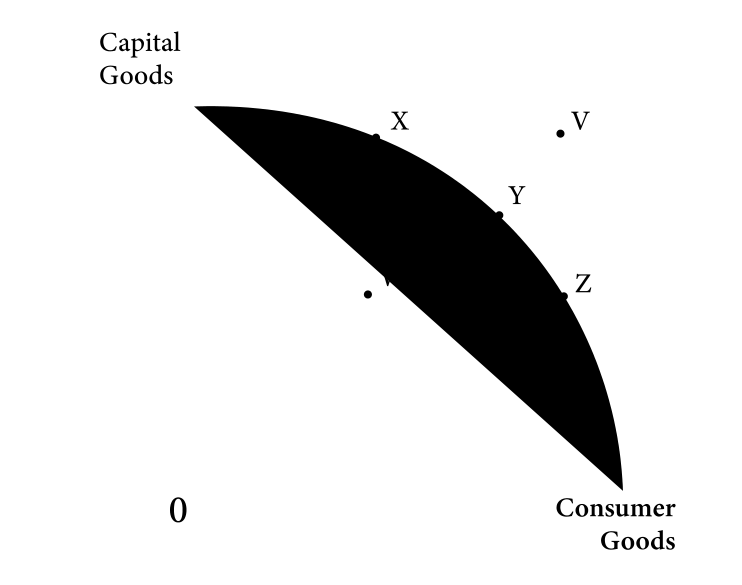
Based on the graph provided of a country's production possibilities curve, which of the following is true?
A. Point V represents an inefficient use of resources.
B. Point W represents an unattainable production level.
C. Point Y is more productively efficient than Point Z.
D. Points X, Y, and Z are all productively efficient points.
E. Points X, Y, and Z are all allocatively efficient points.
Question 4
A firm experienced increasing returns through the hiring of the fourth worker, and then started to experience diminishing returns with the hiring of the fifth worker. Which of the following describes the marginal cost curve for this firm as the quantity of output increases?
A. It initially slopes upward and then slopes downward.
B. It initially slopes downward and then slopes upward.
C. It initially slopes upward and then becomes horizontal.
D. It always slopes downward.
E. It always slopes upward.
Question 5
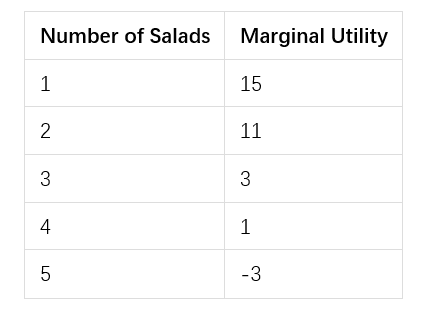
During the week, Juliette can eat salads for lunch. Based on the provided table, how many salads consumed per week would maximize Juliette's total utility?
A. 1
B. 2
C. 3
D. 4
E. 5
Question 6
For an upward-sloping market supply curve of dog treats, which of the following is true?
A. Selling an additional unit of dog treats will decrease total revenue.
B. An increase in the price of dog treats will lead to an increase in the supply of dog treats.
C. An increase in the price of dog treats will lead to an increase in the quantity supplied of dog treats.
D. A decrease in the price of peanut butter, and input to dog treats, will lead to a decrease in the quantity demanded for dog treats.
E. A decrease in the price of chew toys for dogs, a substitute in consumption for dog treats, will lead to an increase in the quantity supplied of dog treats.
Question 7
Martina has $25 that can be used to either buy new pair of shoes or a new sweater. She decide to buy the new pair of shoes. Martina's decision not to buy the new sweater represents which of the following concepts?
A. Opportunity cost
B. Income effect
C. Fixed cost
D. Diminishing marginal utility
E. Diminishing marginal returns
Question 8
Which of the following characterizes a firm experiencing economies of scale?
A. Decreasing total cost
B. Decreasing total variable cost
C. Decreasing marginal cost
D. Decreasing total fixed cost
E. Decreasing long-run average total cost
Question 9
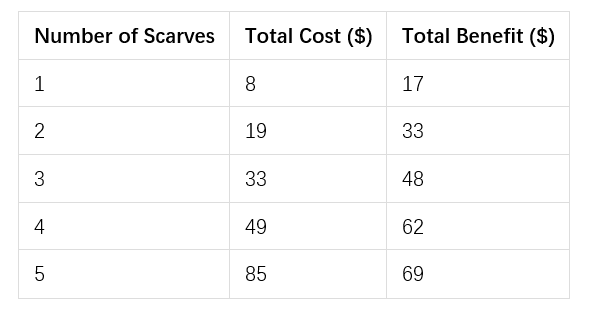
Lily knits scarves for her business. The table provided outlines Lily's daily total cost and total benefit of knitting scarves. How many scarves should Lily knit each day to maximize her total net benefit?
A. 1
B. 2
C. 3
D. 4
E. 5
Question 10
If the price of a good increases from $200 to $220 and, as a result, quantity demanded for that good decreased by 20 percent, then demand over that price range is
A. perfectly elastic
B. relatively elastic
C. unit elastic
D. perfectly inelastic
E. relatively inelastic
Question 11
A country uses all its available resources to produce both pears and sunglasses. Which of the following illustrates the concept of trade-offs caused by scarcity?
A. An increase in the price of sunglasses will increase the quantity demanded of pears.
B. Diminishing marginal utility exists for increased consumption of sunglasses but not for pears.
C. Consumer surplus in the market for sunglasses will decrease producer surplus in the market for pears.
D. Producing more sunglasses will increase the demand for pears.
E. Producing more pears will result in the production of fewer sunglasses.
Question 12
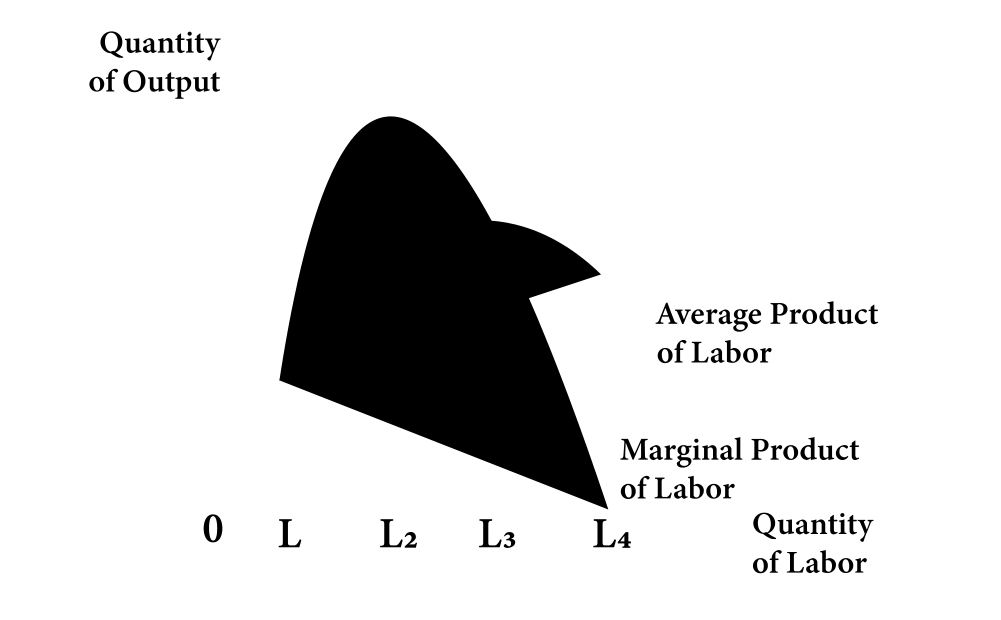
Labor is the only variable input for a firm whose production function is depicted in the graph provided. How many units of labor would maximize total product?
A. L1
B. L2
C. L3
D. L4
E. Cannot be determined from the graph
Question 13
Which of the following will happen if a profit-maximizing firm begins to engage in perfect price discrimination?
A. Total units sold will decrease.
B. All consumers will be better off.
C. Deadweight loss will increase.
D. The firm 's economic profit will increase.
E. The firm's marginal cost will decrease.
Question 14
Tofu Firm is a profit-maximizing firm that produces and sells tofu in a perfectly competitive market. A decrease in the market price of tofu will cause which of the following in the short run?
A. Tofu Firm will produce a higher quantity of output because marginal revenue decreased.
B. Tofu Firm will produce a higher quantity of output because marginal cost increased.
C. Tofu Firm will continue to produce the same quantity of output because the firm is maximizing its profits.
D. Tofu Firm will produce a lower quantity of output because marginal revenue decreased.
E. Tofu Firm will produce a lower quantity of output because marginal cost increased.
Question 15
Which of the following best describes an oligopoly?
A. CoffeeBar can sell as many cups of coffee as it wants at the market price but will lose all its customer if it charges a higher price.
B. CoffeeBar is the only coffee shop in town with complete market power to charge high prices and earns positive economic profit in the long run.
C. CoffeeBar is the only employer of beverage service workers in town and pays a fixed wage to all hired workers.
D. CoffeeBar sets its own price for is coffee beverages, but because it is one of many coffee shops in town, it earns zero economic profit in the long run.
E. CoffeeBar is one of only two coffee shops in town and is constantly offering promotions and discounts to steal customers from the other coffee shop.
Question 16
Bread is produced and sold in a perfectly competitive market with an upward-sloping supply curve and a downward-sloping demand curve. If the cost of flour, a key input in the production of bread, increases, which of the following will happen in the short run in the market for bread?
A. Both price and consumer surplus will increase.
B. Both price and consumer surplus will remain the same.
C. Price will increase and consumer surplus will decrease.
D. Price will increase and consumer surplus will remain the same.
E. Price will decrease and consumer surplus will increase.
Question 17
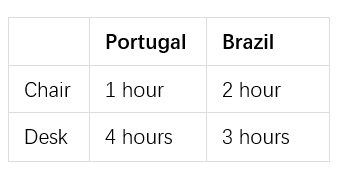
The table provided shows the number of labor hours required to produce one chair OR one desk in Portugal and Brazil. Which of the following is true if each country specializes in the production of the good in which it has a comparative advantage?
A. Neither country will be willing to trade.
B. Trade will be mutually beneficial if 1 desk is exchanged for 1 chair.
C. Trade will be mutually beneficial if 1 desk is exchanged for 5 chairs.
D. Portugal will specialize in producing chairs, and Brazil will specialize in producing desks.
E. Portugal will specialize in producing desks, and Brazil will specialize in producing chairs.
Question 18
For the last unit produced, allocative efficiency is achieved when
A. price is equal to marginal cost
B. price is equal to average total cost
C. price is equal to marginal revenue
D. marginal cost is equal to average total cost
E. marginal cost is equal to average variable cost
Question 19
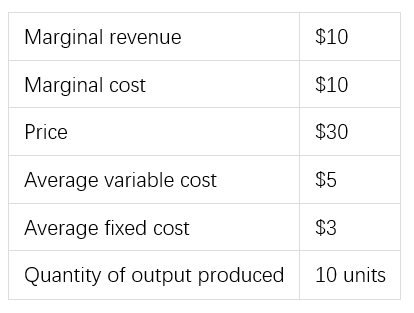
The table provided shows cost and revenue information for Sigmoid, a profit-maximizing monopolist that produces and sells rocket toys. If Sigmoid's average fixed cost increases to $4 because of a change in rent, then its economic profit will
A. remain the same
B. decrease by $1
C. decrease by $10
D. decrease by $20
E. decrease by $30
Question 20
Which of the following will happen at a price above equilibrium in a perfectly competitive market?
A. Supply will increase and demand will decrease until the equilibrium is reestablished.
B. Supply will decrease and demand will increase until the equilibrium is reestablished.
C. Government will impose a binding price ceiling in order to reestablish equilibrium.
D. Quantity supplied will increase and quantity demanded will decrease until the equilibrium is reestablished.
E. Quantity supplied will decrease and quantity demanded will increase until the equilibrium is reestablished.
Question 21
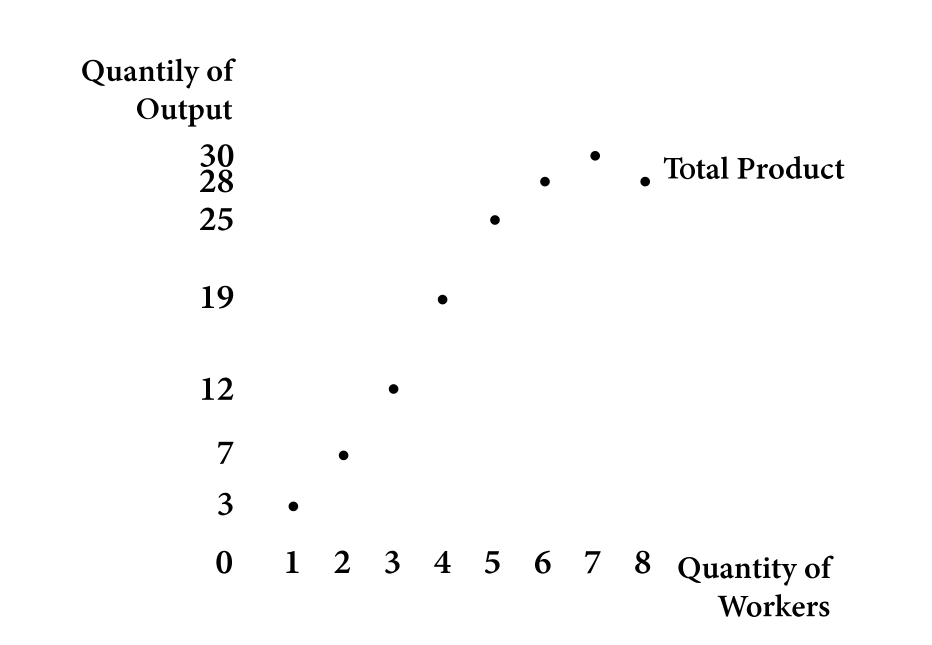
Carnival Funnel Cakes sells its funnel cakes for $4 in a perfectly competitive market and hires workers from a perfectly competitive labor market at a wage of $10. The graph provided shows the total product curve for funnel cakes. Assuming labor is the only variable input, what is the profit-maximizing number of workers that Carnival Funnel Cakes will hire?
A. 3 workers
B. 4 workers
C. 5 workers
D. 6 workers
E. 7 workers
Question 22
Octavia spends her entire budget on yogurt and crackers. PY and PC represent the prices of yogurt (Y) and crackers (C), respectively, and MU refers to marginal utility. Which of the following conditions should be satisfied to maximize Octavia's utility while remaining within her budget?
A. MUY/MUC = PC/PY
B. MUY/PY = MUC/PC
C. MUY/PC = MUC/PY
D. MUY/MUC < PY/PC
E. MUY/PC > MUC/PY
Question 23
Country X imports tea from its trading partners. The government is evaluating whether it should impose a tariff or a quota in the market for tea in Country X. Which of the following statements is true regarding the difference in the outcomes between these two government interventions in the market for tea?
A. A tariff will cause a decrease in domestic consumer surplus, while a quota will not.
B. A tariff will generate government revenue, while a quota will not.
C. A tariff will cause a decrease in domestic producer surplus, while a quota will not.
D. A tariff will cause deadweight loss, while a quota will not.
E. A tariff will increase the price of tea for domestic consumers, while a quota will not.
Question 24
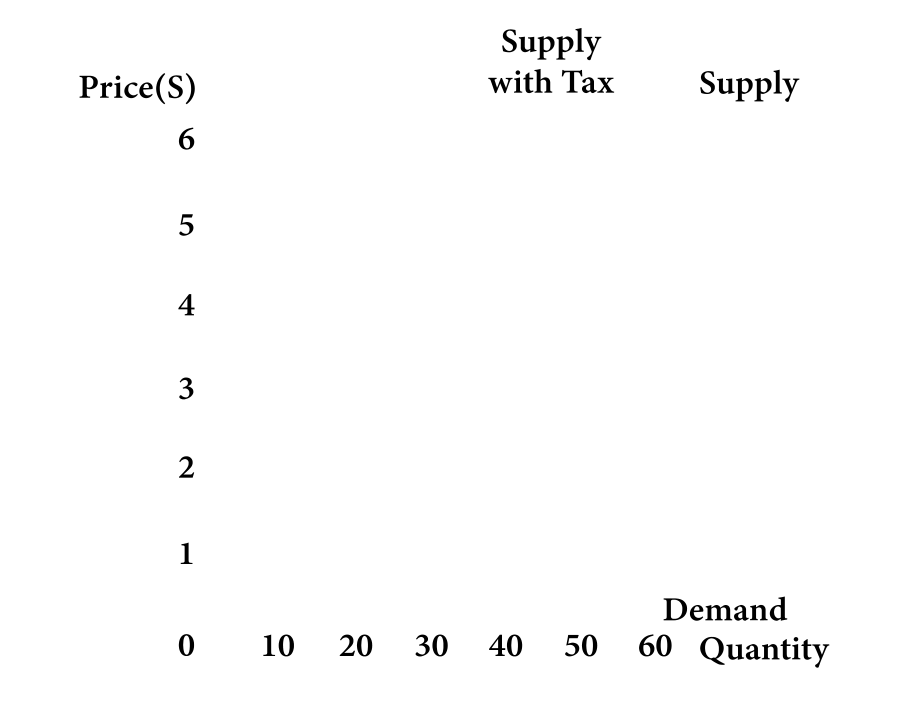
The provided graph shows the imposition of a per-unit tax on the market for a good. After the tax is imposed, what is the change in producer surplus?
A. It will decrease by $25.
B. It will decrease by $40.
C. It will increase by $90.
D. It will increase by $40.
E. It will increase by $25.
Question 25
Which of the following is true of a monopsonist?
A. A monopsonist controls the product market and pays the same wage rate to all workers.
B. A monopsonist needs to offer a higher wage to attract additional workers.
C. A monopsonist produces goods that are sold only in imperfectly competitive product markets.
D. A monopsonist can charge higher prices for a product it sells without losing all its customers.
E. If a monopsonist decreases the wage rate paid to its workers, the firm will lose all its workers to competing employers.
Question 26
Which of the following will cause an increase in the demand for beach umbrellas, a normal good?
A. A decrease in consumers' incomes
B. A decrease in the price of beach umbrellas
C. A decrease in the popularity of visiting the beach
D. A decrease in the price of beach hats, a substitute in consumption
E. A decrease in the price of beach chairs, a complement in consumption
Question 27
Akeilah has received a patent for a new device that gives her the exclusive right to produce it. Which characteristic of imperfectly competitive markets is being described?
A. Barriers to entry
B. Economies of scale
C. Mutual interdependence
D. Price discrimination
E. Collusion
Question 28
Suppose a country has a single person with all the income while all other people have no income. What is the Gini coefficient for that country?
A. -1
B. -0.5
C. 0
D. 0.5
E. 1
Question 29
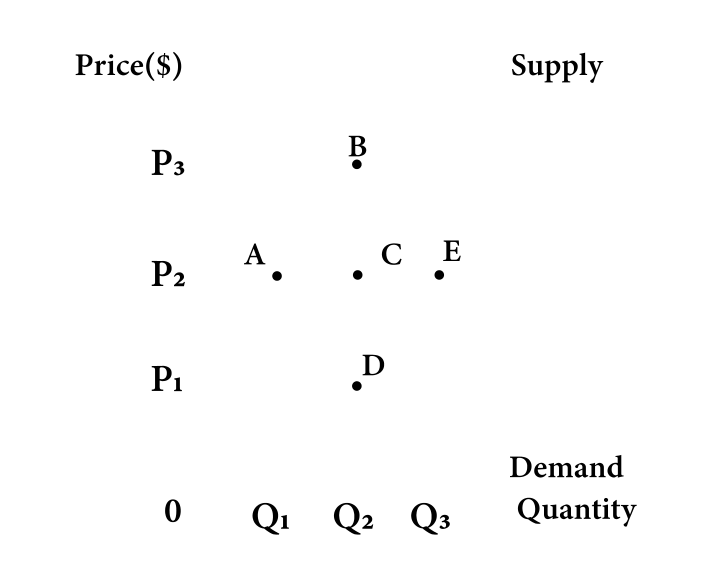
The market for beans in the graph provided is currently in equilibrium. Assume beans are an inferior good. If consumers' incomes increase and there is a technological advancement in harvesting beans, which point on the graph will most likely represent the new equilibrium?
A. Point A
B. Point B
C. Point C
D. Point D
E. Point E
Question 30
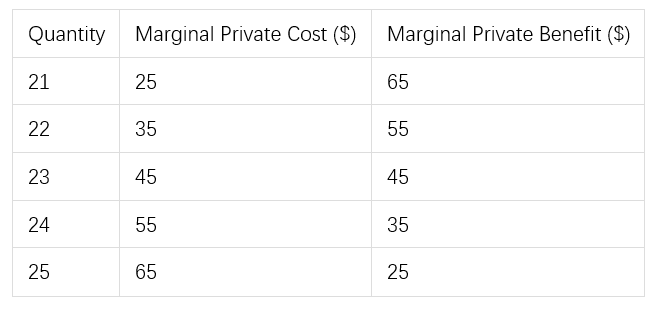
The table provided shows the marginal private cost and marginal private benefit for Good X. The market for Good X is in equilibrium. If the production of Good X generates a constant marginal external cost of $20 per-unit, which of the following actions will improve efficiency in this market?
A. Imposing a $20 per-unit tax on producers, which will decrease output to 22 units
B. Imposing a $20 per-unit tax on consumers, which will decrease output to 21 units
C. Granting a $20 per-unit subsidy to consumers, which will increase output to 25 units
D. Granting a $20 per-unit subsidy to producers, which will decrease output to 21 units
E. Implementing a price floor at $20, which will increase output to 24 units
Question 31
Eli's jewelry store is increasing prices on its gold bracelets. What will happen to Eli's total revenue as a result of the price change?
A. Eli's total revenue will decrease if demand is relatively elastic.
B. Eli's total revenue will decrease if demand is relatively inelastic.
C. Eli's total revenue will increase if demand is relatively elastic.
D. Eli's total revenue will increase if demand is unit-elastic.
E. Eli's total revenue will remain the same if demand is relatively inelastic.
Question 32
Which of the following is true about economic profit and accounting profit?
A. Accounting profit is less than economic profit because accounting profit does not consider implicit costs.
B. Accounting profit is less than economic profit because accounting profit does not consider explicit costs.
C. Accounting profit is greater than economic profit because accounting profit does not consider implicit costs.
D. Accounting profit is greater than economic profit because accounting profit does not consider explicit costs.
E. Accounting profit is equal to economic profit.
Question 33
In the long run, if a firm increases all inputs by 5%, the firm's output increases by 8%. The firm is
A. operating in an industry with low barriers to entry
B. experiencing increasing returns to scale
C. producing at the minimum efficient scale
D. experiencing constant returns to scale
E. experiencing diseconomies of scale
Question 34
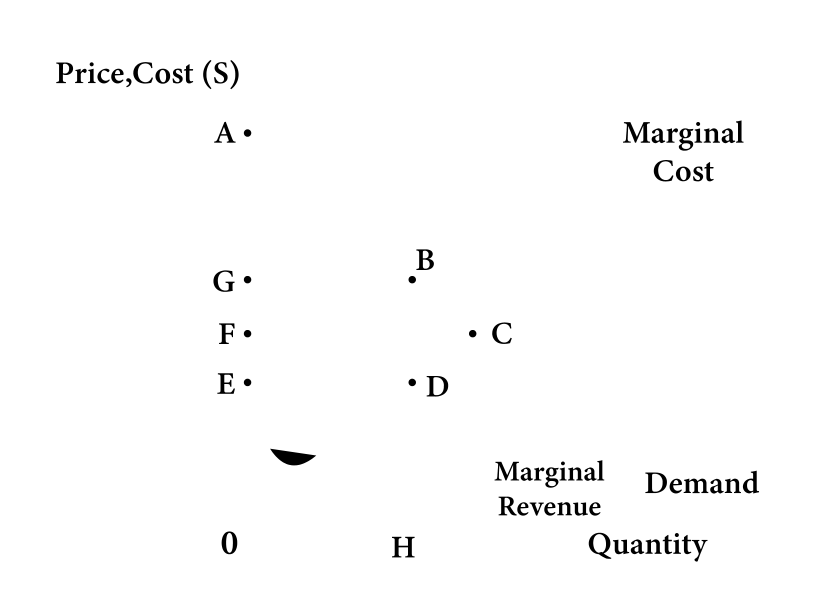
What is the area of consumer surplus in the graph provided when the firm maximizes its profit?
A. ABG
B. ACF
C. ADE
D. BDC
E. GBH
Question 35
Which of the following is true about the value of cross-price elasticity of demand?
A. It is negative for inferior goods and positive for normal goods.
B. It is positive for inferior goods and negative for normal goods.
C. It is positive for complementary goods and negative for unrelated goods.
D. It is positive for substitute goods and negative for complementary goods.
E. It is negative for substitute goods and positive for complementary goods.
Question 36
Which of the following describes the purpose of government antitrust legislation?
A. To increase positive externalities in consumption in order to increase consumers' standard of living
B. To decrease negative externalities in production in order to achieve a socially optimal quantity of output
C. To increase competition in markets in order to reduce inefficiencies caused by monopoly power
D. To encourage firms to pay their workers a wage equal to their marginal revenue product in order to decrease income inequality
E. To limit imports in order to protect domestic producers
Question 37
Spinach is produced in a perfectly competitive market. If a popular health and nutrition group releases a new health report regarding the importance of consuming spinach to increase immunity, which of the following will most likely happen in the short run as a result of the health report?
A. Market equilibrium price will increase, and existing firms will produce a higher quantity.
B. Market equilibrium price will increase, and existing firms will produce a lower quantity.
C. Market equilibrium price will decrease, and existing firms will produce a higher quantity.
D. Market equilibrium price will decrease, and existing firms will produce a lower quantity.
E. Market equilibrium price will decrease, and some firms will exit the market.
Question 38
Labor is the only variable input and capital is the only fixed input for a fum. If the total product of one worker is 15 units of output and the total product of two workers is 27 units of output, which of the following concepts describes the change in total output?
A. Economies of scale
B. Diseconomies of scale
C. Diminishing marginal returns
D. Increasing returns to scale
E. Decreasing returns to scale
Question 39
In the short run, firms decide to produce or shut down by comparing price to
A. average fixed cost
B. average total cost
C. average variable cost
D. marginal cost
E. marginal revenue
Question 40
Kailani's Kernels is a typical profit maximizing firm that produces corn in a constant-Cost, perfectly competitive market and is currently earning positive economic profit. Based on this information, which of the following will occur in long-run equilibrium?
A. The firm will produce at minimum average total cost.
B. The price of corn will increase and be equal to the firm's marginal cost.
C. The firm's average total cost will increase.
D. The firm's profit-maximizing quantity will increase.
E. The firm will continue to earn positive economic profit.
Question 41
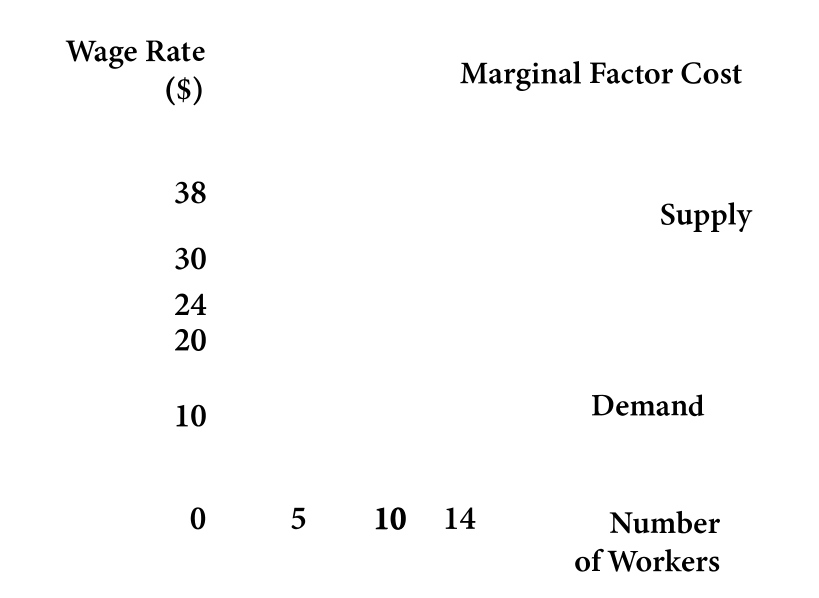
In the graph provided, what is the profit-maximizing number of workers for the monopsonist and what wage will the monopsonist pay?
A. The number of workers is 5 and the wage rate is $38.
B. The number of workers is 10 and the wage rate is $20.
C. The number of workers is 10 and the wage rate is $30.
D. The number of workers is 14 and the wage rate is $24.
E. The number of workers is 14 and the wage rate is $38.
Question 42
Which of the following is true of all profit-maximizing firms, regardless of the typo of competition they face?
A. Firms will produce the quantity where price equals marginal cost.
B. Firms will produce the quantity where price equals marginal revenue.
C. Firms will produce the quantity where price equals average total cost.
D. Firms will produce the quantity where marginal cost equals average total cost.
E. Firms will produce the quantity where marginal cost equals marginal revenue.
Question 43
The market for cauliflower is currently in equilibrium. Which of the following would result in an increase in the supply of cauliflower in the short run?
A. A government-imposed per-unit tax on cauliflower producers
B. An increase in consumers' incomes, and cauliflower is a normal good
C. An increase in the wages of farm workers in cauliflower fields
D. A decrease in the price of broccoli, a substitute product farmers can produce instead of cauliflower
E. A decrease in the price of tomatoes, a complement in consumption for cauliflower
Question 44
Gatafab produces shoes in a monopolistically competitive market. Currently, Gatafab is producing 100 pairs of shoes. Its marginal cost is $15, price is $20, marginal revenue is $15, and average total cost is $17. What is Gatafab's total economic profit?
A. $3
B. $5
C. $300
D. $500
E. $2,000
Question 45
| |
| Change in Quantity Demanded Based on Income Effect |
|
Change in Quantity Demanded Based on Substitution Effect |
| A |
|
|
| B |
|
Decrease |
| C |
No change |
Decrease |
| D |
Decrease |
|
| E |
Decrease |
Decrease |
Maria is interested in purchasing solar panels, a normal good. How will the income effect and substitution effect change the quantity demanded of solar panels for Maria if the price of solar panels increases?
A. A
B. B
C. C
D. D
E. E
Question 46
Which of the following is a difference between monopolies and firms in monopolistic competition?
A. Firms in monopolistic competition can earn negative economic profit in the short run, but monopolies cannot.
B. Firms in monopolistic competition set marginal revenue equal to marginal cost to maximize profit, but monopolies do not.
C. Firms in monopolistic competition produce the socially optimal quantity of output in the long run, but monopolies do not.
D. Monopolies charge a price that is greater than marginal cost, but firms in monopolistic competition do not.
E. Monopolies can earn positive economic profit in the long run, but firms in monopolistic competition cannot.
Question 47
Mike's Bikes has a government license to produce bicycles. The government has increased the annual license fee on bicycle producers. Which of the following will occur in the short run for Mike's Bikes as a result of the increase in the annual license fee?
A. Total revenue will decrease.
B. Marginal revenue will decrease.
C. Marginal cost will increase.
D. Average total cost will increase.
E. Average variable cost will increase.
Question 48
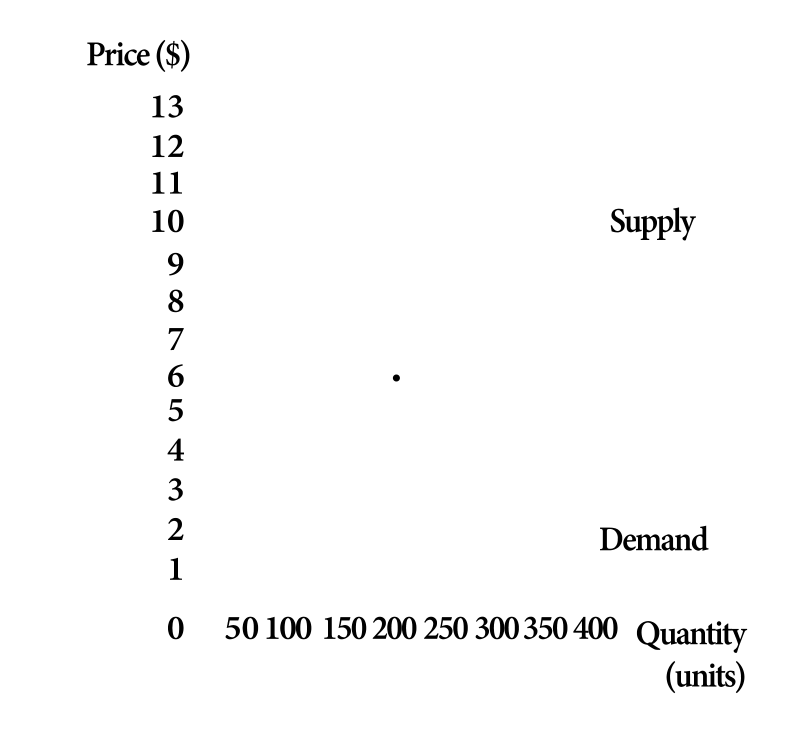
The market in the graph provided is currently in equilibrium. The government wishes to increase the equilibrium quantity of this good to 300 units, Which of the following interventions will achieve the government's goal?
A. Implementing a price floor at $4
B. Imposing a $2 per-unit tax on producers
C. Granting a $2 per-unit subsidy to consumers
D. Granting a $2 per-unit subsidy to consumers and imposing a $2 per-unit tax on producers
E. Granting a $2 per-unit subsidy to consumers and granting a $2 per-unit subsidy to producers
Question 49
The labor market for medical assistants is perfectly competitive. Which of the following would cause the supply curve of medical assistants to shift to the right?
A. An increase in the number of retired medical assistants
B. A decrease in the number of hours worked by medical assistants
C. A decrease in the expected future wages paid to medical assistants
D. A decrease in the requirements for medical assistant certification
E. A decrease in the number of students enrolled in medical assistant programs
Question 50
Which of the following is most likely to cause an increase in income inequality in a country?
A. Increasing access to financial markets for people in low-income groups
B. Providing subsidized job training to people in low-income groups
C. Providing free higher education to people in low-income groups
D. Implementing a progressive income tax structure
E. Implementing a regressive income tax structure
Question 51
| Quantity |
|
| 1 |
70 |
| 2 |
60 |
| 3 |
50 |
| 4 |
40 |
| 5 |
30 |
The table provided shows a demand schedule for a good that a firm produces. If the firm's marginal cost to produce this good is constant at $15, what is the firm's profit-maximizing quantity?
A. 1 unit
B. 2 units
C. 3 units
D. 4 units
E. 5 units
Question 52
The reason profit-maximizing monopolistically competitive firms in long-run equilibrium have excess capacity is
A. they charge a price equal to marginal cost
B. they produce a quantity at which average total cost is not minimized
C. they produce a quantity at which price equals marginal revenue
D. they produce a quantity at which marginal cost is greater than average total cost
E. they are experiencing diseconomies of scale
Question 53
A firm hiring labor from a perfectly competitive labor market will have hired more than the profit-maximizing quantity of labor when the
A. marginal revenue product of labor is greater than its marginal factor cost
B. marginal revenue product of labor is less than its marginal factor cost
C. marginal revenue product of labor is equal to its marginal factor cost
D. total revenue is greater than the total cost
E. total revenue is equal to the total cost
Question 54
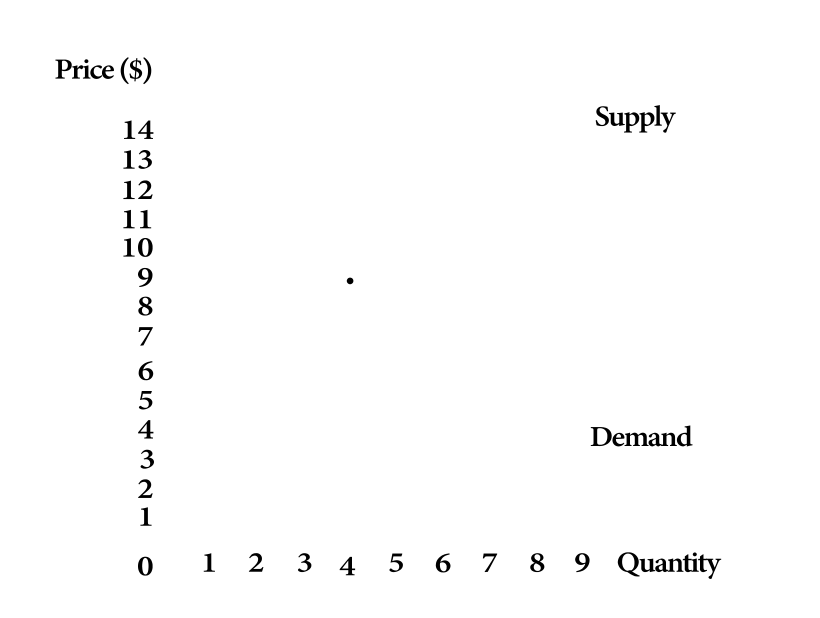
The graph provided shows the domestic supply and demand curves for hats in Econopolis. If Econopolis opens the hat market to free trade and the world price of hats is $7, what will be the total amount spent on imported hats in Econopolis?
A. $7
B. $14
C. $28
D. $36
E. $42
Question 55
For a good to be considered a pure public good, it must be
A. produced at zero marginal cost
B. rival and nonexcludable
C. rival and excludable
D. nonrival and excludable
E. nonrival and nonexcludable
Question 56
Yann's Waffles can hire all the workers it wants at $20 per hour. Yann's Waffles sells its waffles at $10 each. Assuming that labor is the only variable input, Yann's Waffles will maximize its profits when
A. the marginal product of the last worker hired is 2 waffles per hour
B. the marginal revenue product of the last worker hired is $200
C. the marginal factor (resource) cost of the last worker hired is $200
D. the total product of all workers hired is 200 waffles per hour
E. the total revenue from all waffles sold is $200
Question 57
| |
|
Cleared4U |
|
| |
|
Recycling |
Composting |
| Bygone2 |
Recycling |
$45, $47 |
$42, $37 |
| |
Composting |
$38, $43 |
|
Bygone2 and Cleared4U are two competing firms in the waste management industry. When deciding to invest in future technologies, each firm can choose to open a new recycling center or a new composting center. The payoff matrix provided shows the value of profits for each combination of strategies, and both firms have complete information. The first value in each cell represents the payoff for Bygone2, and the second value represents the payoff for Cleared4U. Each fum independently and simultaneously chooses its strategy. Which of the following statements is true?
A. Neither firm has a dominant strategy.
B. Both firms have a dominant strategy to open a new composting center.
C. Both firms have a dominant strategy to open a new recycling center.
D.
Cleared4U has a dominant strategy to open a new recycling center, and Bygone2 has a dominant strategy to open a new composting center.
E.
Bygone2 has a dominant strategy to open a new recycling center, and Cleared4U has a dominant strategy to open a new composting center.
Question 58
Task-It Basket is a firm with some market power. The firm produces and sells baskets for $50 each. At the current quantity of baskets, the firm's marginal revenue is $27 and marginal cost is $34. Task-It Basket should do which of the following to maximize its profits?
A. Produce fewer baskets because marginal revenue is less than marginal cost.
B. Produce fewer baskets because marginal revenue is less than price.
C. Produce fewer baskets because price is greater than marginal cost.
D. Produce more baskets because price is greater than marginal cost.
E. Produce more baskets because price is greater than marginal revenue.
Question 59
Which of the following will happen if a government increases a per-unit subsidy to consumers of a good in a market that has no externalities?
A. Producers will receive a lower price.
B. Government revenue will increase.
C. Producer surplus will increase.
D. Consumer surplus will decrease.
E. Deadweight loss will decrease.
Question 60
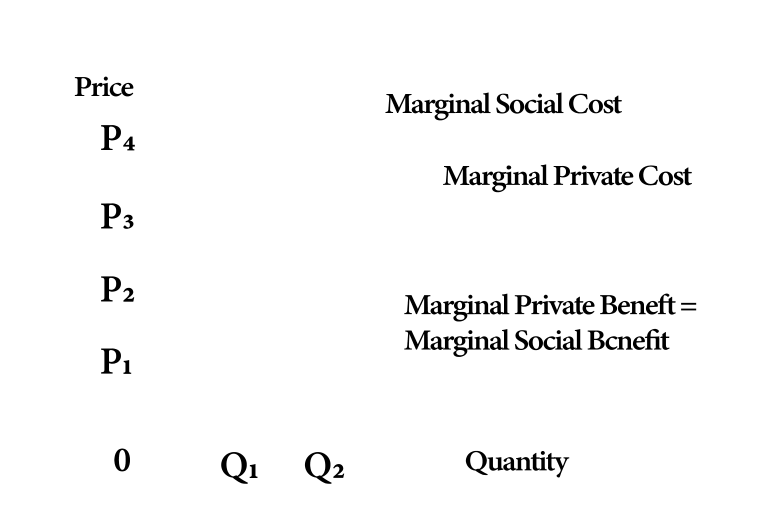
Which of the following policies would address the externality problem in the market depicted in the graph provided?
A. Granting a per-unit subsidy of P4-P2 to consumers
B. Imposing a per-unit tax of P3-P1 on producers
C. Setting a price floor at P2
D. Setting a price ceiling at P3
E. Limiting production to Q2
Section II - Free Response (3 questions)
Question 1
Paolo's Pineapple Farm is a typical profit-maximizing firm that produces and sells pineapples in a constant-cost, perfectly competitive market that is in long-run equilibrium.
Part A
If Paolo's Pineapple Farm incurs explicit and implicit costs, is its accounting profit positive, negative, or zero?
Part B
Draw correctly labeled side-by-side graphs for the pineapple market and Paolo's Pineapple Farm and show each of the following.
(i) The market equilibrium price and quantity, labeled PM and QM, respectively
(ii) The profit-maximizing price and quantity for Paolo's Pineapple Farm, labeled PF and QF, respectively
(iii) Paolo's Pineapple Farm's average total cost curve consistent with long-run equilibrium, labeled ATC
Part C
Pineapples are used in the production of nutritional supplements, which have now become more popular in consumption. On your graphs in part(b), show the short-run effect of the increased popularity of nutritional supplements on each of the following.
(i) The new market equilibrium price and quantity of pineapples, labeled P2 and Q2 respectively
(ii) Paolo's Pineapple Farm's new profit-maximizing quantity, labeled Q*
Part D
Assume that the market for pineapples has adjusted to the new long-run equilibrium. Compared to the short-run equilibrium in part (c), will the number of firms in the pineapple market increase, decrease, or remain the same? Explain.
Part E
Now assume that Paolo's Pineapple Farm successfully differentiates its pineapples from those of its competitors. Will Paolo's Pineapple Farm's price be greater than, less than, or equal to its marginal revenue? Explain.
Part F
The income elasticity of demand for pineapples is 0.30. If there is a 10% increase in income, calculate the percentage change in quantity demanded of pineapples. Show your work.
Question 7
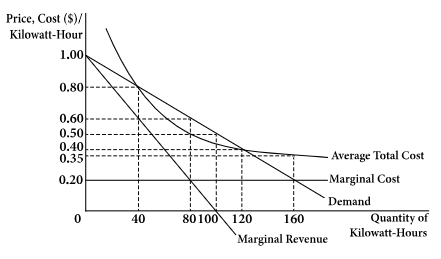
Grand Power Company operates as an unregulated, single-price natural monopoly that produces and supplies electrical power to the city of Grandville. The graph provided shows the demand, revenue, and cost curves for Grand Power Company.
Part A
Identify Grand Power Company's profit-maximizing price and quantity.
Part B
At the profit-maximizing quantity, is Grand Power Company's demand elastic, unit elastic, or inelastic? Explain.
Part C
The city government of Grandville wants to regulate Grand Power Company and is considering two proposals.
• Proposal I: Regulate Grand Power Company to produce the maximum quantity that would allow it to earn zero economic profit.
• Proposal II: Regulate Grand Power Company to achieve allocative efficiency.
(i) If the government chooses Proposal I, identify the price that Grand Power Company will charge and the quantity it will produce.
(ii) Calculate the deadweight loss if the government chooses Proposal I. Show your work.
(iii) Which proposal will result in a greater consumer surplus? Explain using numbers.
Question 10
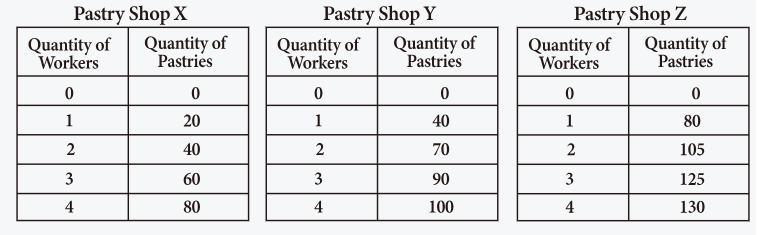
The tables provided show the production schedules for three pastry shops (Pastry Shop X, Pastry Shop Y, and Pastry Shop Z), indicating the quantity of pastries that can be produced using varying quantities of workers at each shop. Workers are hired in a perfectly competitive labor market at a wage of $35, and shops can sell pastries at a price of $2 per unit in a perfectly competitive market.
Part A
What is Pastry Shop X's total revenue if it employs four workers?
Part B
For Pastry Shop Y, calculate the marginal revenue product (value of the marginal product) of the second worker. Show your work.
Part C
If the market wage is $35, how many workers should Pastry Shop Z hire to maximize profits? Explain using marginal analysis.
Part D
Which pastry shop or shops exhibit diminishing marginal returns?
Part E
Suppose Penelope is an entrepreneur who owns all three of the pastry shops and currently employs three workers at each shop (for a total of nine workers). If Penelope decides to hire a tenth worker, at which shop should the tenth worker be hired to maximize the total profits from all three shops?
Multiple-choice answer key
Answers reproduced from the website. No FRQ scoring guide was provided in the question pages.
1: C | 2: B | 3: D | 4: B | 5: D
6: C | 7: A | 8: E | 9: C | 10: B
11: E | 12: D | 13: D | 14: D | 15: E
16: C | 17: D | 18: A | 19: C | 20: E
21: D | 22: B | 23: B | 24: A | 25: B
26: E | 27: A | 28: E | 29: D | 30: A
31: A | 32: C | 33: B | 34: A | 35: D
36: C | 37: A | 38: C | 39: C | 40: A
41: B | 42: E | 43: D | 44: C | 45: E
46: E | 47: D | 48: E | 49: D | 50: E
51: C | 52: B | 53: B | 54: C | 55: E
56: A | 57: C | 58: A | 59: C | 60: B