AP Micro 2023
Shanmao online question bank | Archived 2026-10-25
Section I - Multiple Choice (60 questions)
Question 1
Which of the following statements about short-run costs is always true as a firm increases its production?
A. Average fixed cost decreases.
B. Average variable cost decreases.
C. Average total cost decreases.
D. Marginal cost is lower than the average variable cost.
E. Marginal cost is lower than the average total cost.
Question 2
The allocatively efficient level of output is produced in any market structure when
A. firms are experiencing economies of scale
B. marginal revenue is equal to zero
C. long-run economic profit is equal to zero
D. price is equal to marginal cost
E. average variable cost is at a minimum
Question 3
The government of Annapolita has determined that the country's power company, an unregulated natural monopolist, should be required to produce the allocatively efficient quantity of electricity. Which of the following actions will achieve the government's goal?
A. The government imposes a per-unit tax on each unit of output the monopoly produces and imposes a lump-sum tax on the monopolist to eliminate any remaining profit.
B. The government sets the price at the point where demand and average total cost curves intersect and provides a lump-sum subsidy to the monopolist equal to the monopolist's normal profit.
C. The government sets the price at the point where demand and average total cost curves intersect and imposes a lump-sum tax on the monopolist to eliminate the monopolist's normal profit.
D. The government sets the price at the point where demand and marginal cost curves intersect and imposes a lump-sum tax on the monopolist to eliminate the monopolist's normal profit.
E. The government sets the price at the point where demand and marginal cost curves intersect and provides a lump-sum subsidy to the monopolist to earn normal profit.
Question 4
A decrease in the demand for antique lanterns, a normal good, would be caused by which of the following?
A. An increase in consumers' incomes
B. An increase in the price of antique lanterns
C. An increase in the expected price of antique lanterns in the future
D. An increase in the price of electric lanterns, a substitute good
E. An increase in the price of lamp oil, a complementary good
Question 5
Apple trees need bees to pollinate their flowers and produce apples. Apple farmers hire beekeepers to bring bees to their orchards to pollinate the flowers. This is an example of a
A. negative externality
B. tragedy of the commons
C. public good
D. market transaction
E. free-rider problem
Question 6
| |
Apples |
|
| Marginal utility of last unit |
15 |
12 |
| Price per unit |
$5 |
$3 |
The table provided shows Ricardo's marginal utility of the last unit consumed of apples and bananas and the price of each good. Ricardo has $125 to spend on apples and bananas. He currently buys 10 apples and 25 bananas. Assuming that he remains within his budget constraint, Ricardo should do which of the following to increase his utility?
A. Buy more of both goods
B. Buy fewer of both goods
C. Buy more bananas and fewer apples
D. Buy more apples and fewer bananas
E. Continue buying the same quantities of both goods
Question 7

Apples are produced in a perfectly competitive market with no government intervention. Which of the following price changes will cause the total economic surplus to increase for the apple market depicted in the graph provided?
A. A decrease in price from $8 to $6
B. A decrease in price from $6 to $4
C. A decrease in price from $6 to $0
D. An increase in price from $6 to $8
E. An increase in price from $8 to $12
Question 8
Which of the following is true in a command economy?
A. There is more private ownership of the factors of production than in a market economy.
B. Production decisions are based on the incentive of firms to maximize profits.
C. The government directs the use of factors of production.
D. The price system is used to allocate resources.
E. There is more freedom of enterprise than in a market economy.
Question 9

Consumer surplus could be the shaded area in which of the following situations?
A. A price floor set at P1 in the market
B. A price floor set at P2 in the market
C. A price ceiling set at P1 in the market
D. A per-unit subsidy equal to P2-P1 granted to producers
E. A per-unit tax equal to P2-P1 imposed on producers
Question 10
Daily Tools is a typical firm in a monopolistically competitive market that produces tool kits for everyday use. Which of the following explains why Daily Tools is inefficient in long-run equilibrium?
A. The entry of more efficient firms is blocked.
B. The firm produces the quantity at which marginal cost equals average total cost.
C. The firm does not produce the quantity that results in minimum average total cost.
D. The firm does not produce the quantity that minimizes total cost.
E. The firm's customers value the last unit of output at less than its cost.
Question 11
For a rational consumer with diminishing marginal utility, the consumption of an additional unit of a good will result in which of the following?
A. Total utility will increase until it equals marginal utility.
B. Total utility will increase while marginal utility will be negative.
C. Total utility will increase while marginal utility will decrease.
D. Total utility will decrease while marginal utility will be positive.
E. Total utility will decrease while marginal utility will increase.
Question 12
A player's dominant strategy is
A. independent of the other player's choice
B. dependent on the other player's choice
C. the strategy that results in the maximum combined payoff for both players
D. the strategy that always delivers the other player's best outcome of the game
E. the strategy that always delivers the other player's worst outcome of the game
Question 13
Donuts for Dollars is a typical profit-maximizing firm in a perfectly competitive market that is earning positive economic profit in the short run. Which of the following statements must be true?
A. Price must be less than average total cost in the short run, and firms will exit the market in the long run.
B. Price must be less than average total cost in the short run, and firms will earn normal profit in the long run.
C. Price must equal average total cost in the short run, and firms will enter the market in the long run.
D. Price must be greater than average total cost in the short run, and firms will exit the market in the long run.
E. Price must be greater than average total cost in the short run, and firms will earn normal profit in the long run.
Question 14
The use of environmentally friendly drinking straws has benefits to society beyond those enjoyed by their direct users. As a result, a government with the goal of maximizing total economic surplus in society would have an incentive to
A. allow the free market to determine the equilibrium price and quantity of environmentally friendly drinking straws
B. implement a binding price ceiling on environmentally friendly drinking straws
C. implement a binding price floor on environmentally friendly drinking straws
D. implement a per-unit tax on consumers of environmentally friendly drinking straws
E. implement a per-unit subsidy to consumers of environmentally friendly drinking straws
Question 15
Dylan recently quit his job as a journalist for a local newspaper where he was making $80,000 per year. He opened an ice-cream shop where he earns a yearly total revenue of $250,000. He spends $150,000 each year on rent, resources, and workers he hires. Which of the following equals Dylan's accounting profit and economic profit from the ice-cream shop?
A.
| Accounting Profit |
Economic Profit |
| $250,000 |
$20,000 |
B.
| Accounting Profit |
Economic Profit |
| $230,000 |
$10,000 |
C.
| Accounting Profit |
Economic Profit |
| $150,000 |
$70,000 |
D.
| Accounting Profit |
Economic Profit |
| $100,000 |
$80,000 |
E.
| Accounting Profit |
Economic Profit |
| $100,000 |
$20,000 |
Question 16
A nation engages in international trade with its trading partners and is currently an importer of aluminum. Imposing an import tariff on aluminum will affect the domestic market for aluminum in which of the following ways?
A.
| Domestic Quantity Supplied |
Domestic Consumer Surplus |
Domestic Producer Surplus |
| Increase |
Decrease |
Decrease |
B.
| Domestic Quantity Supplied |
Domestic Consumer Surplus |
Domestic Producer Surplus |
| Increase |
Decrease |
Increase |
C.
| Domestic Quantity Supplied |
Domestic Consumer Surplus |
Domestic Producer Surplus |
| No change |
Decrease |
Decrease |
D.
| Domestic Quantity Supplied |
Domestic Consumer Surplus |
Domestic Producer Surplus |
| Decrease |
Increase |
Decrease |
E.
| Domestic Quantity Supplied |
Domestic Consumer Surplus |
Domestic Producer Surplus |
| Decrease |
Increase |
Increase |
Question 17
Which of the following combinations is most likely to result in the demand for a product being highly price inelastic?
A. The product has few close substitutes and represents a small percentage of a consumer's income.
B. The product has few close substitutes and represents a large percentage of a consumer 's income.
C. The product has many close substitutes and represents a small percentage of a consumer' 's income.
D. The product has many close substitutes and represents a moderate percentage of a consumer's income.
E. The product has many close substitutes and represents a large percentage of a consumer 's income.
Question 18

FishNets hires workers from the labor market depicted in the provided graph. The government imposes a binding minimum wage in the labor market. What is the binding minimum wage that would cause FishNets to hire the same number of workers as a perfectly competitive labor market?
A. $24
B. $32
C. $40
D. $48
E. $64
Question 19
The cross-price elasticity of demand for flashlights and Good H is 2.5. This indicates which of the following?
A. Flashlights and Good H are inferior goods.
B. Flashlights and Good H are normal goods.
C. Flashlights and Good H are substitutes in consumption.
D. Flashlights and Good H are complements in consumption.
E. Flashlights and Good H both have elastic demand.
Question 20
FormalWear is a clothing factory that hires workers as a variable input and rents sewing machines as a fixed input. Which of the following will happen when the marginal product of workers decreases?
A. Total variable cost will decrease.
B. Total fixed cost will increase.
C. Short-run average total cost will decrease.
D. Marginal cost will increase.
E. Marginal cost will equal average total cost.
Question 21
Gale Furniture uses labor, capital, and wood as inputs in its production of office desks. When Gale Furniture doubles the quantity of labor, capital, and wood, the quantity of office desks doubles. Gale Furniture's production process is characterized by
A. economies of scale
B. diseconomies of scale
C. constant returns to scale
D. decreasing returns to scale
E. increasing returns to scale
Question 22
Which of the following situations best fits with the description of a firm in a perfectly competitive market?
A. GaryNote constantly offers discounts to steal customers from EricNote, which retaliates by offering price cuts.
B. GaryNote has many competitors in the market, and each firm differentiates its product to gain customer loyalty.
C. GaryNote can hire as many workers as it wants at the market wage, but it must decrease its price to sell more output.
D. GaryNote sets its own price for its output, but because of market competition, it earns zero economic profit in the long run.
E. GaryNote can sell as many units of output as it wants at the market price but will lose all its customers if it charges a higher price.
Question 23
Greencom is currently producing 20 units of output. At this level of output, Greencom's marginal revenue is $6, marginal cost is $6, and average total cost is $9. If Greencom operates in a monopolistically competitive market and sells all 20 units of output for $10 per unit, it can be
concluded that
A. Greencom would earn more profit by decreasing output
B. Greencom would earn more profit by increasing output
C. Greencom is earning zero economic profit
D. Greencom is earning negative economic profit
E. Greencom is earning positive economic profit
Question 24
| Number of Cases |
Total Cost ($) |
| 0 |
15 |
| 1 |
25 |
| 2 |
45 |
| 3 |
75 |
| 4 |
115 |
| 5 |
165 |
The table provided shows the daily total cost data for Hansel's Hot Sauce. If the average fixed cost was $5 per case, how many cases of hot sauce had Hansel's Hot Sauce produced?
A. 1
B. 2
C. 3
D. 4
E. 5
Question 25
Cross-price elasticity of demand for honey with respect to yogurt is -4. At the current equilibrium, consumers are buying 100 containers of yogurt per week and 20 containers of honey per week. If the price of yogurt increases by 10 percent per container, what will be the new quantity demanded of honey?
A. 4 containers
B. 8 containers
C. 10 containers
D. 12 containers
E. 40 containers
Question 26
| Quantity |
Price ($) |
Total Cost ($) |
| 1 |
10 |
11 |
| 2 |
8 |
14 |
| 3 |
7 |
18 |
| 4 |
5 |
25 |
| 5 |
3 |
34 |
The table provided shows price and cost data for Howell's Toy Hoops, a typical profit-maximizing firm that sells its toys in a monopolistically competitive market. At the profit-maximizing quantity, the economic profit for Howell's Toy Hoops is
A. -$19
B. -$5
C. -$1
D. $2
E. $3
Question 27

The graph shows the cost and revenue curves for a profit-maximizing firm. Which of the following is true about the firm?
A. The firm operates in a perfectly competitive market, producing the allocatively efficient quantity and charging P1.
B. The firm is a monopolist, producing the allocatively efficient quantity and charging P1.
C. The firm is a natural monopoly, producing Q1 and earning positive economic profit.
D. The firm operates in an imperfectly competitive market, producing Q1 and earning positive economic profit.
E. The firm operates in a monopolistically competitive market, producing Q1 and earning negative economic profit.
Question 28
The income and substitution effects explain which of the following?
A. Decreasing marginal productivity of labor
B. Market power caused by barriers to entry
C. Increasing marginal cost of production
D. Increasing returns to scale
E. The downward slope of the market demand curve
Question 29

The graph provided shows five different short-run average total cost (SRATC) curves of a firm and its long-run average total cost (LRATC) curve. Which of the following is true if the firm is operating on its SR ATC
2 curve and producing quantity Q
2?
A. The firm is producing at the minimum efficient scale.
B. The firm must decrease its output to achieve the minimum efficient scale.
C. The firm must increase its output to achieve the minimum efficient scale.
D. The firm is producing at its productively efficient quantity of output.
E. The firm is experiencing diseconomies of scale.
Question 30

Which of the following will happen if the firm continues to hire additional units of labor beyond L
2 in the short run?
A. The firm's marginal cost will decrease.
B. The firm will begin experiencing diminishing marginal returns.
C. The firm's fixed cost will increase.
D. The average product of labor will be equal to zero.
E. The total product of labor will decrease.
Question 31
The market for Good Z has relatively elastic supply and demand curves. Market efficiency is attained when
A. total labor cost is minimized for each firm
B. each firm experiences economies of scale
C. consumer surplus is greater than producer surplus
D. producer surplus is zero
E. deadweight loss is zero
Question 32
The government imposition of a minimum wage in a perfectly competitive labor market is a policy that would
A. be used in a pure market economy
B. be used in a mixed economy
C. eliminate deadweight loss
D. increase the number of workers hired
E. decrease the supply of labor
Question 33
A natural monopoly exists when a single firm
A. produces a quantity of output that maximizes the total producer surplus
B. produces the allocatively efficient quantity of output of a good
C. has an upward-sloping marginal cost curve
D. has a downward-sloping average total cost curve over the relevant range of output
E. sets price equal to marginal cost in order to maximize profit
Question 34
Which of the following is an example of a good that is nonexcludable and rival in consumption?
A. Fish sandwich
B. Public highway
C. Private dance lesson
D. Online music
E. National defense
Question 35
OfficeClips is a typical firm that produces and sells paper clips in a perfectly competitive market. OfficeClips is currently earning a positive economic profit. In the long run, what will happen to the firm's economic profit, the market price, and the market quantity?
A.
| Firm's Profit |
Market Price |
Market Quantity |
| No change |
Decrease |
Increase |
B.
| Firm's Profit |
Market Price |
Market Quantity |
| No change |
Increase |
Decrease |
C.
| Firm's Profit |
Market Price |
Market Quantity |
| Decrease |
Increase |
Decrease |
D.
| Firm's Profit |
Market Price |
Market Quantity |
| Decrease |
Decrease |
Decrease |
E.
| Firm's Profit |
Market Price |
Market Quantity |
| Decrease |
Decrease |
Increase |
Question 36
Which of the following best represents the most distinctive characteristic of an oligopoly?
A. A market with a single firm that faces no competition
B. A market where a few firms have significant market share
C. A market with low barriers to entry
D. A market with many firms selling differentiated products
E. A market with many firms earning zero economic profits in the long run
Question 37

The graph provided shows the marginal revenue (MR), average variable cost (AVC), average total cost (ATC), and marginal cost (MC) curves for a perfectly competitive firm. Which of the following is true if the firm is currently producing Q
* units of output?
A. The firm can increase its economic profit by producing fewer units of output.
B. The firm can increase its economic profit by increasing the price of its product.
C. The firm is maximizing its economic profit at the current level of output.
D. The firm can increase total revenue by producing fewer units of output.
E. The firm can increase total revenue by decreasing the price of its product.
Question 38
Which of the following is an example of physical capital?
A. Earnings from a job
B. Fish in the ocean
C. Money in a person's wallet
D. An unskilled worker
E. A tractor used in farming
Question 39

The graph provided shows the production possibilities curve for a country's economy. The economy is currently producing at point Z. What is the opportunity cost of changing production to point M?
A. 3 units of Good Y
B. 8 units of Good Y
C. 3 units of Good X
D. 4 units of Good X
E. 2 units of Good X
Question 40
A firm with market power sells its product in two markets. The firm faces the same cost curves in both markets but faces a relatively elastic demand in one market for its product and a relatively inelastic demand in the other market for that same product. Which of the following will increase the firm's profits?
A. The firm charges a lower price in both markets.
B. The firm charges a higher price in both markets.
C. The firm charges a price equal to its marginal cost in both markets.
D. The firm charges a lower price in the market with elastic demand and a higher price in the market with inelastic demand.
E. The firm charges a lower price in the market with inelastic demand and a higher price in the market with elastic demand.
Question 41
Which of the following will occur in the market for bicycles if the government establishes a binding price floor?
A. A market shortage
B. A decrease in the demand for bicycles
C. A decrease in the quantity of bicycles purchased
D. An increase in consumer surplus
E. An increase in the equilibrium quantity of bicycles
Question 42
| Quantity of Output (units) |
Total Variable Cost ($) |
Total Cost ($) |
| 1 |
100 |
200 |
| 2 |
190 |
290 |
| 3 |
270 |
370 |
| 4 |
340 |
440 |
| 5 |
420 |
520 |
| 6 |
510 |
610 |
| 7 |
610 |
710 |
The table provided shows the total variable cost and total cost of production for varying quantities of output by a typical profit-maximizing firm in a perfectly competitive market. How many units will the firm produce at a market price of $95 to maximize profits?
A. 2 units
B. 3 units
C. 4 units
D. 6 units
E. 7 units
Question 43
Which of the following is true at the quantity of labor hired by a profit-maximizing monopsonist?
A. Marginal revenue product is less than marginal factor cost.
B. Marginal revenue product is greater than marginal factor cost.
C. Marginal revenue product is less than the market wage.
D. Marginal revenue product is greater than the market wage.
E. Marginal revenue product equals the market wage.
Question 44

Home remodeling services are provided in a perfectly competitive market but generate noise that angers neighbors. What is the socially optimal quantity of home remodeling services and the area that represents deadweight loss associated with the market equilibrium?
A. Q1 and area ACD
B. Q1 and area ABC
C. Q2 and area ABC
D. Q2 and area ACD
E. Q1 and area CEF
Question 45
Robots and workers are substitutes in production and are both variable inputs. Both robots and workers are hired in perfectly competitive factor markets. If the daily rental price of robots increases, which of the following will most likely happen to wages paid to workers and the number of workers employed in the short run?
A.
| Wages |
Number of Workers Employed |
| Decrease |
Decrease |
B.
| Wages |
Number of Workers Employed |
| Decrease |
Increase |
C.
| Wages |
Number of Workers Employed |
| Increase |
Decrease |
D.
| Wages |
Number of Workers Employed |
| Increase |
Increase |
E.
| Wages |
Number of Workers Employed |
| No change |
No change |
Question 46
Rover's Rest and Dave's Den are the only two dog daycare companies in a town. Each firm is considering whether to run ads or to not run ads. The first entry in each cell shows Dave's Den's profit, and the second entry shows Rover's Rest's profit. Each dog daycare company independently and simultaneously chooses its strategy. Assume the two firms know all the information in the matrix and do not cooperate. Use the payoff matrix provided to answer the next two questions.
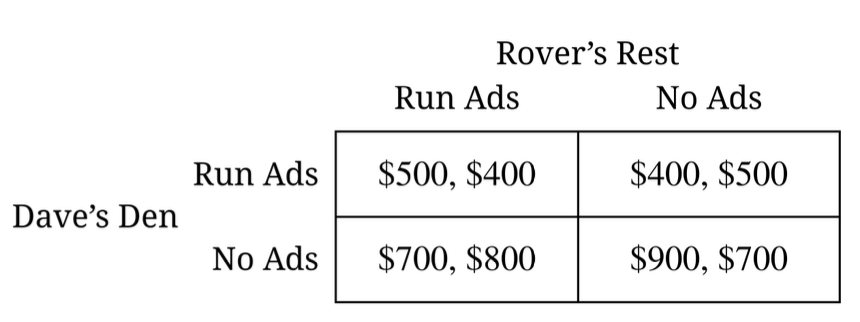
Which of the following represents the Nash equilibrium?
A. Dave's Den chooses "Run Ads," and Rover's Rest chooses "No Ads"
B. Both Dave's Den and Rover's Rest choose "Run Ads."
C. Both Dave's Den and Rover's Rest choose "No Ads."
D. Dave's Den chooses "No Ads," and Rover's Rest chooses"Run Ads."
E. There are multiple Nash equilibria.
Question 47
The advertising agency raises its prices, causing a firm that chooses to run ads to earn $200 less in profits. Once the firms adjust to the higher advertising prices, what is the total combined profit of the two firms in the new Nash equilibrium?
A. $500
B. $700
C. $1,300
D. $1,500
E. $1,600
Question 48
Scarcity leads to which of the following?
A. Unemployed resources
B. Absolute advantage
C. Opportunity cost
D. Efficiency
E. Monopolies
Question 49
| |
Orange juice (in liters) |
Canvases |
| Stefan |
40 |
30 |
| Donna |
20 |
10 |
Stefan and Donna produce orange juice and canvases. The table provided shows the maximum possible production of orange juice OR canvases that can be produced by Stefan and Donna. Which of the following terms of trade would be mutually beneficial to Stefan and Donna?
A. 1 canvas for 0.4 liter of orange juice
B. 1 canvas for 0.5 liter of orange juice
C. 1 canvas for 1 liter of orange juice
D. 1 canvas for 1.5 liters of orange juice
E. 1 canvas for 2.5 liters of orange juice
Question 50
Which of the following is most likely true if textile production generates pollution during the production process?
A. The market will underproduce textiles relative to the socially optimal quantity, and the government would need to provide a lump-sum subsidy to firms to correct the externality.
B. The market will underproduce textiles relative to the socially optimal quantity, and the government would need to provide a per-unit subsidy to firms to correct the externality.
C. The market will overproduce textiles relative to the socially optimal quantity, and the government would need to impose a lump-sum tax on firms to correct the externality.
D. The market will overproduce textiles relative to the socially optimal quantity, and the government would need to impose a per-unit tax on firms to correct the externality.
E. The market will produce the socially optimal quantity of textiles, and the government would not need to intervene in the market to influence the production decisions of firms.
Question 51
If the value of the price elasticity of supply for a product is 0.5, which of the following statements is correct?
A. A 10 percent increase in the price of the product will decrease the quantity supplied by 5 percent.
B. A 10 percent increase in the price of the product will decrease the quantity supplied by 20 percent.
C. A 10 percent increase in the price of the product will increase the quantity supplied by 20 percent.
D. A 20 percent decrease in the price of the product will decrease the quantity supplied by 10 percent.
E. A 20 percent decrease in the price of the product will decrease the quantity supplied by 40 percent.
Question 52
Income inequality is measured by what economic concept?
A. Market failure
B. Unemployment
C. Production function
D. Gini coefficient
E. Deadweight loss
Question 53
Toby's Toy Trains produces train sets in a monopolistically competitive market. If Toby increases the price of a train set by 5 percent, causing a 10 percent decrease in the quantity demanded of train sets, which of the following will occur?
A. Toby's total revenue will increase.
B. Toby's total revenue will decrease.
C. Toby's total revenue will remain the same.
D. The demand for Toby's train sets will increase.
E. The demand for Toby's train sets will decrease.
Question 54
A decrease in the cost of land devoted for building townhouses will most likely cause which of the following?
A. The supply curve of townhouses will shift to the left.
B. The demand curve for townhouses will become more elastic.
C. The price of townhouses will increase.
D. The supply of townhouses will increase.
E. There will be less incentive to build townhouses.
Question 55
| Number of Workers |
Quantity of T-Shirts |
| 0 |
0 |
| 1 |
24 |
| 2 |
44 |
| 3 |
60 |
| 4 |
72 |
| 5 |
80 |
The table provided shows the daily output for a profit-maximizing T-shirt firm that is operating in a perfectly competitive product market and hires labor from a perfectly competitive labor market. If each T-shirt sells for $10 and the equilibrium daily wage is $100, how many workers will the firm hire to maximize profit?
A. 1
B. 2
C. 3
D. 4
E. 5
Question 56
Which of the following ignores implicit costs?
A. Normal profit
B. Accounting profit
C. Economic profit
D. Opportunity cost
E. Economic cost
Question 57
Which of the following best explains why the government provides public goods?
A. Nonexcludable goods have a perfectly inelastic demand.
B. Nonrival goods benefit only private consumers.
C. Surpluses result from the private production of nonrival goods.
D. Production of socially optimal quantities results in positive economic profits.
E. Nonexcludable goods are underproduced by private firms.
Question 58
Which of the following reasons could explain why a firm might hire fewer workers?
A. A decrease in the wage rate
B. A decrease in labor productivity
C. An increase in the price of a substitute input
D. An increase in the price of the firm's product
E. An increase in demand for the firm's product
Question 59
ZBA is a typical profit maximizing firm in a perfectly competitive market that produces and sells widgets at $5 each. ZBA hires labor in a perfectly competitive labor market. The table shows ZBA's production function for widgets.
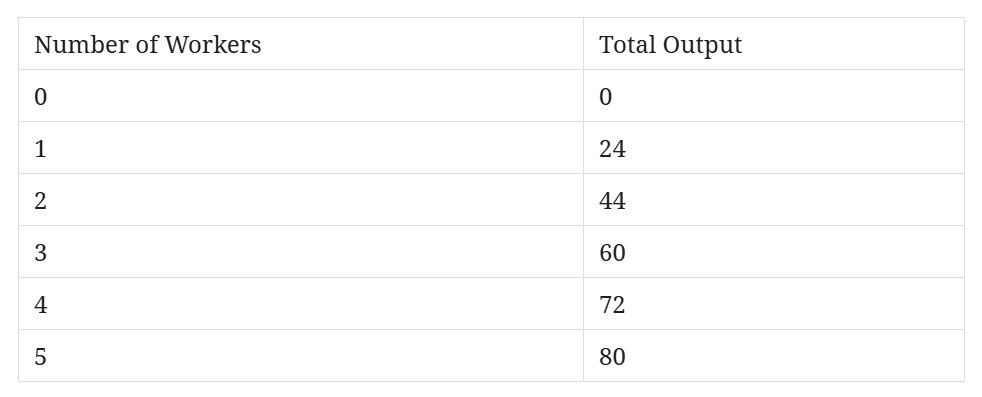
What is the marginal revenue product of the fourth worker?
A. $5
B. $12
C. $25
D. $36
E. $60
Question 60
If the hourly wage is $60, how many workers will the firm hire to maximize profit?
A. 1
B. 2
C. 3
D. 4
E. 5
Section II - Free Response (3 questions)
Question 1
Heirloom Gardens is a typical profit-maximizing firm that produces and sells tomatoes in a constant-cost, perfectly competitive market that is in long-run equilibrium.
Part A
Draw correctly labeled side-by-side graphs for the tomato market and for Heirloom Gardens and show each of the following.
i. The market equilibrium price and quantity, labeled PM and QM, respectively
ii. The profit-maximizing price and quantity for Heirloom Gardens, labeled PF and QF, respectively
iii. The average total cost curve consistent with a long-run equilibrium, labeled ATC
Part B
Suppose the government imposes a binding price floor in the market for tomatoes.
i. Will this price floor benefit all tomato farmers? Explain.
ii. Will consumer surplus increase, decrease, or stay the same? Explain.
Part C
Suppose that the government does not impose the price floor referred to in part (b) and that there is now an increase in consumers' incomes and tomatoes are a normal good. On your graphs in part (a), show each of the following.
i. The short-run effect of the increase in consumers' incomes on the market equilibrium price and quantity of tomatoes, labeled P2 and Q2, respectively
ii. The short-run profit-maximizing quantity for Heirloom Gardens, labeled Q*
iii. The area representing Heirloom Gardens' economic profit, shaded completely
Part D
Given the increase in consumers' incomes in part (c), what will happen to the market equilibrium price and quantity of tomatoes in the long run? Explain.
Question 5
The provided graph shows the marginal private cost (MPC) curve, the marginal social cost (MsC) curve, the marginal private benefit (MPB) curve, and the marginal social benefit (MsB) curve in the market for smoke alarms.

Part A
Does the graph show a negative consumption externality or a positive consumption externality? Explain.
Part B
Identify the socially optimal quantity of smoke alarms.
Part C
What is the dollar value of the marginal externality?
Part D
Calculate the deadweight loss in the market for smoke alarms at the market equilibrium. Show your work.
Part E
The government wants the socially optimal quantity of smoke alarms to be produced and consumed. Would the government implement a per-unit tax on producers, a lump-sum subsidy to producers, a per-unit subsidy to consumers, or a lump-sum tax on consumers? Explain.
Question 10
The provided graph shows cost, revenue, and demand curves for a single-price monopolist that sells leather shoes. The fixed cost is zero, and the marginal cost is constant.

Part A
Identify the monopolist's profit -maximizing quantity and price.
Part B
Calculate the monopolist's economic profit at the profit-maximizing quantity. Show your work.
Part C
If the monopolist decides to produce 10 additional units beyond the profit-maximizing quantity identified in part (a), would total revenue increase, decrease, or remain the same? Explain.
Part D
Suppose the government breaks up the monopoly, resulting in a perfectly competitive market for leather shoes.
i. Identify the new equilibrium quantity and price.
ii. Calculate the total economic surplus. Show your work.
Multiple-choice answer key
Answers reproduced from the website. No FRQ scoring guide was provided in the question pages.
1: A | 2: D | 3: E | 4: E | 5: D
6: C | 7: A | 8: C | 9: C | 10: C
11: C | 12: A | 13: E | 14: E | 15: E
16: B | 17: A | 18: B | 19: C | 20: D
21: C | 22: E | 23: E | 24: C | 25: D
26: E | 27: D | 28: E | 29: C | 30: E
31: E | 32: B | 33: D | 34: B | 35: E
36: B | 37: A | 38: E | 39: E | 40: D
41: C | 42: D | 43: D | 44: B | 45: D
46: D | 47: E | 48: C | 49: D | 50: D
51: D | 52: D | 53: B | 54: D | 55: D
56: B | 57: E | 58: B | 59: E | 60: D