AP Micro 2021
Shanmao online question bank | Archived 2026-10-25
Section I - Multiple Choice (60 questions)
Question 1
Raheem is currently working as a financial analyst earning $75,000 a year and is considering quitting his current job to start an art gallery. The estimated annual revenue from the art gallery is $175,000. The annual cost of labor, advertising, and acquiring the art inventory is $125,000. What are Raheem s accounting and economic profits if he opens the art gallery?
A. Accounting profit is -$25,000, and economic profit is $50,000.
B. Accounting profit is $100,000, and economic profit is $50,000.
C. Accounting profit is $50,000, and economic profit is -$25,000.
D. Accounting profit is $100,000, and economic profit is -$25,000.
E. Accounting profit is $50,000, and economic profit is $100,000.
Question 2
Suppose a firm's production process exhibits diseconomies of scale. How and why will costs change if the firm reduces its output?
A. Long-run average total cost will increase because it becomes more difficult for the firm to manage its workforce.
B. Long-run average fixed costs will increase because the firm produces fewer units of output.
C. Long-run average total cost will decrease because it becomes easier for the firm to manage its workforce.
D. Long-run average fixed costs will decrease because the firm produces fewer units of out-put.
E. Long-run average total cost will decrease because it becomes more difficult for the firm to manage its workforce.
Question 3
What does the minimum efficient scale measure?
A. The smallest output level at which short-run average total cost is minimized.
B. The smallest output level at which short-run total cost is minimized.
C. The smallest output level at which long-run average total cost is minimized.
D. The largest output level at which long-run average total cost is minimized.
E. The largest output level at which long-run total cost is minimized.
Question 4
If a binding minimum wage increases in a perfectly competitive labor market, then which of the following will likely occur in the labor market?
A. The supply of workers will increase.
B. The supply of workers will decrease.
C. The demand for workers will increase.
D. The demand for workers will decrease.
E. The quantity of workers supplied will increase.
Question 5
Assume that the government imposes a binding price ceiling on a market for an inferior good. Which of the following is most likely to occur in the market if consumers' incomes increase?
A. The market demand will shift to the right.
B. The market supply will shift to the right.
C. The shortage in the market will decrease.
D. The surplus in the market will increase.
E. The market price will increase.
Question 6
The table provided shows the number of labor hours required to produce a cell phone or a unit of lumber in Estonia and in Finland.
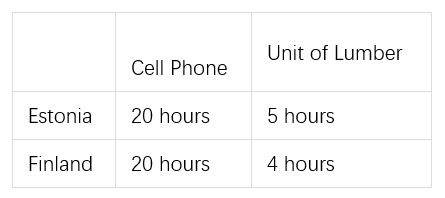
Based on the information in the table, which of the following is true?
A. Estonia has a comparative advantage in producing lumber.
B. Finland has a comparative advantage in producing cell phones.
C. Finland has an absolute advantage in producing lumber.
D. Estonia has both the absolute and comparative advantages in producing lumber.
E. Neither country has a comparative advantage in producing cell phones.
Question 7
Which of the following will shift the demand curve for a factor of production to the left?
A. A decrease in the price of the factor of production
B. A decrease in the price of a substitute factor of production
C. An increase in the price of the product produced by the factor
D. An increase in the marginal product of the factor
E. An improvement in technology used by the factor of production
Question 8
Suppose the market for health-care workers is perfectly competitive. Which of the following will happen in the market for health-care workers in the short run if the demand for health care increases?
A. The supply curve of health-care workers will shift to the right.
B. The supply curve of health-care workers will shift to the left.
C. The demand curve for health-care workers will shift to the right.
D. The demand curve for health- care workers will shift to the left.
E. Neither the demand curve nor the supply curve of health-care workers will shift.
Question 9
If the supply of fish increases, there will be
A. an increase in the demand for chicken, a substitute good
B. an increase in the demand for fish
C. an increase in the price of fish tacos
D. a decrease in the price of fish
E. a decrease in the supply of potatoes, a complementary good
Question 10
What will happen to the price and quantity of footballs as a result of an increase in the price of leather used to make footballs?
A. Price will increase, and quantity will increase.
B. Price will increase, and quantity will decrease.
C. Price will decrease, and quantity will increase.
D. Price will decrease, and quantity will decrease.
E. Price will not change, and quantity will not change.
Question 11
Suppose hot dogs and hamburgers are substitutes in consumption. If the supply of hot dogs decreases, which of the following will happen in the market for hamburgers?
A. The supply curve for hamburgers will shift to the right.
B. The supply curve for hamburgers will shift to the left.
C. The demand curve for hamburgers will shift to the right.
D. The demand curve for hamburgers will shift to the left.
E. Both the demand curve and supply curve for hamburgers will shift to the left.
Question 12
Mary manages a manufacturing plant. Two inputs are used to produce the product. To minimize the costs of production, Mary should continue to hire inputs up to the level at which the
A. price of each input is equal
B. marginal product of each input is equal
C. (marginal product × price) of each input is equal
D. (marginal product ÷ price) of each input is equal
E. (marginal product - price) of each input is equal
Question 13
Pickleco, a pickle-producing firm, hires labor and capital in perfectly competitive factor markets. The firm is minimizing its costs at the current production level. The marginal product of labor is 100 units and the marginal product of capital is 60 units. If the rental price of capital is $12, what is the wage Pickleco is paying its workers?
A. $5.00
B. $8.33
C. $12.00
D. $20.00
E. $40.00
Question 14
At a given quantity of output of a firm, if the marginal product of capital equals the marginal product of labor and the wage rate equals the rental rate of capital, then
A. the firm is producing that quantity at the lowest cost
B. the firm should use more capital and less labor to minimize cost
C. the firm should use less capital and more labor to minimize cost
D. the firm should use more of both inputs to increase quantity
E. the firm should use less of both inputs to increase quantity
Question 15
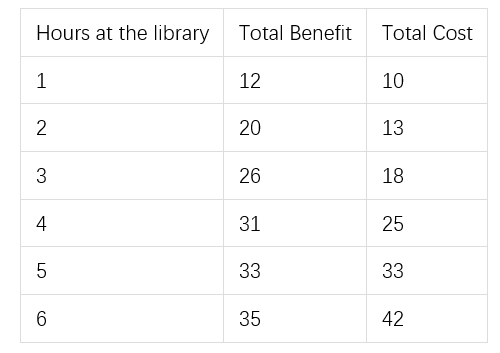
The table provided shows the total benefits and costs of studying at the library. If the student is rational, the optimal number of hours to spend at the library is
A. 2
B. 3
C. 4
D. 5
E. 6
Question 16
In relation to tacos, the cross-price elasticity of demand for Good X is negative. What would be the result if the price of tacos increases?
A. There will be a movement up the demand curve for Good X because it is a complement to tacos.
B. There will be a movement down the demand curve for Good X because it is a complement to tacos.
C. The demand for Good X will increase because it is a substitute for tacos.
D. The demand for Good X will decrease because it is a complement to tacos.
E. The demand for Good X will increase because tacos and Good X are normal goods.
Question 17
Which of the following is true for a perfectly competitive, decreasing-cost industry?
A. The price of inputs will decrease as the number of firms in the industry decreases.
B. The long-run market supply curve will be downward sloping.
C. Firms earn positive economic profit in the long run.
D. Firms do not have a shutdown condition.
E. There are no economies of scale.
Question 18
A monopsonistic labor market has a
A. single employer of labor
B. horizontal labor supply curve
C. labor force of identically skilled workers
D. backward bending labor supply curve
E. demand curve for labor that is perfectly elastic
Question 19
With capital held constant, when Zane employs one additional worker, the marginal product of labor decreases by 5 units. Which economic concept best characterizes Zane's production process?
A. Diminishing marginal returns
B. Increasing marginal returns
C. Constant returns to scale
D. Economies of scale
E. Diseconomies of scale
Question 20
Downtown Tech Company and Uptown Tech Company compete in the gaming console market. Downtown Tech Company is deciding whether to charge a high price or a low price for its product. Uptown Tech Company is deciding whether to invest in research and development or advertising. Each company's profit depends on the actions taken by the other firm, which are listed in the payoff matrix provided. The first entry in the matrix is Downtown Tech Company's profit, and the second is Uptown Tech Company's profit. Each firm independently and simultaneously selects an action. Each firm knows all of the information about the payoffs associated with the strategies each firm can choose.

The Nash equilibrium to this game, if one exists, is which of the following?
A. High Price, Research and Development
B. Low Price, Advertising
C. High Price, Advertising
D. Low Price, Research and Development
E. None of the strategy pairs represents a Nash equilibrium.
Question 21
In a command economy, the quantity of computers produced would be determined by
A. factory owners
B. the government
C. consumers and producers
D. international trade
E. the wealthy
Question 22
If a firm experiences economies of scale over the entire range of output, the long-run average cost curve will be
A. U-shaped
B. upward sloping
C. downward sloping
D. horizontal
E. below the marginal cost curve
Question 23
Which of the following is always true about a negative externality?
A. It can be corrected by the government subsidizing the good or activity that creates the externality.
B. It results in a market output that is smaller than the socially optimal output.
C. It results in a market output that is greater than the socially optimal output.
D. It results in a larger deadweight loss than a positive externality does.
E. It results in a smaller deadweight loss than a positive externality does.
Question 24
Where on a graph of a production possibilities curve would a point showing that an economy is using its resources efficiently be located?
A. On the production possibilities curve
B. Inside the production possibilities curve
C. Beyond the production possibilities curve
D. On the y-axis and below the production possibilities curve
E. On the x-axis and below the production possibilities curve
Question 25
If the imposition of a per-unit tax on a good reduces the total consumer surplus by more than the reduction of total producer surplus in a competitive market, then which of the following must be true?
A. The price sellers receive decreases by more than the amount of the tax.
B. The price buyers pay increases by more than the amount of the tax.
C. Demand is less elastic than supply.
D. Demand is more elastic than supply.
E. Demand and supply are both unit elastic.
Question 26
A 10 percent increase in Sandra's income causes Sandra's consumption of milk to decrease from 10 cartons to 6 cartons. Sandra's income elasticity of demand for milk is
A. greater than zero and therefore milk is a necessity
B. greater than zero and therefore milk is a normal good
C. less than zero and therefore milk is a normal good
D. less than zero and therefore milk is an inferior good
E. greater than one and therefore milk is a necessity
Question 27
Which of the following is NOT an effective way to manage the inefficiency resulting from a negative externality?
A. Government intervention in the form of obligatory controls
B. Per-unit taxes
C. Assignment of property rights
D. Lump-sum taxes
E. Private negotiations among affected parties
Question 28
A firm's short-run production function uses capital and labor as inputs. Assume the quantity of capital is fixed in the short run. The marginal product of labor will decrease as more labor is used in the short run because each unit of labor will have
A. zero units of capital to work with
B. fewer units of capital to work with
C. an increase in the capital-to-labor ratio
D. more units of capital to work with
E. an infinite number of units of capital to work with
Question 29
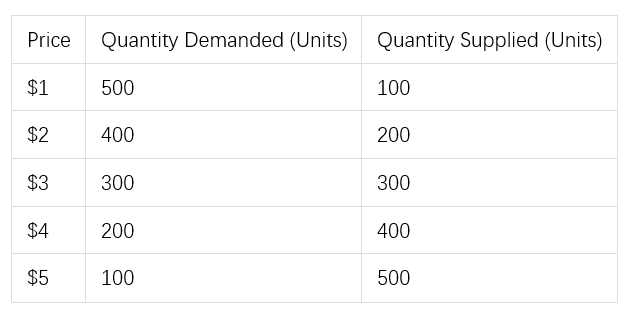
The table provided shows the market demand and supply schedules for wheat. Which of the following is true?
A. At a price of $1, there is excess supply of wheat and the price will decrease.
B. At a price of $2, there is excess demand for wheat and the price will decrease.
C. At a price of $3, there is excess demand for wheat and the price will increase.
D. At a price of $4, there is excess supply of wheat and the price will decrease.
E. At a price of $5, there is excess demand for wheat and the price will increase.
Question 30
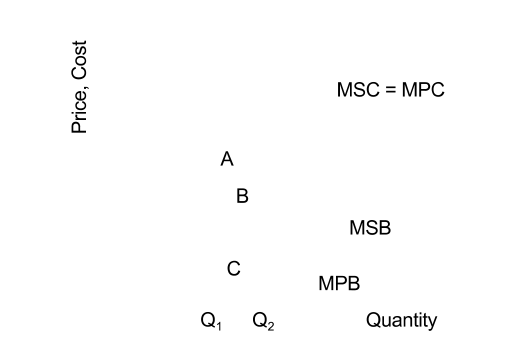
The diagram provided illustrates the marginal private benefit (MPB), marginal social benefit (MSB), marginal private cost (MPC), and marginal social cost (MSC) measured in dollars for a competitive market.
Assume that the goal of the government is to increase efficiency in the market. The cost of a government intervention that increases market output from Q
1 to Q
2 is $1.2 million. The intervention will definitely improve market efficiency if the area of
A. A is greater than $1.2 million
B. B is less than $1.2 million
C. C is less than $1.2 million
D. A+B is greater than or equal to $1.2 million
E. B+C is greater than or equal to $1.2 million
Question 31
Assume that Larry spends his entire allowance on the purchase of pretzels and ice-cream cones. The price of a bag of pretzels is $1, and the price of an ice-cream cone is $2. At his current consumption combination, the marginal utility of pretzels is 20 and of ice-cream cones is 60. To maximize his utility, Larry should
A. buy more of both goods
B. buy less of both goods
C. buy more pretzels and fewer ice-cream cones
D. buy fewer pretzels and more ice-cream cones
E. maintain his current consumption level
Question 32
As the quantity of a good increases, which of the following is true in the elastic region of a monopolist's demand curve?
A. Marginal revenue and total revenue are negative.
B. Marginal revenue is increasing, and total revenue is positive.
C. Marginal revenue is decreasing, and total revenue is negative.
D. Marginal revenue is positive, and total revenue is increasing.
E. Marginal revenue is negative, and average revenue is decreasing.
Question 33
Which of the following is true of the marginal revenue curve for a monopolistically competitive firm?
A. It is the same as the demand curve because there are many firms in the market.
B. It is the same as the demand curve because marginal revenue is always equal to price.
C. It is upward sloping because total revenue increases as the quantity sold increases.
D. It lies below the demand curve because the firm must lower its price for all units in order to increase sales.
E. It lies below the demand curve because marginal revenue increases when price decreases.
Question 34
Which of the following is true about price (P), marginal cost (MC), marginal revenue MR, and economic profit of a monopolistically competitive firm in long-run equilibrium?
A. P > MC; Marginal revenue is below demand; Economic profit is zero
B. P < MC; Marginal revenue is below demand; Economic profit is positive
C. P > MC; Marginal revenue is above demand; Economic profit is positive
D. P= MR = MC; Marginal revenue is equal to demand; Economic profit is zero
E. P= MR = MC; Marginal revenue is above demand; Economic profit is positive
Question 35
A monopoly is producing the allocatively efficient output if, for the last unit produced,
A. price equals minimum average total cost
B. price equals marginal cost
C. marginal cost equals marginal revenue
D. marginal cost equals average variable cost
E. marginal revenue equals average variable cost
Question 36
Which of the following is always true for a firm with monopsony power?
A. The marginal revenue product curve is upward-sloping.
B. The marginal revenue product curve lies above the input demand curve.
C. The marginal factor cost curve lies above the input supply curve.
D. The marginal factor cost curve lies above the input demand curve.
E. The input demand curve lies above the marginal factor cost curve.
Question 37
National defense is generally provided by the public sector for which of the following reasons?
A. The opportunity cost of privately providing national defense is too high.
B. The government always provides the socially optimal quantity.
C. National defense is a natural monopoly.
D. National defense is subject to negative externalities.
E. The benefits of national defense are mostly nonrival and nonexcludable.
Question 38
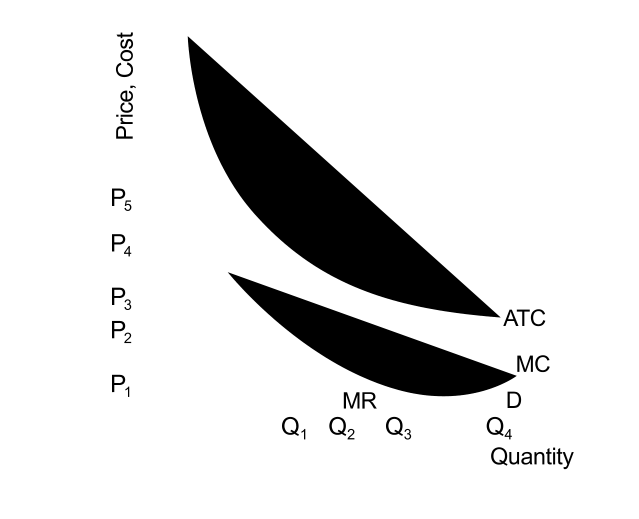
The graph provided shows the demand (
D), marginal revenue (
MR), marginal cost (
MC), and average total cost (
ATC) curves for a monopolist. If a regulatory agency requires that the monopolist set a price that earns the monopolist a normal profit, what price will the monopolist set?
A. P1
B. P2
C. P3
D. P4
E. P5
Question 39
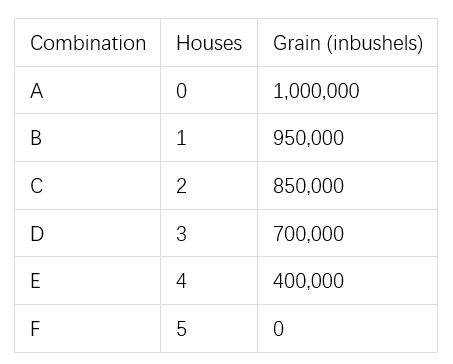
The table above shows six possible combinations of houses and grain that a country can produce in a year using all currently available resources and technology. The opportunity cost of changing production from combination B to combination C is
A. 1 house
B. 2 houses
C. 100,000 bushels of grain
D. 850,000 bushels of grain
E. 950,000 bushels of grain
Question 40
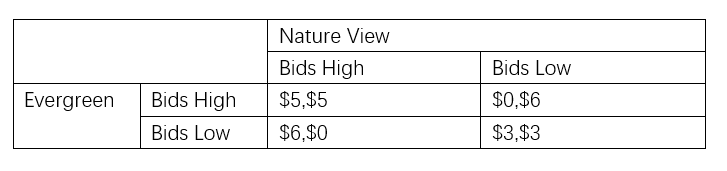
Evergreen and Nature View are bidding for a landscaping contract. The payoff matrix provided shows what each firm's total weekly profit will be for each combination of bids. The first entry in each cell shows the profits of Evergreen, and the second entry shows the profits of Nature View. Evergreen and Nature View act independently and simultaneously, and each firm knows all the information about the payoffs associated with the strategies. Which of the following describes their dominant strategies?
A. Evergreen does not have a dominant strategy. Nature View's dominant strategy is to bid high.
B. Evergreen's dominant strategy is to bid high. Nature View does not have a dominant strategy.
C. Evergreen's dominant strategy is to bid low. Nature View's dominant strategy is to bid high.
D. Evergreen's dominant strategy is to bid high. Nature View's dominant strategy is to bid high.
E. Evergreen's dominant strategy is to bid low. Nature View's dominant strategy is to bid low.
Question 41
In the short run, a firm in a perfectly competitive industry will definitely
A. shut down if total revenue is less than total variable cost
B. produce the market equilibrium output to maximize profit
C. earn zero economic profit
D. cover all of its fixed costs
E. charge a price lower than its competitors to increase its sales
Question 42
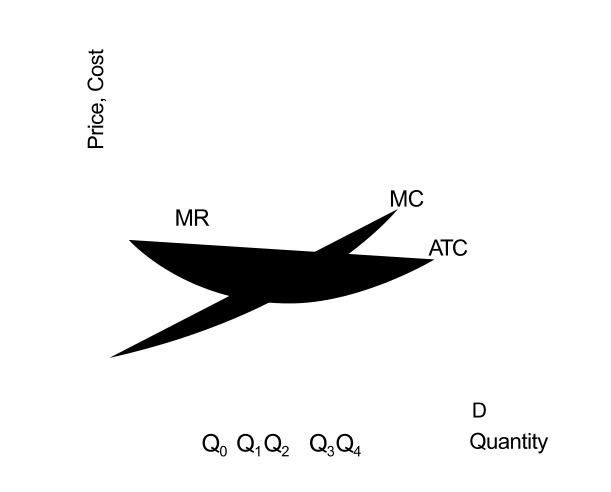
The graph above shows the demand (
D), marginal revenue (
MR), marginal cost (
MC), and average total cost (
ATC) curves for a monopoly. Based on the information in the graph provided, what is the profit-maximizing quantity for a monopolist that engages in perfect price discrimination?
A. Q0
B. Q1
C. Q2
D. Q3
E. Q4
Question 43
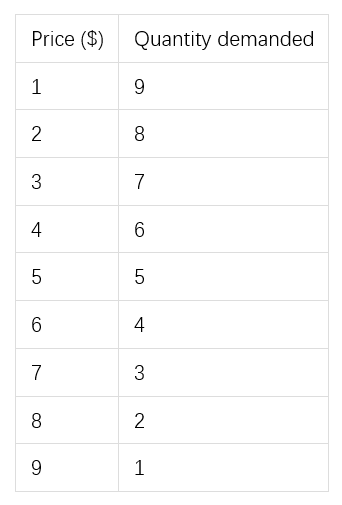
A profit-maximizing monopolist faces the market demand schedule provided and has a constant marginal cost of $5. If the monopolist engages in perfect price discrimination, its total revenue will equal which of the following?
A. $10
B. $15
C. $25
D. $35
E. $45
Question 44
Which of the following is NOT an example of physical capital?
A. A delivery truck
B. A warehouse
C. Office furniture
D. Machinery
E. Land
Question 45
If the absolute value of the price elasticity of demand for Good X is 0.5, then a 10 percent decrease in the price of Good X will result in which of the following?
A. A 5% decrease in the quantity demanded of Good X
B. A 5% increase in the quantity demanded of Good X
C. A 5% increase in revenues from the sale of Good X
D. A 10% decrease in revenues from the sale of Good X
E. A 10% increase in revenues from the sale of Good X
Question 46
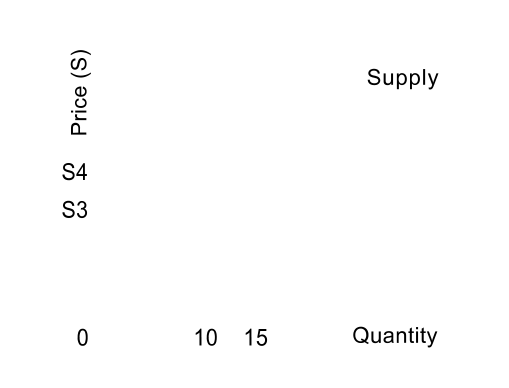
What is the price elasticity of supply between $3 and $4 in the graph above?
A. It is greater than 1, and the supply is relatively inelastic
B. It is greater than 1, and the supply is relatively elastic.
C. It is equal to 1, and the supply is unit elastic.
D. It is less than 1, and the supply is relatively elastic.
E. It is less than 1, and the supply is relatively inelastic.
Question 47
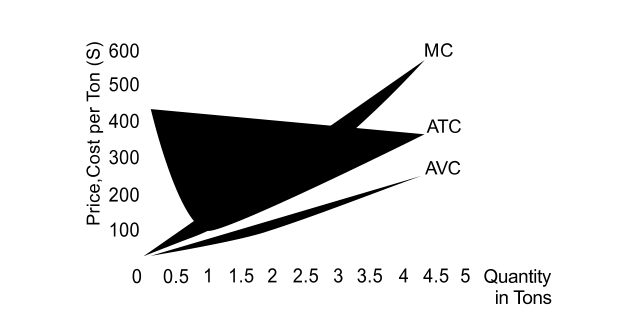
The graph above shows the marginal cost (
MC), average total cost (
ATC), and average variable cost (
AVC) curves for a firm. If the market price is 100 per ton, the firm will maximize profits or minimize losses by doing which of the following?
A. Producing 0 tons and shutting down in the short run
B. Producing 0 tons and exiting the market in the long run
C. Producing 1 ton and earning zero economic profit
D. Producing 1.5 tons and earning zero economic profit
E. Producing 2 tons and earning zero economic profit
Question 48
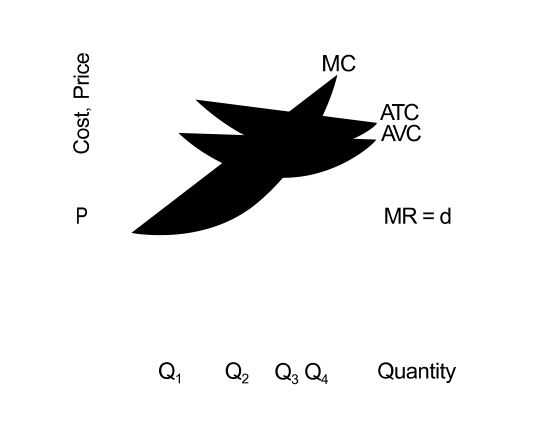
The graph provided shows the demand (
d), marginal revenue
(MR), marginal cost (
MC), and average total cost (
ATC) curves for a perfectly competitive firm. In order to maximize short-run profits, this perfectly competitive firm should produce at which of the following quantities of production?
A. Zero
B. Q1
C. Q2
D. Q3
E. Q4
Question 49
A perfectly competitive firm finds that for the last shirt that it produces and sells, the marginal revenue is $20 and the marginal cost is $22. The firm should
A. charge $22 to maximize profit
B. produce more shirts to increase profit
C. produce fewer shirts to increase profit
D. hire more workers to increase production
E. shut down if the average variable cost is less than $20
Question 50
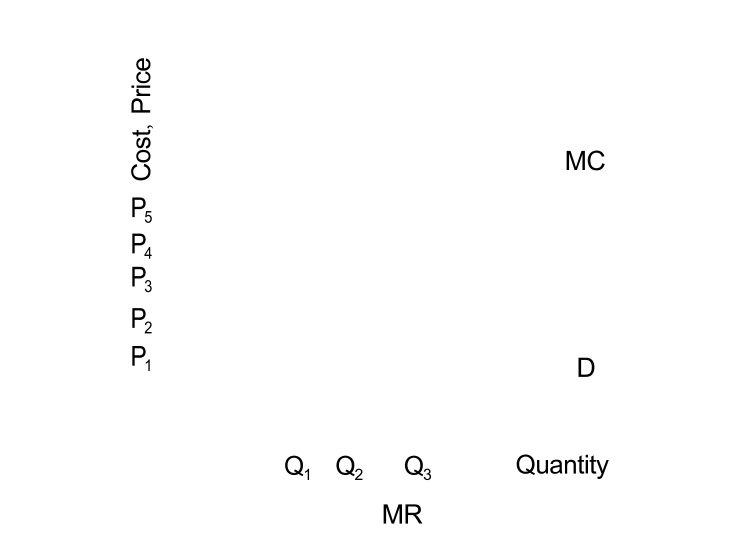
Given the information in the graph provided, what is the monopolist's profit-maximizing quantity and price combination?
A. Q1, P1
B. Q3, P3
C. Q2, P2
D. Q2, P4
E. Q1, P5
Question 51
Public goods are under produced in a competitive market because the free-rider problem causes
A. supply to be perfectly elastic
B. a price ceiling to become binding
C. consumers to not reveal their true demand
D. positive externalities to increase
E. demand to be perfectly inelastic
Question 52
Which of the following will result in the short run if the government imposes a binding quota?
A. A decrease in the price paid by consumers
B. A rightward shift in the supply curve
C. A leftward shift in the demand curve
D. An increase in consumer surplus
E. A deadweight loss
Question 53
People must make choices among available options because people
A. are irrational
B. have limited wants
C. have limited resources
D. are not provided goods by the government
E. do not receive positive benefits from consuming certain goods
Question 54
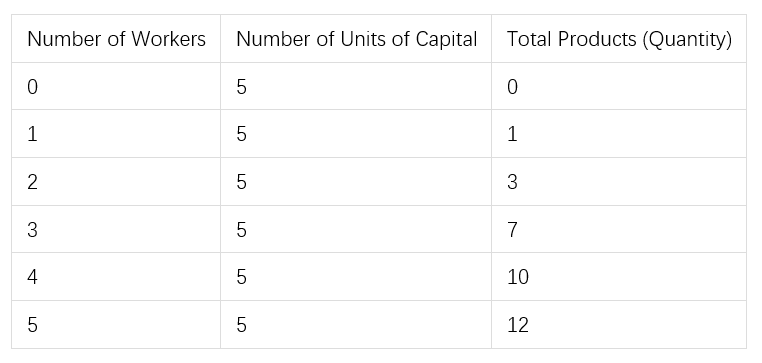
Suppose labor and capital can be hired in a competitive market. The wage is $15 per worker and the rental rate of capital is $10 per unit. Based on the table, what are the average variable cost (
AVC) and average total cost (
ATC) of producing 10 units of output?
A. AVC is $5 and ATC is $12
B. AVC is $6 and ATC is $11
C. AVC is $15 and ATC is $25
D. AVC is $60 and ATC is $110
E. AVC is $105 and ATC is $175
Question 55
A perfectly competitive market produces the socially efficient level of output when the marginal Social benefit of the last unit of output produced is
A. equal to the marginal social cost
B. less than the marginal social cost
C. zero
D. greater than the total producer surplus
E. equal to the total producer surplus
Question 56
According to the law of demand, which of the following occurs when the price of a good increases?
A. The demand for the good decreases.
B. The quantity demanded of a substitute good decreases.
C. The quantity demanded of a complementary good increases.
D. The quantity demanded of the good increases.
E. The quantity demanded of the good decreases.
Question 57
A short-run production function shows the relationship between a firm's inputs and the output it produces when the firm
A. does not vary any of its inputs
B. has at least one fixed input
C. varies all of its inputs
D. has constant marginal cost
E. has no fixed costs
Question 58
A market supply curve is more elastic in the long run than in the short run because
A. producers' marginal costs are increasing
B. the quantity demanded increases at a steady rate
C. there are no fixed inputs in the long run
D. of constant returns to scale in production
E. of diseconomies of scale in production
Question 59
A Lorenz curve can be used to
A. show the historical pattern of production
B. forecast production costs
C. show inequality in the income distribution
D. show economies and diseconomies of scale
E. show the shape of the long-run supply curve
Question 60
Josephine is buying candy and gum. If she is maximizing her utility for the combination of candy and gum she buys, which of the following must hold?
A. Marginal utility of candy ÷ price of candy = marginal utility of gum ÷ of price of gum
B. Total utility of candy ÷ price of candy = total utility of gum ÷ price of gum
C. Marginal utility of candy ÷ total utility of candy = marginal utility of gum ÷ total utility of gum
D. Marginal utility of candy × price of candy = marginal utility of gum × price of gum
E. Total utility of candy × price of candy = total utility of gum × price of gum
Section II - Free Response (3 questions)
Question 1
The government of an island nation grants Sky Runner Airlines exclusive monopoly rights to serve the island. SkyRunner is eaming positive economic profits.
Part A
Draw a correctly labeled graph for Sky Runner, and show each of the following.
(i) The profit-maximizing quantity of tickets, labeled QM
(i) The profit-maximizing price of a ticket, labeled PM
(iii) The area representing profits, shaded completely
Now the island's tourist bureau asks the government to consider the following two proposals.
● Proposal I: Set a price ceiling on tickets that eliminates all deadweight loss.
● Proposal II: Eliminate SkyRunner's monopoly rights, which will remove all barriers to entry.
Part B
Suppose the government adopts proposal I. On your graph in part (a), indicate the quantity of tickets sold in the short run, labeled QC.
Part C
Suppose instead the government adopts proposal II. How will each of the following be affected in the long run compared to the market conditions in part (a) ?
(i) The quantity of tickets sold by Sky Runner. Explain.
(i) The price elasticity of demand for SkyRunner's airline service. Explain.
(iii) SkyRunner's profits
(iv) The deadweight loss in the market. Explain.
Question 3
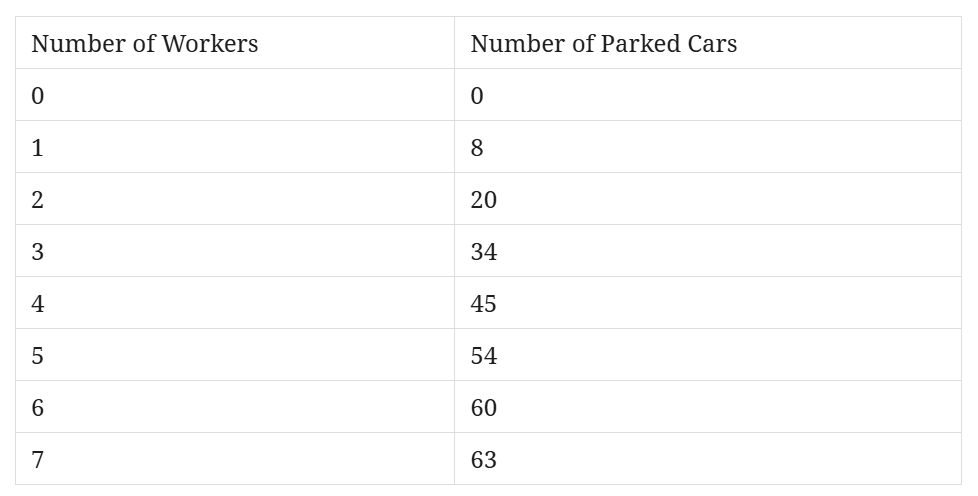
Assume that Schmitt Inc. provides car parking services in a perfectly competitive output market and hires labor in a perfectly competitive input market. The market price per car parked is $10, the daily market wage per worker is $100, and fixed costs are $50 per day. The table above shows the number of workers required to park different quantities of cars per day.
Part A
Calculate the marginal revenue product of the second worker. Show your work.
Part B
How many workers will Schmitt Inc. hire to maximize profit? Relative to this number of hired workers, explain why Schmitt Inc. will not hire one additional worker. Your answer must use marginal analysis and numbers from the table.
Part C
Calculate the daily profit for Schmitt Inc. at the profit-maximizing quantity identified in part (b). Show your work.
Part D
Suppose new legislation requires each worker in the parking industry to purchase an individual insurance policy at the worker's expense in order to legally park cars.
(i) Will the market wage paid by a typical firm in this industry increase, decrease, or stay the same in the long run?
(ii) For a typical firm in the industry, will the number of workers hired in the short run increase, decrease, or stay the same? Explain.
Question 7
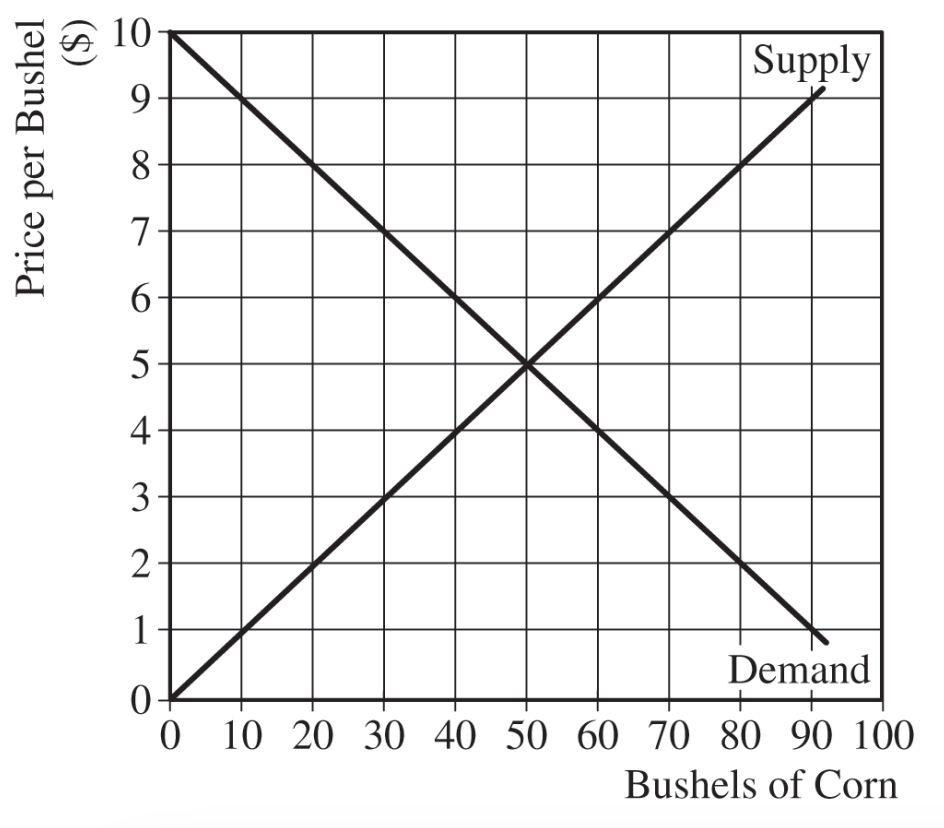
The diagram above shows the market for corn in the country of Microland. Corn is produced and sold in a constant-cost, perfectly competitive market.
Part A
Calculate the total revenue earned by corn farmers at the market equilibrium price. Show your work.
Part B
In an attempt to assist corn farmers in Microland, the government sets a $7 price floor on corn.
(i) How many bushels of corn will be exchanged at the price floor?
(i) Calculate the deadweight loss associated with the price floor. Show your work.
(iii) Assume the government agrees to buy the unsold quantity at $7. Calculate the producer surplus. Show your work.
(iv) Assume the price floor and the government buying program remain in effect. In addition, assume the demand for corn does not change. In the long run, will the quantity of com purchased by the government increase, decrease, or remain the same? Explain.
Multiple-choice answer key
Answers reproduced from the website. No FRQ scoring guide was provided in the question pages.
1: C | 2: C | 3: C | 4: E | 5: C
6: C | 7: B | 8: C | 9: D | 10: B
11: C | 12: D | 13: D | 14: A | 15: B
16: D | 17: B | 18: A | 19: A | 20: E
21: B | 22: C | 23: C | 24: A | 25: C
26: D | 27: D | 28: B | 29: D | 30: A
31: D | 32: D | 33: D | 34: A | 35: B
36: C | 37: E | 38: C | 39: C | 40: E
41: A | 42: D | 43: D | 44: E | 45: B
46: B | 47: C | 48: A | 49: C | 50: E
51: C | 52: E | 53: C | 54: B | 55: A
56: E | 57: B | 58: C | 59: C | 60: A