AP Micro 2018
Shanmao online question bank | Archived 2026-10-25
Section I - Multiple Choice (60 questions)
Question 1
The study of economics exists because people are confronted with the basic problem of
A. elasticity
B. negative externality
C. scarcity
D. overabundance
E. monopoly
Question 2
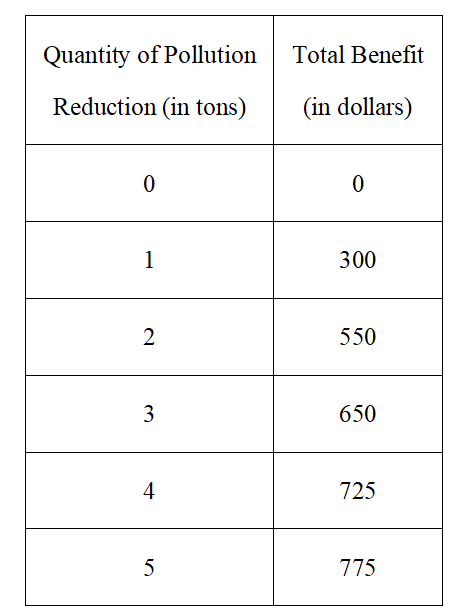 The table above shows the total benefit associated with reducing different levels of pollution on a small island. The cost of eliminating one ton of pollution is $150. Which of the following is the optimal quantity of pollution to eliminate?
A. 5 tons
B. 4 tons
C. 3 tons
D. 2 tons
E. 1 tons
Question 3
If a hurricane reduced the crab population, the price of crabs and quantity sold would change in which of the following ways?
Price Quantity
A. Increase Increase
B. Increase Decrease
C. Decrease Increase
D. Decrease Decrease
E. No change Decrease
Question 4
To determine whether two goods are complements, one would calculate the
A. price elasticity of demand
B. price elasticity of supply
C. income elasticity of demand
D. cross-price elasticity of demand
E. input-price elasticity of supply
Question 5
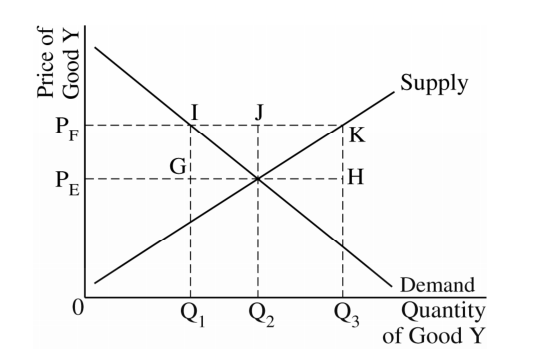 The diagram above depicts the demand and supply curves for good Y. The perfectly competitive market is initially in equilibrium, but the government decides to institute a price floor program by setting the price of good Y at PF and agrees to purchase all unsold units of good Y from the producers. The cost of this program to the government is represented by which of the following areas?
A. 0PFJQ2 0PFJQ3
B. 0PFJQ3
C. GIKH
D. Q1IJQ2
E. Q1IJQ2
Question 6
For a normal good, the income effect of a price change refers to the change in the consumption of the good that occurs because of the change in
A. consumers’ purchasing power
B. the demand for a substitute good
C. the supply of the good
D. relative price
E. marginal utility
Question 7
Questions 7-8 are based on the table below, which shows a firm’s average variable cost and average total cost.
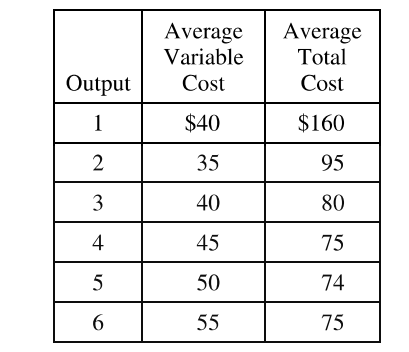
The average fixed cost of producing four units of output is equal to
A. $120
B. $95
C. $75
D. $50
E. $30
Question 8
In the short run, the lowest price at which the firm will continue to produce is
A. $80
B. $74
C. $50
D. $35
E. $30
Question 9
Bruce is a talented writer and graphic artist who enjoys both types of work equally. Instead of earning $45,000 as a writer, Bruce now earns $25,000 in accounting profits as a graphic artist using the same computer equipment he would have used as a writer. What is Bruce’s economic profit from choosing to work as a graphic artist?
A. -$45,000
B. -$20,000
C. $20,000
D. $45,000
E. $70,000
Question 10
Game theory is most useful in describing outcomes in markets where
A. firms are price takers
B. there is only one producer
C. there are many small producers
D. products are identical for all firms
E. there are interdependent firms
Question 11
Which of the following is a characteristic of firms in a perfectly competitive industry?
A. Engaging in collusive behavior
B. Facing significant barriers to entry
C. Setting the market price
D. Producing identical products
E. Earning positive long-run economic profit
Question 12
A perfectly competitive firm’s short-run supply curve is the portion of the marginal cost curve that is
A. above the average total cost curve
B. above the average variable cost curve
C. above the minimum average fixed cost curve
D. above the demand curve
E. between the average fixed cost curve and the average variable cost curve
Question 13
Which of the following is a necessary condition for price discrimination?
A. Resale of the product or service is possible.
B. Buyers have identical elasticities of demand.
C. The seller can separate consumers according to their elasticities of demand.
D. The seller is a perfectly competitive firm.
E. Buyers are aware of prices charged to other buyers.
Question 14
Which of the following would cause the wage for computer programmers to increase?
A. A decrease in the amount of physical capital per computer programmer
B. An improvement in the education of computer programmers
C. An increase in the social prestige associated with being a computer programmer
D. A decrease in the value that computer programmers place on leisure
E. A minimum wage set below the equilibrium wage in the market for computer programmers
Question 15
The socially optimal quantity of a public good is provided when
A. marginal private cost equals marginal private benefit
B. marginal social cost equals marginal social benefit
C. total private cost equals total social benefit
D. total social cost equals total social benefit
E. marginal social benefit minus marginal social cost is at a maximum
Question 16
Command economies differ from capitalist economies mainly because of which of the following?
A. Command economies have higher prices for oil.
B. Capitalist economies have higher prices for oil.
C. Command economies have higher degree of government ownership of resources.
D. Capitalist economies have higher degree of government ownership of resources.
E. Command economies rely on prices to allocate resources.
Question 17
In the rental housing market, what would be the effect of a rent control that was set at the market equilibrium rental price?
A. It would increase the number of housing units available, creating a surplus.
B. It would decrease the number of housing units available, creating a shortage.
C. It would have no impact on the number of housing units available.
D. It would increase the consumer surplus and decrease the producer surplus.
E. It would decrease the consumer surplus and increase the producer surplus.
Question 18
If the demand for product X is perfectly elastic and the supply of product X decreases, which of the following will occur in the market for X?
A. Total revenue will increase.
B. Total revenue will decrease.
C. Total revenue will remain the same.
D. Quantity demanded will exceed quantity supplied.
E. Quantity supplied will exceed quantity demanded.
Question 19
All of the following cause a rightward shift in the demand schedule for a normal good EXCEPT
A. a decrease in the price of the good
B. a decrease in the price of a complementary good
C. an increase in the price of a substitute good
D. an increase in consumers’ income
E. an increase in consumers’ preference for the good
Question 20
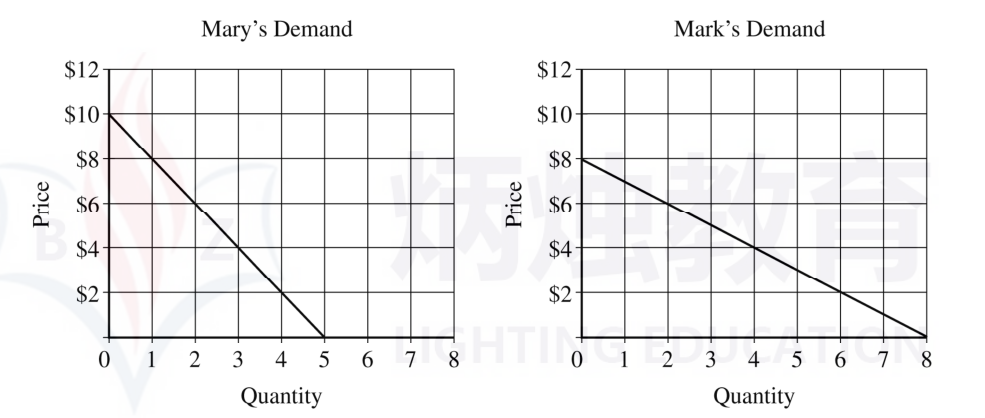
The graphs above show Mary’s demand for hamburgers and Mark’s demand for hamburgers. Suppose Mary and Mark are the only two consumers in the market. Which of the following is a point on the market demand curve for hamburgers?Price
Quantity
A. $2
12
B. $4
7
C. $6
6
D. $8
4
E. $10 8
Question 21
A firm is currently employing a cost-minimizing combination of labor and capital for a given level of output. The firm is employing 20 workers, and the marginal product of the last worker is 40 units of output. The firm is employing 100 units of capital, and the marginal product of the last unit of capital is 10 units of output. If the wage rate is $20 per hour, what is the price of capital?
A. $2.5 per hour
B. $5 per hour
C. $10 per hour
D. $100 per hour
E. $200 per hour
Question 22
If a firm’s production function exhibits diminishing marginal product of the variable input in the short run, which of the following about the firm’s short-run marginal cost (MC) curve must be true?
A. As output increases, the MC curve slopes upward.
B. As output increases, the MC curve slopes downward and becomes flatter.
C. As output increases, the MC curve slopes downward and becomes steeper.
D. The MC curve is horizontal.
E. The MC curve is vertical.
Question 23
Catering, Inc., which provides catering services in a perfectly competitive market, was maximizing profits at the market price of $22 per meal. The market price has recently increased to $28 per meal. Which of the following short-run adjustments will increase profits for Catering, Inc.?
A. Increasing output until the marginal cost equals the new price
B. Increasing output until the average total cost equals the new price
C. Decreasing output because of the increase in market price
D. Increasing the wage rate paid to its workers
E. Increasing advertising to increase demand for the meals
Question 24
Monopolistically competitive product markets are inefficient because
A. price equals the marginal value to the buyer of the last item produced
B. price is greater than marginal cost
C. excessive competition prevents other firms from entering the market
D. homogeneous goods are usually overpriced
E. short-run economic profit-making opportunities exist
Question 25
North Springs and South Springs are two firms that serve the local market for bottled water. Each firm must choose to either maintain or increase its current output. The first entry in each cell in the payoff matrix below shows the profits for North Springs, and the second entry in each cell shows the profits for South Springs.
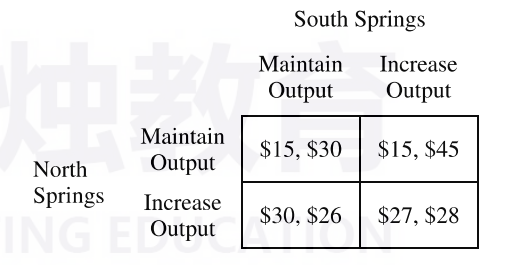
If the two firms do not cooperate, which of the following represents the payoff North Springs and South Springs receive in the dominant-strategy equilibrium and the Nash equilibrium?Dominant Strategy
Nash Equilibrium
A. None
($27, $28)
B. ($27, $28)
($15, $45)
C. ($30, $26)
($15, $45)
D. ($27, $28)
($27, $28)
E. ($30, $26)
($27, $28)
Question 26
A monopolist’s demand curve is necessarily
A. the same as the market demand curve
B. the same as its marginal revenue curve
C. upward sloping
D. perfectly elastic
E. perfectly inelastic
Question 27
A profit-maximizing, perfectly competitive firm is currently in long-run equilibrium. It is earning $15,000 of total revenue from a sale of 1,000 units. Its total fixed cost of production is $2,500. Which of the following can correctly be inferred from the information provided?
A. Its marginal cost is $12.50, and its average total cost is $12.50.
B. Its marginal cost is $12.50, and its average variable cost is $12.50.
C. Its marginal cost is $15.00, and its average total cost is $12.50.
D. Its marginal cost is $15.00, and its average variable cost is $12.50.
E. Its marginal cost is $15.00, and its average fixed cost is $12.50.
Question 28
When the demand for new homes decreases, the demand for construction workers who build homes decreases. This relationship illustrates the concept of
A. derived demand
B. diminishing marginal productivity of labor
C. substitution in production
D. supply shock
E. property rights
Question 29
Which of the following is likely to shift an industry’s labor supply curve to the left?
A. A decrease in immigration restrictions
B. A decrease in the cost of child care
C. An increase in the number of remote-working jobs
D. An increase in preference for leisure
E. An increase in wages
Question 30
Questions 30-31 refer to the following diagram, which shows the marginal social cost (MSC), the marginal private cost (MPC), and the marginal social benefit (MSB) associated with the production of a good in a market.
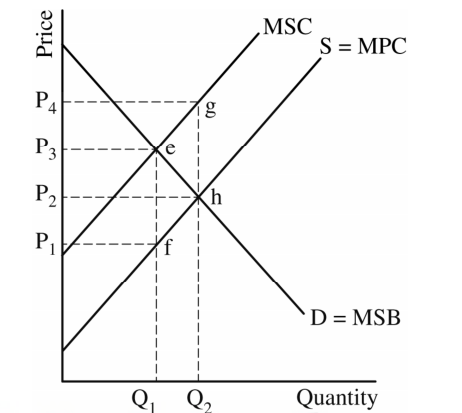
Which of the following describes the type of externality generated by the unregulated private market and the resulting deadweight loss?Type of Externality
Deadweight Loss
A. Positive
egh
B. Positive
ehf
C. Negative ehf
D. Negative egh
E. Negative P4ghP2
Question 31
The government can attempt to correct the externality by setting a
A. per-unit tax equal to (P4 - P1)
B. per-unit tax equal to (P4 - P2)
C. per-unit subsidy equal to (P4 - P2)
D. per-unit subsidy equal to (P3 - P2)
E. price ceiling at (P2)
Question 32
Both Amy and Brad produce and consume apple pie and ice cream. In one hour, Brad makes five apple pies or ten gallons of ice cream while Amy makes fifteen apple pies or fifteen gallons of ice cream. Based on the above information, one can correctly conclude that
A. Brad has an absolute advantage in making ice cream and will sell ice cream to Amy
B. Brad has a comparative advantage in making ice cream and will sell ice cream to Amy
C. Brad does not have a comparative advantage in making either good and will not trade with Amy
D. Brad has an absolute advantage in making apple pies but a comparative advantage in making ice cream
E. Brad’s opportunity cost of making ice cream is higher than Amy’s
Question 33
If the government imposes a per-unit tax on personal computers, consumer surplus in the personal computer market will
A. decrease, because the price paid by consumers for personal computers will have increased
B. decrease, because there will be more personal computers on the market
C. increase, because personal computer manufacturers will pass the tax on to consumers
D. increase, because consumers will buy more imported personal computers
E. not change because the demand is unit elastic
Question 34
Assume that the supply of corn is relatively price inelastic, while the demand for corn is relatively price elastic. If the government imposes a per-unit excise tax on the production of corn, the incidence of the tax will fall
A. entirely on buyers
B. more on buyers than on sellers
C. entirely on sellers
D. more on sellers than on buyers
E. equally on both buyers and sellers
Question 35
Assume the following utility schedule for Aaliyah’s ice cream consumption. If she consumes 6 units, what is the value of her total utility from consuming ice cream?
Quantity Consumed
Marginal Utility
1
8
2
6
3
4
4
2
5
0
6
-2
A. 22
B. 20
C. 18
D. 0
E. -2
Question 36
Economies of scale can be illustrated by
A. an increasing short-run marginal cost curve as a firm produces more output
B. a decreasing short-run average total cost curve as a firm produces more output
C. a downward-sloping long-run supply curve for an industry
D. a decreasing long-run average total cost curve as a firm produces more output
E. an increasing long-run average total cost curve as a firm produces more output
Question 37
In a monopsonistic labor market, a firm will continue to hire workers until the marginal revenue product of labor
A. equals marginal factor (resource) cost, resulting in more workers being hired at a lower wage compared with a perfectly competitive labor market
B. equals marginal factor (resource) cost, resulting in fewer workers being hired at a lower wage compared with a perfectly competitive labor market
C. equals marginal factor (resource) cost, resulting in fewer workers being hired at a higher wage compared with a perfectly competitive labor market
D. is less than marginal factor (resource) cost, resulting in more workers being hired at a lower wage compared with a perfectly competitive labor market
E. is less than marginal factor (resource) cost, resulting in fewer workers being hired at a lower wage compared with a perfectly competitive labor market
Question 38
Assume that a monopolistically competitive firm is currently maximizing profit with an output of 100 units and a price of $50. Which of the following is true?
A. Total revenue is maximized when the firm produces 100 units of output.
B. Marginal revenue equals $50 when the firm produces 100 units of output.
C. Marginal cost is greater than marginal revenue when the firm produces 150 units of output.
D. Marginal cost is minimized when the firm produces 100 units of output.
E. Average total cost is minimized when the firm produces 100 units of output.
Question 39
There are four firms in an oligopolistic industry. The four firms agree to collude and act like a monopoly. If one of the firms violates the agreement and charges a lower price or sells a larger quantity than what was agreed to, what will happen in the short run?
A. The firm that cheats will earn higher profits, and industry profits will be lower.
B. The firm that cheats will earn higher profits, and industry profits will be higher.
C. The firm that cheats will earn lower profits, and industry profits will be lower.
D. The firm that cheats will earn lower profits, and industry profits will be higher.
E. The firms that do not cheat will earn higher profits.
Question 40
Which of the following can give a firm market power?
A. Having access to common information
B. Producing a standardized or homogeneous product
C. Lacking barriers to entry or exit
D. Having a large number of competitors in the market
E. Having economies of scale in production over the range of market output
Question 41
In monopolistic competition, a goal of advertising is to
A. reduce a firm’s short-run average total cost
B. minimize a firm’s long-run average total cost
C. make a firm’s demand curve more elastic
D. make a firm’s demand curve less elastic
E. shift a firm’s demand curve to the left
Question 42
Questions 42-43 are based on the following output and total revenue for a monopolist in the product market.
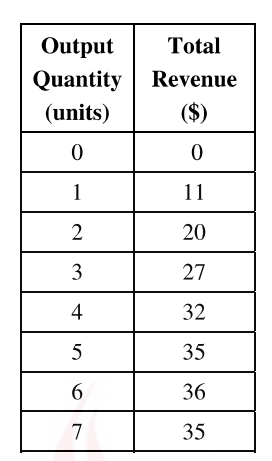 The marginal product of labor is constant at 1 unit for every additional unit of labor. The monopolist hires labor in a perfectly competitive market at the wage rate of $5 per hour.
What is the marginal revenue product of labor when the firm produces the third unit of output?
A. $3
B. $7
C. $9
D. $20
E. $27
Question 43
How many units of labor should the firm employ to maximize profits?
A. 1
B. 2
C. 4
D. 5
E. 6
Question 44
In a perfectly competitive market for a good with a downward sloping demand curve and an upward sloping supply curve, the marginal social benefit is greater than the marginal social cost at the market equilibrium quantity. The government imposition of a new per-unit tax on the production of the good would
A. have no effect on the price of the good
B. increase consumer surplus
C. increase the deadweight loss
D. increase producer surplus
E. increase the quantity sold of the good
Question 45
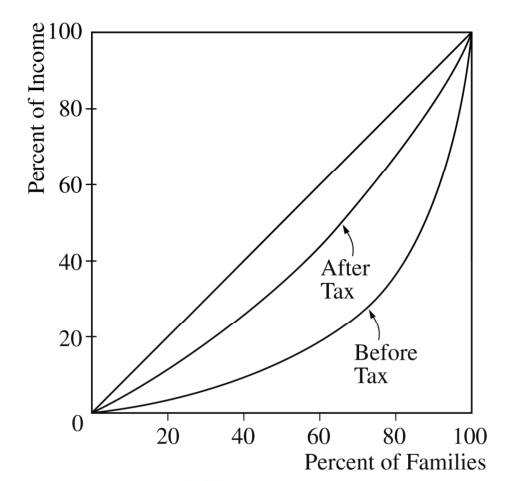
The Lorenz curves in the graph above show the effects of a tax system on income inequality. Which of the following statements must be true?
A. Before the tax, 20% of families lived below the poverty level, and after the tax, none did.
B. The tax redistributed income only from the top 20% of families to the lowest 20%.
C. The tax system is proportional.
D. The tax system is regressive.
E. The tax system is progressive.
Question 46
Movement along a production possibilities curve shows which of the following?
A. The trade-offs society faces
B. The total amount of available resources
C. The combination of inputs required for a given output
D. The relationship between the price of an input and the quantity demanded
E. The decrease in efficiency
Question 47
Assume that the market for beef is perfectly competitive and in equilibrium. Which of the following would most likely result in an increase in both the equilibrium price and the equilibrium quantity of beef?
A. An increase in the supply of chicken, a substitute good
B. A decrease in consumers’ income, assuming that beef is a normal good
C. An increase in the supply of potatoes, a complementary good
D. An increase in the price of corn, an input in the production of beef
E. An announcement by the medical community that consumption of beef increases the risk of heart disease
Question 48
Assume that more corn is used to produce ethanol. Simultaneously, more effective control of pests and weeds occurs in farming. Which of the following will definitely occur in the corn market?
A. The price of corn will increase.
B. The quantity of corn will decrease.
C. The price of corn will decrease.
D. The quantity of corn will increase.
E. The supply of corn will decrease.
Question 49
The absolute value of the price elasticity of demand for a good increases when
A. the good has fewer substitutes
B. the good becomes a necessity
C. consumers spend greater portion of their budget on the good
D. the price of an input used to produce the good increases
E. the good must be purchased immediately
Question 50
Mickey has a $20 gift card that she is planning to use to download 10 songs and 5 games. The download price for each song is $1 and the download price for each game is $2. Her marginal utility from the tenth song is 30, and her marginal utility from the fifth game is 70. Based on this information, which of the following statements is true?
A. Mickey’s plan will maximize her utility.
B. Mickey can increase utility by buying more songs and fewer games.
C. Mickey can increase utility by buying more games and fewer songs.
D. Since games are twice as expensive as songs, Mickey should buy twice as many songs.
E. Since games are twice as expensive as songs, Mickey should buy twice as many games.
Question 51
Max Company produces electronic gadgets using labor and capital. If Max increases labor and decreases capital to produce the same quantity of gadgets, what will happen to the marginal product (MP) of labor and the MP of capital?
MP of Labor
MP of Capital
A. Decrease
Increase
B. Decrease
No change
C. Increase
Increase
D. Increase
Decrease
E. No change
Increase
Question 52
The table below shows a competitive firm’s total variable cost (TVC) and total fixed cost (TFC) at various units of output.
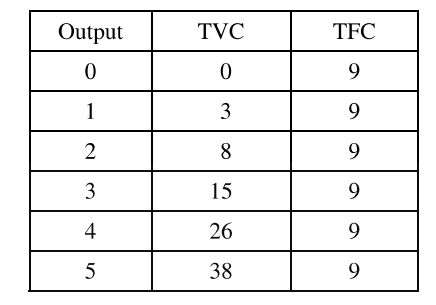
When output is 3 units, which of the following is correct?
Average
Variable
Marginal
Cost
Cost
A. 5
6
B. 5
7
C. 6
5
D. 7
7
E. 7
6
Question 53
Questions 53-54 refer to the graph of a profit-maximizing firm below.
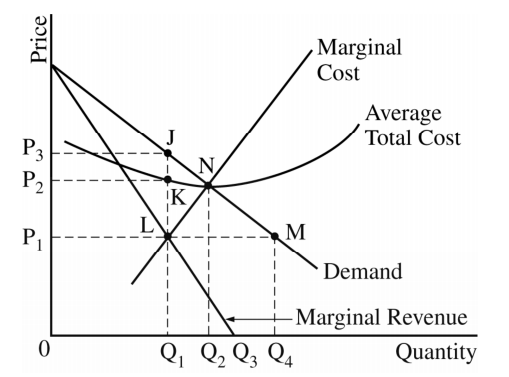
The firm’s total revenue is equal to
A. area P1P2KL
B. area P1P3JL
C. area 0P3JQ1
D. area 0P2KQ1
E. area JLM
Question 54
The firm’s economic profit is equal to
A. area 0P3JQ1
B. area 0P2KQ1
C. area P2P3JK
D. area P1P3JL
E. zero
Question 55
Which of the following is true of a monopolistically competitive firm in long-run equilibrium?
A. It produces where price equals marginal cost, and it earns zero economic profits.
B. It produces where marginal revenue exceeds marginal cost, and it earns positive economic profits.
C. It produces where marginal cost equals marginal revenue, and the price is equal to average total cost.
D. It produces at the minimum average total cost, and it utilizes all excess capacity.
E. It produces more than the allocatively efficient quantity, and the price is greater than marginal cost.
Question 56
Assume that barber shops operate in perfectly competitive product and factor markets. Which of the following will happen to working barbers if the price of haircuts decreases?
A. The marginal product of the last barber hired will not change.
B. The marginal product of the last barber hired will decrease.
C. The marginal revenue product curve will shift to the right.
D. The marginal revenue product curve will shift to the left.
E. There will be a movement upward along the marginal revenue curve.
Question 57
In a market with two firms, a firm that has a dominant strategy will do which of the following?
A. Maintain that strategy independent of the strategies chosen by its competitor.
B. Adjust its strategies based on the strategies chosen by its competitor.
C. Make the first move, and wait to see whether its competitor responds to the move.
D. Keep its competitor guessing about its next move.
E. Collude with its competitor to reduce uncertainty.
Question 58
Antitrust policies are put in place to limit which of the following?
A. Income inequality
B. Monopoly power
C. Double taxation of corporations
D. Price ceilings
E. The provision of public goods
Question 59
If the government regulates a natural monopolist to produce the allocatively efficient level of output, it will require the monopolist to set a price that is
A. equal to its marginal cost and grant a subsidy to cover the loss
B. equal to its average total cost and levy a tax on the excess profit
C. greater than its marginal cost and levy a tax on the excess profit
D. greater than its marginal cost but that minimizes the deadweight loss
E. greater than its average total cost but that minimizes the deadweight loss
Question 60
One major difference between public goods and private goods is that
A. public goods exclude nonpaying consumers, while private goods are available to all
B. public goods are inferior goods, while private goods are normal goods
C. public goods generate negative externalities, while private goods generate positive externalities
D. it is difficult to charge customers directly for the provision of public goods
E. it is impossible for private firms to produce public goods
Section II - Free Response (3 questions)
Question 1
Assume that pencils are manufactured in a perfectly competitive market that is in long-run equilibrium.
Part A
Draw correctly labeled side-by-side graphs for the pencil market and for a representative firm and show each of the following.
(i) The market price and quantity, labeled PM and QM, respectively
(ii) The firm’s profit-maximizing price and quantity, labeled PF and QF, respectively
Part B
What is the relationship between PM and PF? Explain.
Part C
Rent on the factory building is an important fixed cost in the production of pencils, and the industry experiences significant increases in rent.
(i) What will happen to the firm’s profit-maximizing quantity in the short run? Explain.
(ii) On your graph in part (a), show the impact of the rent increase and completely shade the area representing the firm’s profit or loss in the short run.
Part D
As a result of the rent increase, what will happen to each of the following in the long run?
(i) The number of firms in the market. Explain.
(ii) The market equilibrium quantity relative to QM and the market equilibrium price relative to PM. Explain.
Question 5
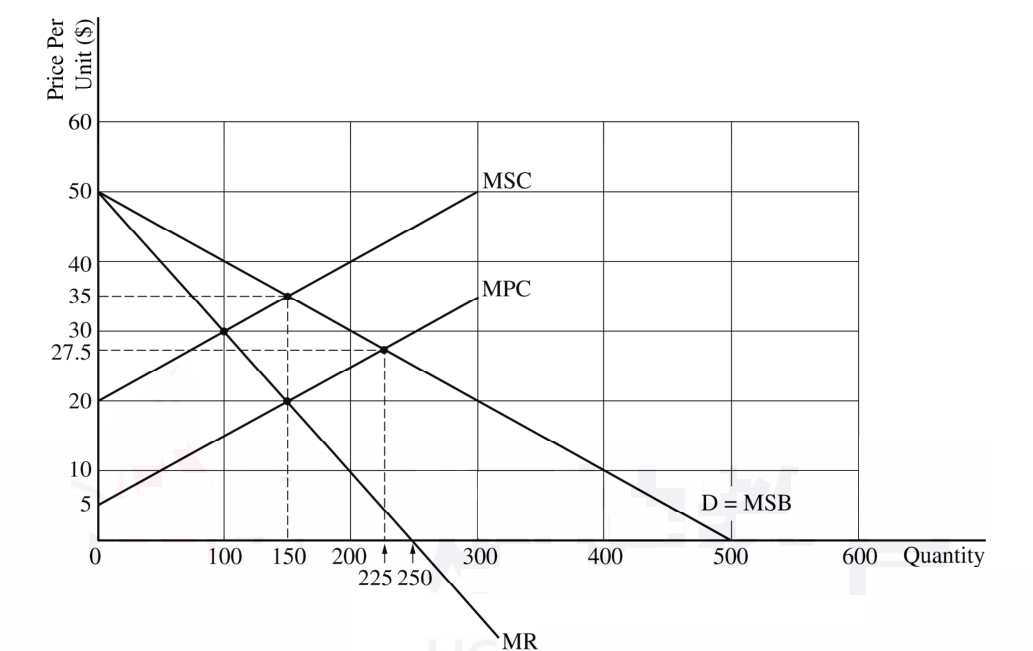
The graph below depicts the market conditions Zhao, Inc., faces in the zizzles market, where D = demand, MSB = marginal social benefit, MR = marginal revenue, MSC = marginal social cost, and MPC = marginal private cost.
Part A
What two potential sources of market failure exist in the market for Zhao’s zizzles? Explain each potential source of market failure using the information in the graph.
Part B
Using numerical values from the graph, identify Zhao’s profit-maximizing quantity and price.
Part C
Assume a $15 per-unit tax is imposed on the zizzles market. Using numerical values from the graph, identify Zhao’s profit - maximizing quantity and price.
Part D
Zhao opposes the $15 per-unit tax analyzed above in part (c) and instead proposes a policy of no government intervention. If economic advisers are only interested in maximizing social welfare, would they support the policy of no government intervention? Explain.
Question 6
Assume milk is produced and sold in a perfectly competitive market. To help milk producers, the government imposes an effective price floor on milk. Assume milk producers continue to sell milk only to households after the imposition of the price floor.
Part A
Draw a correctly labeled graph for the milk market and show the price floor, labeled PF, and the quantity of milk purchased by households, labeled QF.
Part B
Is the market for milk allocatively efficient after the price floor is imposed? Explain.
Part C
On your graph from part (a), shade the area that represents total producer surplus after the price floor is imposed.
Part D
Assume the absolute value of price elasticity of demand for milk is 2 throughout the price range. Would total consumer spending on milk increase, decrease, not change, or be indeterminate after the imposition of the price floor? Explain.
Part E
Assume the price floor in the milk market caused the equilibrium price of eggs, a related consumption good, to increase.
(i) Draw a correctly labeled graph of the egg market, and show the effect of the price floor in the milk market on the egg market.
(ii) What economic term describes the relationship between milk and egg?
Multiple-choice answer key
Answers reproduced from the website. No FRQ scoring guide was provided in the question pages.
1: C | 2: D | 3: B | 4: D | 5: E
6: A | 7: E | 8: D | 9: B | 10: E
11: D | 12: B | 13: C | 14: B | 15: B
16: C | 17: C | 18: B | 19: A | 20: B
21: B | 22: A | 23: A | 24: B | 25: D
26: A | 27: D | 28: A | 29: D | 30: D
31: B | 32: B | 33: A | 34: D | 35: C
36: D | 37: B | 38: C | 39: A | 40: E
41: D | 42: B | 43: C | 44: C | 45: E
46: A | 47: C | 48: D | 49: C | 50: C
51: A | 52: B | 53: C | 54: C | 55: C
56: D | 57: A | 58: B | 59: A | 60: D