AP Micro 2017
Shanmao online question bank | Archived 2026-10-25
Section I - Multiple Choice (59 questions)
Question 1
An outward shift of a production possibilities curve can be caused by
A. planting a more profitable farm crop
B. improving technology
C. using idle resources
D. changing consumer preferences
E. increasing the minimum wage
Question 2
At a price of $10, the quantity demanded of pizzas is 100 and the quantity supplied is 150. Which of the following statements must be true?
A. There is a shortage of pizza at a price of $10.
B. The equilibrium price of pizza is below $10.
C. The quantity of pizzas sold will be 150.
D. At equilibrium, fewer than 100 pizzas will be sold.
E. The pizza market is in equilibrium.
Question 3
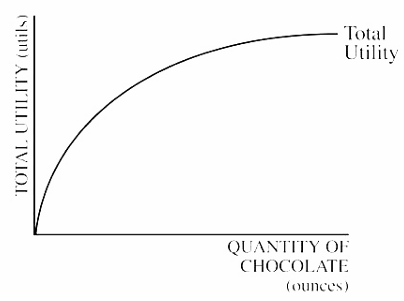
The diagram above shows Sally`s utility function for chocolate. Her utility function illustrates the principle of
A. trade-offs when making choices
B. diminishing marginal utility
C. income and substitution effects
D. increasing opportunity cost
E. constrained utility maximization
Question 4
At a perfectly competitive firm`s current output level, average total cost is $15, average variable cost is $10, and marginal cost is $8 and increasing. If the product price is $15, what should this firm do to maximize profits?
A. Increase the quantity of output produced.
B. Increase the product price.
C. Decrease the product price to increase sales.
D. Shut down immediately.
E. Continue to produce at its current output level.
Question 5
The government must provide public goods such as national defense because
A. the production of public goods requires economies of scale that the private sector cannot achieve
B. it is generally impossible to exclude individuals who value public goods but do not pay for them
C. public goods cannot be produced in private competitive markets, since they have highly inelastic demand
D. private producers charge a price that is substantially greater than marginal cost
E. no single individual should have to pay for public goods, since they benefit society as a whole
Question 6
Which of the following will increase the demand for pizza, a normal good?
A. An increase in the cost of producing pizza
B. A decrease in the price of pizza
C. An increase in the price of a complementary product
D. An increase in consumers` income
E. An increase in the number of restaurants selling pizza
Question 7
Game theory is used to explain
A. why firms price discriminate
B. how monopolies evolve into oligopolies
C. strategic behavior of firms in oligopoly
D. profit maximization in monopoly
E. price leadership of monopolistic competition
Question 8
If a profit-maximizing firm in a perfectly competitive market chooses to produce in the short run, then marginal cost is always
A. greater than or equal to total cost
B. greater than or equal to average total cost
C. greater than or equal to average variable cost
D. greater than or equal to average fixed cost
E. less than average total cost
Question 9
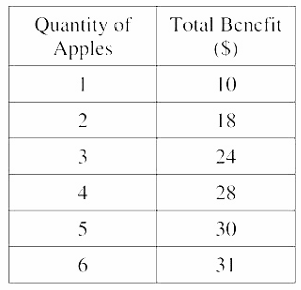
The table above shows the total benefit Tony gets from eating different quantities of apples. If apples cost $3 each, how many should he buy to maximize his consumer surplus?
A. 1
B. 2
C. 3
D. 4
E. 5
Question 10
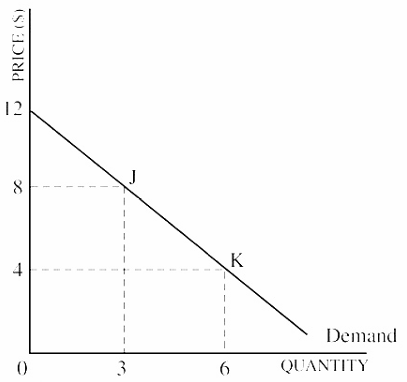
Given the demand curve above, if price decreases from $8 to $4 per unit, total consumer surplus will
A. increase by $4
B. increase by $8
C. increase by $12
D. increase by $18
E. remain constant at $24
Question 11
Which of the following describes how a market will respond when the scarcity of a good increases?
A. Consumers will increase their demand for the good.
B. Consumers will decrease their demand for the good.
C. The price of the good will increase.
D. The price of the good will decrease.
E. Producers will increase the supply of the good.
Question 12
Suppose that the demand for vegetables is price elastic. If the price of vegetables increases by 5 percent, the quantity of vegetables demanded would
A. increase by 5 percent
B. increase by more than 5 percent
C. increase by less than 5 percent
D. decrease by more than 5 percent
E. decrease by less than 5 percent
Question 13
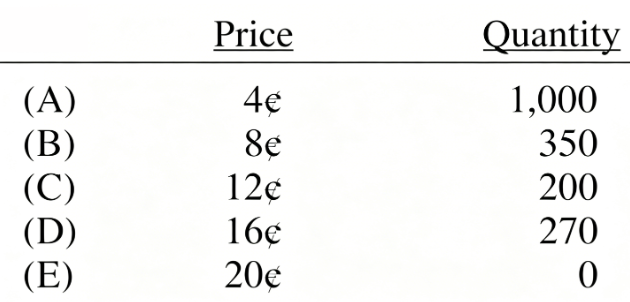
The table below lists the monthly individual demand schedules for text messages for the only three buyers in the market: Allison, Bill, and Chang.
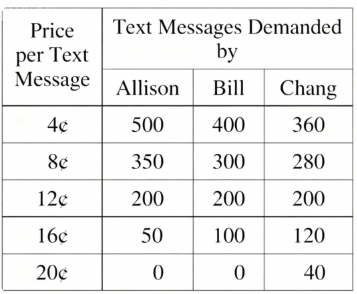
Which of the following combinations of price and quantity lies on the market demand curve?
A. A
B. B
C. C
D. D
E. E
Question 14
Which of the following best explains why a firm's short-run marginal cost curve shifts down when it purchases new, more efficient equipment and experiences an increase in its total cost?
A. The situation represents an exception to the law of diminishing returns.
B. The average total cost curve shifts upward as a result of the equipment purchase, and there is a movement up along the marginal cost curve.
C. The equipment purchase is a fixed cost, and the new equipment will cause a reduction in the cost of producing each additional unit.
D. The average variable cost curve shifts upward as a result of the equipment purchase, and the marginal cost curve shifts downward.
E. The marginal cost curve shifts downward because of the law of diminishing returns.
Question 15
Questions 15-16 are based on the chart below for a firm that is perfectly competitive in both the labor and product markets, showing how much daily output a firm can produce using different numbers of workers.
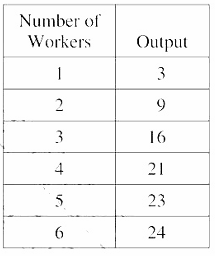
If output sells for $20 per unit, what is the marginal revenue product of the fifth worker?
A. $2
B. $40
C. $100
D. $115
E. $460
Question 16
If output sells for $20 per unit and the daily wage is $100 per worker, how many workers should the firm hire to maximize profit?
A. 1
B. 2
C. 4
D. 5
E. 6
Question 17
| Units of Labor |
Quantity of Output |
Total Cost |
| 0 |
0 |
$100 |
| 1 |
10 |
$120 |
| 2 |
25 |
$150 |
Given the information above, the average variable cost of 25 units of output is
A. $2
B. $6
C. $25
D. $50
E. $75
Question 18
A typical firm in a perfectly competitive constant-cost industry is operating with an economic loss in the short run. When the industry returns to long-run equilibrium, what will happen to the number of firms in the industry, the market price, and the typical firm's quantity?
Number of Firms
Market Price
Firm's Quantity
A. Decrease
Increase
Increase
B. Decrease
Decrease
Increase
C. Decrease
Increase
Decrease
D. Increase
Increase
Decrease
E. Increase
Decrease
Decrease
Question 19
Questions 19-20 refer to the table below.
The two firms in an industry are deciding whether to advertise. The profit to each firm depends on the other firm's decision. The first entries in the matrix indicate the profit earned, in millions of dollars, by Firm A; and the second entries indicate the profits earned, in millions of dollars, by Firm B.
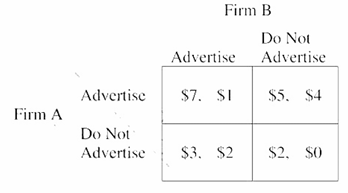
Based on the payoff matrix, which of the following is correct?
A. Firm A always gets a smaller share of the industry profits.
B. Firm A's dominant strategy is to advertise.
C. Firm B's dominant strategy is not to advertise.
D. The dominant strategy for both firms is not to advertise.
E. Neither firm has a dominant strategy.
Question 20
The combination where Firm A advertises and Firm B does not advertise is Nash equilibrium because
A. it is best for each firm given what the other firm has chosen
B. the total industry profits are maximized
C. Firm A has an incentive to change its strategy and chooses not to advertise
D. it is the best outcome for Firm B regardless of what Firm A does
E. advertising is always the best strategy for Firm A
Question 21
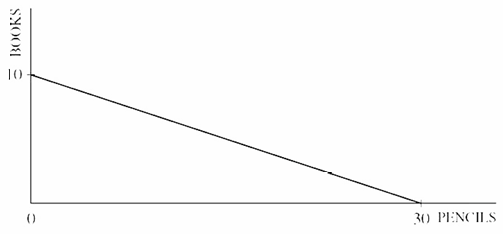
Based on the production possibilities curve for books and pencils shown above, what is the opportunity cost of producing a book?
A. 30 pencils
B. 10 pencils
C. 3 pencils
D. 1/3 of a pencil
E. 1/10 of a pencil
Question 22
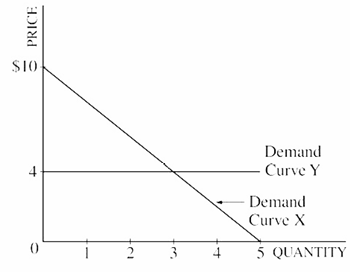
The demand curves X and Y are shown in the graph above. Which of the following offers the most accurate comparison of the price elasticities of demand curves X and Y at a price of $4?
Demand Curve X
Demand Curve Y
A. Perfectly elastic
Perfectly inelastic
B. Perfectly inelastic
Perfectly elastic
C. Perfectly inelastic
Relatively elastic
D. Relatively inelastic
Perfectly elastic
E. Relatively elastic
Relatively inelastic
Question 23
An art student spends all of her income on pencils and drawing pads. The student currently buys 30 pencils at $1 each and 10 pads at $5 each. If the marginal utility of the 30th pencil is 100 utils and the marginal utility of the 10th pad is 400 utils, to maximize utility the student should change her purchases of pencils and pads in which of the following ways?
Pencils
Pads
A. Not change
Buy more
B. Buy more
Buy more
C. Buy more
Buy less
D. Buy less
Buy more
E. Buy less
Buy less
Question 24
Assume that the current market equilibrium price for milk is $2.80 per gallon and that 5 million gallons are sold per day. If the government sets a price ceiling of $2.00 per gallon, which of the following is true?
A. The demand for milk will increase.
B. The supply of milk will decrease.
C. There will be an excess supply of milk in the market.
D. More than 5 million gallons of milk will be sold.
E. Less than 5 million gallons of milk will be sold.
Question 25
Which of the following is most likely to cause the demand curve for nurses to shift to the right?
A. An increase in the number of nurses graduating from nursing schools
B. An increase in nursing schools' tuition
C. An increase in the number of hospitals that employ nurses
D. A decrease in the marginal productivity of nurses
E. An improvement in the health of older people
Question 26
In a given year, Jennifer earns $50,000 and spends $40,000. During the same period, Steve earns $30,000 and spends $27,000. If Jennifer and Steve both must pay a 10 percent sales tax on goods purchased, the sales tax is
A. a higher percentage of income for Jennifer than for Steve
B. a higher percentage of spending for Steve than for Jennifer
C. progressive with respect to income
D. regressive with respect to income
E. proportional with respect to income
Question 27
A monopolistically competitive firm is currently producing the profit-maximizing level of output. If the price of a variable input increases, which of the following will occur?
A. The firm will increase its output to increase its revenue.
B. The firm will increase the price of its output by the same amount.
C. The firm's average total cost and marginal cost curves will shift upward.
D. The firm's average fixed cost will decrease as it decreases production.
E. The firm's marginal cost will increase, but its output level will be unaffected.
Question 28
The table below shows the long-run total cost function of a firm.
| Quantity of Output |
Total Cost ($) |
| 0 |
0 |
| 1 |
10 |
| 2 |
20 |
| 3 |
30 |
| 4 |
40 |
| 5 |
50 |
The firm's cost function exhibits
A. diseconomies of scale
B. constant returns to scale
C. economies of scale
D. decreasing marginal cost
E. increasing marginal cost
Question 29
Questions 29-30 are based on the following graph, which shows a firm's marginal cost (MC), average total cost (ATC), and average variable cost (AVC).
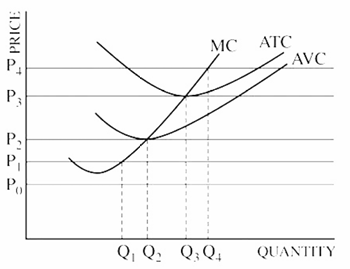
In the short run, the firm will
A. shut down if the price falls below P₃
B. continue to produce as long as the price is greater than P₁
C. continue to produce as long as the price is greater than P₂
D. earn economic profits as long as the price is greater than P₂
E. covers its fixed cost as long as the price is less than P₃
Question 30
The firm's short-run supply curve is which of the following?
A. The AVC curve above P₁
B. The AVC curve above P₂
C. The ATC curve above P₃
D. The MC curve above P₂
E. The MC curve above P₃
Question 31
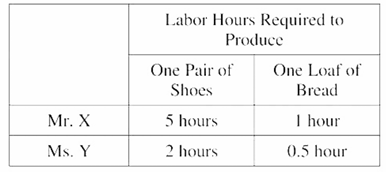
According to the data above, if Mr. X and Ms. Y have the opportunity to trade, which of the following will be mutually beneficial?
A. Ms. Y sells shoes to and buys bread from Mr. X.
B. Ms. Y sells bread to and buys shoes from Mr. X.
C. Ms. Y sells both bread and shoes to Mr. X.
D. Ms. Y buys both bread and shoes from Mr. X.
E. Ms. Y and Mr. X do not trade with each other.
Question 32
If the government eliminates an effective minimum wage in a competitive labor market, which of the following is true?
A. Minimum wage workers will experience no change in hourly pay.
B. Minimum wage workers will experience a decrease in hourly pay.
C. The number of people employed will decrease because people do not want to work for low wages.
D. There will be an excess demand for workers.
E. There will be an increase in the supply of workers.
Question 33
Carmen consumes both entertainment and medical care. For Carmen, entertainment is a normal good, and the income elasticity of her demand for medical care is zero. If Carmen's income increases, which of the following will be the immediate impact on her consumption?
Entertainment
Medical Care
A. Increase
Increase
B. Increase
No change
C. No change
Increase
D. Increase
Decrease
E. Decrease
Increase
Question 34
Assume that a perfectly competitive firm is in long-run equilibrium. If industry demand for the product increases, how will this firm's price, output, and profit change in the short run?
Price
Output
Profit
A. Increase
Increase
Increase
B. Increase
Decrease
Decrease
C. Increase
Increase
Decrease
D. No change
Decrease
Decrease
E. Decrease
Increase
Increase
Question 35
One difference between oligopolies and monopolistically competitive markets is that
A. there is no deadweight loss in monopolistically competitive markets, but there is in oligopolies
B. the products sold in monopolistically competitive markets are identical
C. oligopolies have fewer barriers to entry
D. firms maximize profits in monopolistically competitive markets but not in oligopolies
E. there are fewer firms in oligopolistic markets than in monopolistically competitive ones
Question 36
Questions 36-37 refer to the following diagram of a natural monopolist.
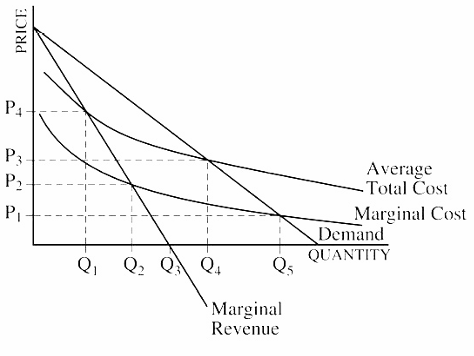
The firm shown in the diagram above qualifies as a natural monopoly because
A. the demand curve is downward sloping
B. the demand curve lies above the marginal revenue curve
C. the average total cost is decreasing in the relevant range of market demand
D. the firm can maximize profit with any output level it chooses
E. marginal revenue is positive at the profit-maximizing output level
Question 37
If government regulated the natural monopoly to produce the output resulting in zero economic profit, then the output would be
A. Q₁
B. Q₂
C. Q₃
D. Q₄
E. Q₅
Question 38
Which of the following characteristics is prevalent in oligopolies?
A. Allocative efficiency
B. Low barriers of entry
C. Consideration of rivals' reactions
D. No deadweight loss
E. Zero economic profit
Question 39
A firm uses capital and labor in its production process. The marginal product for the last unit of labor is 5, the marginal product for the last unit of capital is 10, and the wage is $10. At what cost of hiring each unit of capital would the firm be minimizing the cost of the current output?
A. $5
B. $10
C. $15
D. $20
E. $50
Question 40
Which of the following must be true if a profit-maximizing monopolistically competitive firm continues to operate in the short run while incurring a loss?
A. Marginal revenue equals marginal cost and price is greater than average total cost.
B. Marginal revenue equals marginal cost and price is greater than average variable cost.
C. Marginal revenue equals marginal cost and price is less than average variable cost.
D. Price equals both marginal cost and marginal revenue.
E. Price is less than marginal revenue, but greater than average variable cost.
Question 41
Marginal analysis suggests that an individual will consume one additional unit of a good if the
A. sunk cost can be recovered
B. total benefit is less than the total cost
C. total benefit is greater than the total cost
D. additional benefit is less than the additional cost
E. additional benefit is greater than the additional cost
Question 42
If a perfectly competitive market with no government intervention is allocatively efficient, which of the following must be true?
A. Consumer surplus plus producer surplus is at its maximum.
B. Consumer surplus is larger than producer surplus.
C. Producer surplus is larger than consumer surplus.
D. All surplus is producer surplus.
E. All surplus is consumer surplus.
Question 43
Questions 43-44 are based on the output and cost data in the table below.
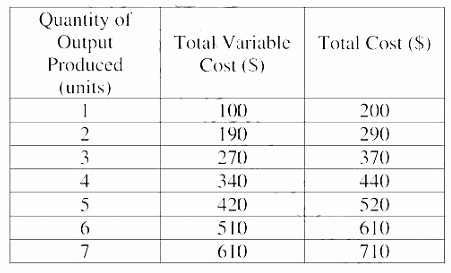
According to the cost schedule in the table above, the firm's total fixed cost is
A. increasing
B. decreasing
C. $90
D. $100
E. impossible to determine
Question 44
If there is only one variable input, diminishing marginal returns first occur with the production of which unit of output?
A. 7th
B. 6th
C. 5th
D. 4th
E. 3rd
Question 45
Max employs both labor and capital to produce toy trains. Currently the last unit of labor employed has a marginal product of 15 units. The last unit of capital employed has a marginal product of 40 units. The price of labor is $3 per unit, and the price of capital is $10 per unit. Which of the following employment decisions should Max follow to use the least-cost combination of labor and capital to produce the current quantity of toy trains?
Employment of Labor
Employment of Capital
A. Increase
No change
B. Decrease
Increase
C. Decrease
Decrease
D. Increase
Increase
E. Increase
Decrease
Question 46
Good X is produced in a perfectly competitive industry in long-run equilibrium. If the consumption of good X generates positive externalities, the private market will produce
A. less than the socially optimum amount of good X
B. more than the socially optimum amount of good X
C. the socially optimum amount of good X
D. good X only if the government grants a subsidy for the production of good X
E. good X only if the government levies a corrective tax on the production of good X
Question 47
Questions 47-48 refer to the following graph, which shows the cost and revenue curves for a profit-maximizing monopolistically competitive firm.
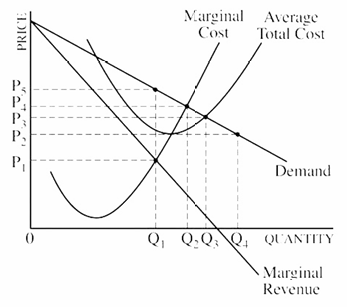
What is the profit-maximizing price and quantity?
Price
Quantity
A. P₁
Q₁
B. P₂
Q₂
C. P₃
Q₃
D. P₄
Q₄
E. P₅
Q₁
Question 48
Is the firm in short-run or long-run equilibrium?
A. Short run, because price is greater than marginal cost
B. Short run, because the firm is earning a positive economic profit
C. Long run, because price is greater than average total cost
D. Long run, because marginal revenue is not equal to zero
E. Either short run or long run, because the firm is producing where marginal revenue equals marginal cost
Question 49
Which of the following is true of a firm in a perfectly competitive industry?
A. It faces a perfectly elastic demand curve.
B. It faces a downward-sloping demand curve.
C. It will increase its total revenue if it increases the selling price of its product.
D. Its cost could be greatly reduced if it did not have to advertise its product.
E. It sets the price of its product at the level at which profits are maximized or losses are minimized.
Question 50
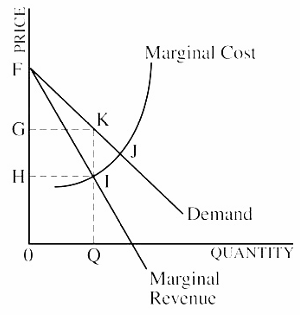
In the diagram above, the deadweight loss from a profit-maximizing monopolist is represented by area
A. FGK
B. FHI
C. IJK
D. GHIK
E. 0HIQ
Question 51
As the population of a country ages, the demand for health care is projected to increase. As a result, the health care industry is likely to experience all of the following EXCEPT
A. an increase in demand for health care workers
B. an increase in demand for medicine
C. an increase in the quantity of health care workers supplied
D. an increase in the wages of health care workers
E. a decrease in the prices of medicine
Question 52
Suppose that the government imposes a per-unit tax on the producers of a good that has a perfectly inelastic demand. After the tax, the price and quantity of the good sold would change in which of the following ways?
Price
Quantity
A. Increase
Increase
B. Increase
Decrease
C. Increase
Not change
D. Not change
Increase
E. Decrease
Not change
Question 53
When the marginal cost curve lies below the average total cost curve, it is true that as output increases
A. marginal cost is decreasing
B. marginal cost is increasing
C. average total cost is decreasing
D. average total cost is increasing
E. average variable cost is decreasing
Question 54
Assume that the government imposes an excise tax on the consumption of a good. The tax will have the least impact on the market equilibrium quantity for which of the following combinations of the price elasticities of demand and supply?
Absolute Value of Elasticity of Demand
Elasticity of Supply
A. 4
4
B. 4
0.50
C. 1
1
D. 0.50
4
E. 0.50
0.50
Question 55
The monopolist's marginal factor (resource) cost curve for labor is
A. above the labor supply curve because the product price is found on the demand curve above where marginal cost equals marginal revenue
B. above the labor supply curve because to hire more workers the firm must raise the wage for all workers
C. below the labor supply curve because the firm is a wage taker
D. below the labor supply curve because of diminishing marginal returns to labor
E. below the labor supply curve because to sell additional units of output the firm must lower its product price
Question 56
Which of the following best demonstrates nonrivalry in consumption?
A. Occupying a seat in a sold-out movie theatre
B. Sharing rent equally among roommates
C. Catching fish in a local pond
D. Playing golf on a crowded public golf course
E. Listening to a radio program
Question 57
The Lorenz curve is used to study the
A. relationship between output and unemployment
B. relationship between income and consumption
C. extent of income inequality within a society
D. incidence of an excise tax on buyers and sellers in a market
E. impact of foreign trade on domestic production of goods
Question 58
An effective minimum wage policy in a competitive market will increase unemployment and increase the total earnings of labor only if the demand for labor is
A. relatively inelastic
B. relatively elastic
C. unit elastic
D. greater than the supply
E. positively related to the wage rate
Question 59
Compared with a perfectly competitive market, a single-price monopoly with the same market demand and cost curves will
A. increase output and price
B. increase output and decrease price
C. decrease output and price
D. decrease output and increase price
E. produce the same level of output and increase price
Section II - Free Response (3 questions)
Question 1
Joyce owns a gas station and monopolizes gas sales along a remote stretch of road. In February, Joyce stayed open even though she earned negative economic profits.
(a) Draw a correctly labeled graph for Joyce's gas station during February and show each of the following.
(i) The profit-maximizing output and price, labeled QJ and PJ
(ii) The average total cost curve, labeled ATC
(iii) Deadweight loss, completely shaded
(b) What must have been true for Joyce to continue operating during the month of February even though she earned negative economic profit?
(c) Assume that fixed costs for Joyce's gas station decrease. Would Joyce's profit-maximizing quantity increase, decrease, or stay the same in February? Explain.
(d) During the month of July, demand increases so that Joyce now earns a positive economic profit. However, she realizes her profits would have been higher if she had reduced the price of gasoline.
(i) At the quantity sold in July, was marginal revenue greater than, equal to, or less than marginal cost?
(ii) Would the price decrease cause quantity demanded to increase, decrease, or stay the same?
(iii) Would the price decrease cause the total revenue to increase, decrease, or stay the same? Explain.
Question 2
Brody's firm produces trumpets in a perfectly competitive market. The table below shows Brody's total variable cost. He has a fixed cost of $240, and the price per trumpet is $60.
| Quantity |
Total Variable Cost ($) |
| 6 |
120 |
| 7 |
145 |
| 8 |
165 |
| 9 |
220 |
| 10 |
290 |
| 11 |
390 |
(a) Calculate the average total cost of producing 6 trumpets. Show your work.
(b) Calculate the marginal cost of producing the 11th trumpet.
(c) What is Brody's profit-maximizing quantity? Use marginal analysis to explain your answer.
(d) At the profit-maximizing quantity you determined in part (c), calculate Brody's profit or loss. Show your work.
(e) Brody also produces saxophones at a loss in a perfectly competitive market. Draw a correctly labeled graph for Brody's firm showing the following at a market price of $200.
(i) Brody's profit-maximizing quantity of saxophones
(ii) Brody's loss, completely shaded
Question 3
The market supply and demand for a product are shown in the diagram below.
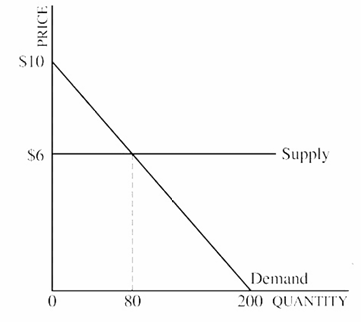
(a) Is the price elasticity of supply less than one, equal to one, or greater than one? Explain.
(b) Calculate consumer surplus at the equilibrium price.
Show your work.
(c) Now suppose the government imposes a per-unit tax of $1 on producers.
(i) What happens to total revenue received by producers after they pay the tax to the government? Explain.
(ii) Will producer surplus increase, decrease, or stay the same?
(iii) Will total surplus increase, decrease, or stay the same? Explain.
Multiple-choice answer key
Answers reproduced from the website. No FRQ scoring guide was provided in the question pages.
1: B | 2: B | 3: B | 4: A | 5: B
6: D | 7: C | 8: C | 9: D | 10: D
11: C | 12: D | 13: D | 14: C | 15: B
16: C | 17: A | 18: A | 19: B | 20: A
21: C | 22: D | 23: C | 24: E | 25: C
26: D | 27: C | 28: B | 29: C | 30: D
31: A | 32: B | 33: B | 34: A | 35: E
36: C | 37: D | 38: C | 39: D | 40: B
41: E | 42: A | 43: D | 44: C | 45: E
46: A | 47: E | 48: B | 49: A | 50: C
51: E | 52: C | 53: C | 54: E | 55: B
56: E | 57: C | 58: A | 59: D