AP Micro 2016
Shanmao online question bank | Archived 2026-10-25
Section I - Multiple Choice (60 questions)
Question 1
Two alternative production possibility frontiers for apples and wheat are shown in the figures below.
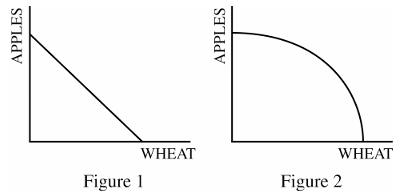
As more wheat is produced, how will the opportunity cost of producing wheat, as represented in Figures 1 and 2, be affected?
Figure 1Figure 2A. Decrease
Increase
B. Increase
Decrease
C. No change
Increase
D. No change
Decrease
E. Increase
No change
Question 2
If an effective rent ceiling is eliminated, which of the following is most likely to occur in the rental housing market?
A. An increase in the demand for housing, resulting in a decrease in the quantity of housing supplied
B. An increase in rents, resulting in an increase in the quantity of housing supplied
C. An increase in the demand for housing, resulting in an increase in the quantity of housing demanded
D. A decrease in rents, resulting in an increase in the quantity of housing supplied
E. A decrease in the demand for housing, resulting in an increase in the quantity of housing supplied
Question 3
Assume that the market for lemonade is perfectly competitive and currently in equilibrium. Lemons are key ingredients in lemonade. If the price of lemons decreases, how will the lemonade market be affected?
A. Supply will shift leftward, increasing the equilibrium price and decreasing the equilibrium quantity of lemonade.
B. Supply will shift rightward, increasing the equilibrium price and increasing the equilibrium quantity of lemonade.
C. Supply will shift rightward, decreasing the equilibrium price and increasing the equilibrium quantity of lemonade.
D. Demand will shift leftward, decreasing the equilibrium price and decreasing the equilibrium quantity of lemonade.
E. Demand will shift rightward, increasing the equilibrium price and increasing the equilibrium quantity of lemonade.
Question 4
When marginal utility is falling but positive, total utility will
A. decrease at an increasing rate
B. decrease at a decreasing rate
C. remain constant
D. increase at an increasing rate
E. increase at a decreasing rate
Question 5
The reason that firms in perfect competition earn zero economic profit in the long run is that
A. firms are small
B. there are a large number of sellers
C. firms cannot advertise
D. there are no barriers to entry or exit
E. the commodities produced are relatively inexpensive
Question 6
If the output of a firm doubles when the firm doubles all of its inputs, the firm must be experiencing
A. economies of scale
B. increasing returns to scale
C. constant returns to scale
D. decreasing returns to scale
E. diseconomies of scale
Question 7
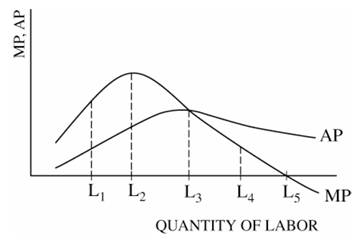
The graph above shows the marginal product average product (MP) and the average product (AP) of labor for a firm that uses labor as the only variable input and hires its labor in a perfectly competitive market. At which quantity of labor does marginal cost change from decreasing to increasing?
A. L1
B. L2
C. L3
D. L4
E. L5
Question 8
A contractor is employing labor and capital to build an office complex. At the current mix of inputs, the marginal product of labor is 30 square feet per day, and the marginal product of capital is 90 square feet per day. The price of labor is $1,000 per day, and the price of capital is $3,000 per day. To hire inputs in a cost-minimizing way, the firm should
A. hire more labor and less capital
B. hire less labor and more capital
C. hire more labor and more capital
D. hire less labor and less capital
E. make no changes to the mix of inputs
Question 9
A single-price monopolist is currently producing in the inelastic portion of its market demand curve. In order to maximize profits, the monopolist should change the price and output in which of the following ways?
Price
Output
A. Increase
Increase
B. Increase
Decrease
C. Increase
Not change
D. Decrease
Increase
E. Not change
Increase
Question 10
Assume that a profit-maximizing, perfectly competitive firm has economic losses in the short run. If the firm continues to produce and sell its goods, then which of the following must be true?
A. The firm is covering all of its fixed and variable costs of production.
B. The firm is covering all of its fixed costs but not all of its variable costs of production.
C. The firm is covering all of its variable costs but not all of its fixed costs of production.
D. The firm is covering all of its implicit costs but not all of its explicit costs.
E. The firm must have raised the price of its goods in order to minimize its losses.
Question 11
The demand curve for a monopolistically competitive firm is downward sloping because
A. there are a large number of firms
B. the product is produced by using scarce resources
C. the products produced by different firms are not identical
D. it is easy for firms to enter or exit the market
E. the marginal cost rises as output produced increases
Question 12
Which of the following is true of a perfectly competitive firm in long-run equilibrium?
A. It produces its output at minimum average total cost.
B. It earns positive economic profits.
C. It will exit the industry.
D. Its price exceeds marginal cost.
E. Its price exceeds marginal revenue.
Question 13
Game theory is most commonly used for analyzing the pricing behavior of firms in which market structure?
A. Perfect competition
B. Monopolistic competition
C. Oligopoly
D. Monopoly
E. Monopsony
Question 14
If the production of good X creates a positive externality, then from society’s perspective, the industry that produces good X tends to produce
A. less than the socially optimal amount of good X
B. greater than the socially optimal amount of good X
C. the socially optimal amount of good X
D. a surplus of good X, unless subsidized
E. a shortage of good X, unless taxed
Question 15
If the goal of government regulators of a natural monopoly is to reduce deadweight loss without subsidizing the monopolist, government regulators would set a price equal to
A. average variable cost
B. average total cost
C. average fixed cost
D. short-run marginal cost
E. long-run marginal cost
Question 16
A production possibilities curve can shift inward if there is
A. an increase in productivity
B. an increase in unemployment
C. an increase in the price of raw materials
D. a misallocation of resources
E. a natural disaster
Question 17
A country produces computers and rice. If resources are fully employed and there is technological progress only in the production of rice, the opportunity costs of producing computers and rice will change in which of the following ways?
Opportunity Cost of Computers
Opportunity Cost of Rice
A. Increase
Increase
B. Increase
Decrease
C. No change
Decrease
D. Decrease
Increase
E. Decrease
Decrease
Question 18
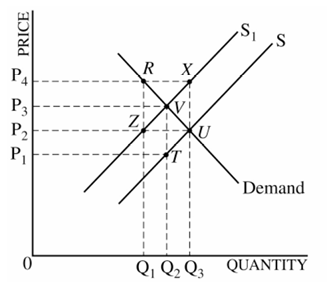
In the graph above, S is the original supply curve, and S1 is the supply curve including an excise tax. The area representing the tax revenue to the government is
A. P1P3VT
B. P2P4RZ
C. P2P4XU
D. P2UQ30
E. P3VQ20
Question 19
Which of the following would cause the supply curve for notebook computers to shift to the right?
A. An increase in the price of notebook computers
B. An increase in the number of firms producing notebook computers
C. An increase in the wages of workers in the notebook-computer industry
D. A decrease in the price of notebook computers
E. A decrease in the supply of notebook computers
Question 20
A perfectly competitive market in equilibrium is allocatively efficient and it maximizes
A. total consumer surplus
B. total producer surplus
C. the sum of total consumer surplus and total producer surplus
D. total revenue
E. total external benefits
Question 21
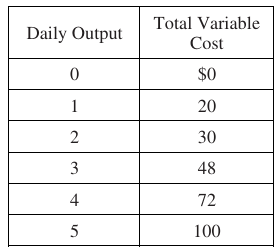
Based on the cost and output data in the table above, a perfectly competitive firm will shut down if price falls below
A. $30
B. $20
C. $18
D. $16
E. $15
Question 22
Shelby is an entrepreneur who has decided to open a small advertising firm. She rents office space at a cost of $25,000 per year, she has employed an assistant at a salary of $30,000 per year, and she incurs annual utility and office supply expenses of $20,000. Her best alternative is to work elsewhere and to earn a salary of $50,000 per year. How much annual revenue must her firm receive so that Shelby earns zero economic profit?
A. $50,000
B. $75,000
C. $100,000
D. $125,000
E. $150,000
Question 23
A firm produces 400 books and sells each book for $15. If the explicit cost of producing the books is $4,500 and the implicit cost is $1,000, the firm’s economic profit is
A. $0
B. $500
C. $1,000
D. $1,500
E. $5,000
Question 24
For a perfectly competitive firm producing the profit-maximizing quantity, the average total cost is $10 and the average variable cost is $8. If the market price for its product is $10, which of the following is true for the firm?
A. It is sustaining a loss and should shut down.
B. It is earning zero economic profit and will remain in business.
C. Its accounting profits exceed implicit costs.
D. It will temporarily shut down until price rises.
E. It is making an economic profit that will attract other firms to the industry.
Question 25
Questions 25-26 refer to the monopoly graph below, where . MC = marginal cost, ATC = average total cost, D = demand, and MR = marginal revenue.
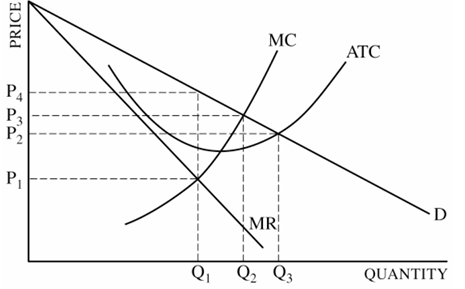
The profit-maximizing combination of output and price for a single-price monopoly is
A. Q1 and P1
B. Q1 and P2
C. Q1 and P4
D. Q2 and P3
E. Q3 and P2
Question 26
If the monopolist could engage in perfect price discrimination, the monopolist’s total output and the price charged for the last unit of output sold would be
A. Q1 and P1
B. Q1 and P2
C. Q1 and P4
D. Q2 and P3
E. Q3 and P2
Question 27
If a large number of unskilled workers enter the labor market, which of the following is most likely to occur in the labor market for unskilled workers?
A. The supply curve will shift to the right and the wage rate will decrease.
B. The supply curve will shift to the left and the wage rate will increase.
C. The demand curve will shift to the right and the wage rate will increase.
D. The demand curve will shift to the left and the wage rate will decrease.
E. There will be a movement up along the demand curve and the wage rate will increase.
Question 28
Assume that a profit-maximizing, perfectly competitive firm hires labor in a perfectly competitive labor market. If the market wage is $12 per hour and the price of the product is $3 per unit, the firm will
A. hire more workers if each worker can produce 3 units per hour
B. hire another worker if the output per hour of the additional worker exceeds 4 units
C. hire fewer workers, since the hourly wage exceeds the cost of producing one unit of output
D. not hire any workers, since the cost of labor is greater than the price of the output
E. continue to operate in the short run but not in the long run
Question 29
Antitrust policy seeks to prevent or eliminate which of the following practices?
A. Firing of workers
B. Collusion and price fixing
C. Pollution of rivers
D. Monopolistic competition
E. Discrimination in the labor market
Question 30
National defense is a good example of a pure public good because it is
A. nonrival and nonexcludable
B. nonrival and excludable
C. rival and nonexcludable
D. rival and excludable
E. free and provided at zero cost
Question 31
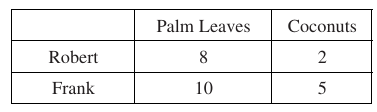
The table above shows the maximum number of palm leaves or coconuts that Robert and Frank can pick respectively in a single day. Which of the following is true?
A. Robert has a comparative advantage in picking coconuts.
B. Frank has a comparative advantage in picking palm leaves.
C. Robert and Frank can both benefit from trade with each other if 1 coconut is traded for 1 palm leaf.
D. Robert and Frank can both benefit from trade with each other if 1 coconut is traded for 3 palm leaves.
E. Robert and Frank can both benefit from trade with each other if 1 coconut is traded for 5 palm leaves.
Question 32
Relative to a command economy, resources in a market economy are more commonly allocated by
A. democratic elections
B. government planning
C. the price system
D. established traditions
E. a system of checks and balances
Question 33
If a 10 percent increase in the price of a good leads to a 25 percent decrease in the quantity demanded of the good, demand is
A. relatively inelastic
B. relatively elastic
C. unit elastic
D. perfectly elastic
E. perfectly inelastic
Question 34
For an inferior good, an increase in consumer income will cause
A. the demand curve to shift to the left
B. the demand curve to shift to the right
C. the short-run supply curve to shift to the right
D. the long-run supply curve to shift to the right
E. new firms to enter the market in the long run
Question 35
Which of the following will cause the demand curve for good X to shift to the right?
A. An increase in the price of good Z, a complement to good X
B. An increase in the price of good Y, a substitute for good X
C. An increase in the consumer’s income, if good X is an inferior good
D. A decrease in the price of good X
E. An increase in the supply of good X
Question 36
One reason consumers typically increase the quantity of a good they purchase when the price of the good decreases is that
A. the marginal utility of the good increases
B. consumers’ purchasing power increases
C. consumers increase their purchases of substitute items
D. consumers increase their purchases of complementary items
E. the demand for the good increases
Question 37
Which of the following is true of a monopolistically competitive firm in long-run equilibrium?
A. The firm produces the allocatively efficient level of output.
B. The firm is allocatively inefficient, because it produces an output level at which price is greater than marginal cost.
C. The firm produces an output level that minimizes average total cost.
D. The firm produces in the inelastic range of its demand curve.
E. The firm earns positive economic profits but zero accounting profits.
Question 38
Assume that a firm uses labor and capital to produce a product. The firm hires labor at a wage rate of $4 per unit and rents capital at $5 per unit. At its current output level, the marginal physical products of labor and capital are 20 and 30 units, respectively. To minimize its cost of production without changing the level of output, the firm should
A. make no changes
B. hire more labor and rent more capital
C. hire less labor and rent more capital
D. hire more labor and rent less capital
E. hire less labor and rent less capital
Question 39
E Soda and R Soda are the only two firms in the soft-drink industry. The companies cannot cooperate. Each firm can follow a high-price strategy or a low-price strategy for pricing its product. In the payoff matrix below, the first entry in each cell shows the profits to E Soda and the second entry shows the profits to R Soda.
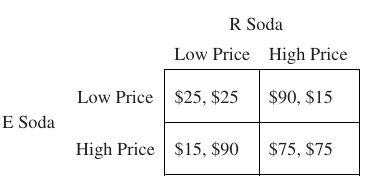
Given the information in the payoff matrix, it can be concluded that
A. neither E Soda nor R Soda has a dominant strategy
B. E Soda has a dominant strategy but R Soda does not
C. R Soda has a dominant strategy but E Soda does not
D. both firms will choose the high-price strategy
E. both firms will choose the low-price strategy
Question 40
A firm with market power engages in price discrimination to
A. earn a higher profit
B. increase consumer surplus
C. decrease deadweight loss
D. make its demand more elastic
E. make its demand more inelastic
Question 41
Reff Corp is a firm with total revenue of $1,000, marginal cost of $5, and average variable cost of $4. Both the output and the input markets are perfectly competitive, and Reff Corp is currently in long-run equilibrium. Reff Corp’s output and total fixed cost of production must be equal to which of the following?
Output
Fixed Cost
A. 250
$ 800
B. 250
$ 400
C. 200
$ 200
D. 200
$ 400
E. 200
$ 800
Question 42
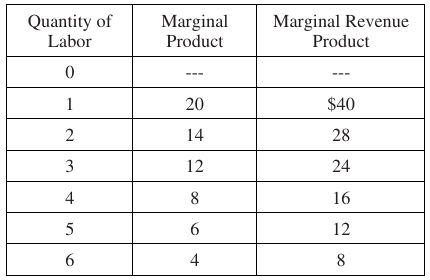
Based on the table for a perfectly competitive firm above, if the wage rate for labor is $15, how many units of labor should the firm hire?
A. 2
B. 3
C. 4
D. 5
E. 6
Question 43
Assume labor and capital are substitute inputs. A manufacturer will employ more labor if
A. the price of labor increases
B. the marginal product of labor decreases
C. the price of capital increases
D. the marginal product of capital increases
E. the product’s demand decreases
Question 44
Assume that the firms in an industry pollute a river. If there is no government intervention, the firms will
A. produce more output than is socially efficient
B. pay production costs that are higher than actual social costs
C. charge a lower price than is necessary to maximize profit
D. charge a higher price to pay for the pollution
E. increase production to achieve allocative efficiency
Question 45
The following table shows Kent’s annual income over two years and the income taxes paid in each year.
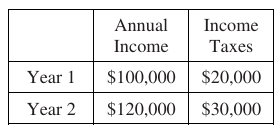
With no changes in the marginal tax-rate schedule, which of the following is true about the tax rates?
A. The marginal tax rate was equal to the average tax rate for both incomes.
B. The marginal tax rate on the last $20,000 earned was greater than the marginal tax rate at $100,000 income, but the average tax rate decreased with the increase in income.
C. The average tax rate when Kent earned $120,000 was less than the marginal tax rate on the last $20,000 he earned.
D. The amount paid in income tax increased as income increased, so the tax is proportional.
E. The amount paid in income tax increased as income increased, so the tax is regressive.
Question 46
Dana and Robin produce smoothies and pizza. In one hour Dana can make 20 smoothies or 10 pizzas. In one hour Robin can make 18 smoothies or 6 pizzas. Which of the following statements is true?
A. Robin has an absolute advantage in making smoothies and a comparative advantage in making pizzas.
B. Robin has both an absolute advantage and a comparative advantage in making pizzas.
C. Dana has a comparative advantage in making both smoothies and pizzas.
D. Dana has a comparative advantage in making pizzas, and Robin has a comparative advantage in making smoothies.
E. Dana has a comparative advantage in making smoothies, and Robin has a comparative advantage in making pizzas.
Question 47
In which of the following cases would a firm’s total revenue increase?
A. Price increases and demand is elastic.
B. Price decreases and supply is inelastic.
C. Price decreases and demand is elastic.
D. Price decreases and supply is elastic.
E. Price decreases and demand is inelastic.
Question 48
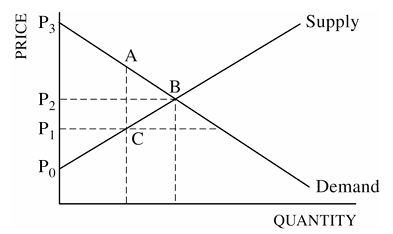
In the diagram above, if there is a price ceiling set at P1, consumer surplus will be represented by the area
A. ABC
B. P2BP0
C. P3BP2
D. P3ACP1
E. P3BCP1
Question 49
Consumer surplus in a market for a good exists because
A. binding price floors encourage producers to increase the supply of the good
B. some consumers would be willing to pay more than the equilibrium price of the good
C. when the price of the good decreases, most consumers increase their demand for the good
D. producers do not have market power to set their own price
E. some producers charge different prices for the good in different markets
Question 50
Assume Pat spends all of her allowance to purchase 4 apples and 4 candy bars. Pat’s marginal utility of the fourth apple is 20 utils, and her marginal utility of the fourth candy bar is 40 utils. If an apple costs $1.00 and a candy bar $0.50, to maximize utility Pat should
A. purchase more apples and more candy bars
B. maintain the current purchase of 4 apples and 4 candy bars
C. purchase more apples and fewer candy bars
D. purchase fewer apples and more candy bars
E. purchase fewer apples and fewer candy bars
Question 51
A firm is producing 100 units of output at a total cost of $400. The firm’s average variable cost is $3 per unit. What is the firm’s total fixed cost?
A. $1
B. $50
C. $100
D. $300
E. $400
Question 52
A profit-maximizing firm will shut down in the short run any time the firm’s total revenue is less than its
A. total cost
B. fixed cost
C. total variable cost
D. explicit cost
E. implicit cost
Question 53
Quantity of Output (units)
Total Variable Cost
0
$0
1
$40
2
$50
3
$65
4
$90
Assume that the fixed cost is $50. Based on the cost and output data in the table above, what is the marginal cost when the firm increases its output from three to four units and the average total cost of producing 4 units?
Marginal Cost
Average Total Cost
A. $35
$40
B. $35
$35
C. $25
$35
D. $25
$25
E. $10
$25
Question 54
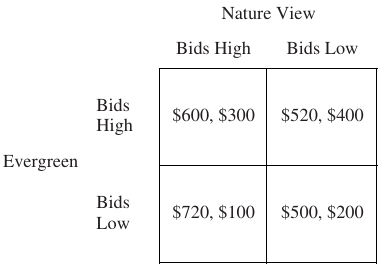
Evergreen and Nature View are bidding for a landscaping contract. The payoff matrix above shows what each firm’s total weekly profits from all its operations will be for each combination of bids. The first entry in each cell shows Evergreen’s profit, and the second entry in each cell shows Nature View’s profit. A Nash equilibrium results under which of the following conditions?
A. When Evergreen bids low, no matter what Nature View’s bid is
B. When both firms bid high and when both firms bid low
C. When Evergreen bids high and Nature View bids low
D. When both firms bid low
E. When both firms bid high
Question 55
Suppose that the demand for soft drinks is price elastic and the supply is price inelastic. If the government imposes a sales tax on soft drinks, which of the following will occur in the short run?
A. The tax burden will fall equally on both consumers and producers.
B. The tax burden will fall more on producers.
C. The tax burden will fall more on consumers.
D. The percentage increase in the price of soft drinks will be greater than the percentage increase in the quantity demanded.
E. The percentage decrease in total revenue will be greater than the percentage decrease in the quantity demanded.
Question 56
If both supply and demand for wheat increase, the equilibrium price and quantity of wheat will most likely change in which of the following ways?
Price
Quantity
A. Decrease
Decrease
B. Decrease
Increase
C. Indeterminate
Increase
D. Increase
Decrease
E. Increase
Indeterminate
Question 57
The last worker currently employed by a firm has a marginal product of 3 units per hour and is paid $20 per hour. Assuming that both the labor market and product market are perfectly competitive and that the product’s price is $5 per unit, the firm should do which of the following?
A. Decrease wages
B. Increase wages
C. Employ more workers
D. Employ fewer workers
E. Increase the product’s price
Question 58
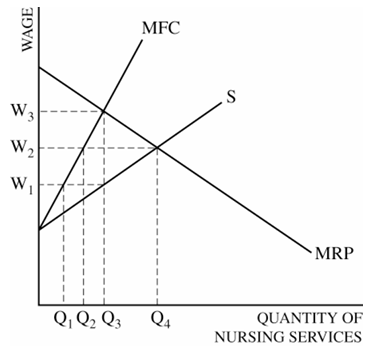
Hope Hospital is a monopsonistic employer of nurses. The marginal revenue product of nursing services, the marginal factor (resource) cost of nursing services, and the market supply curve of nursing services are depicted in the figure above by MRP, MFC, and S, respectively. What wage quantity combination does Hope Hospital choose in order to maximize its profits?
A. W1 and Q1
B. W1 and Q3
C. W2 and Q2
D. W2 and Q4
E. W3 and Q3
Question 59
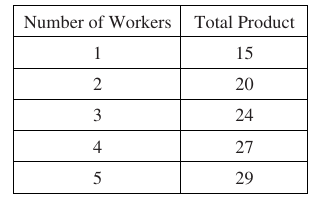
The table above shows the short-run output for a perfectly competitive firm. If the price of the product is $10, what is the marginal revenue product of the third worker hired?
A. $24
B. $27
C. $40
D. $240
E. $300
Question 60
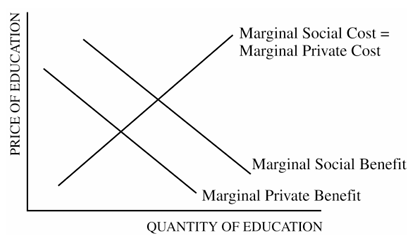
Which of the following is true based on the graph above?
A. Quantity of education in the private market is more than the socially optimal quantity.
B. Consumers of education could be subsidized in order to achieve he socially optimal quantity.
C. Producers of education could be taxed in order to achieve the socially optimal quantity.
D. Consumers of education could be taxed in order to achieve the socially optimal quantity.
E. Consumption of education has a negative externality.
Section II - Free Response (3 questions)
Question 1
Kohelis Mining is a monopoly and is currently operating at a loss.
(a) Draw a correctly labeled graph and show each of the following.
(i) The profit-maximizing quantity, labeled QM
(ii) The profit-maximizing price, labeled PM
(iii) The average total cost curve, labeled ATC
(iv) The allocatively efficient quantity, labeled QA
(b) Suppose the government grants Kohelis Mining a lump-sum subsidy such that the firm earns zero economic profit.
(i) On your graph from part (a), shade the area of the subsidy.
(ii) Will the profit-maximizing quantity increase, decrease, or remain the same? Explain.
(c) Suppose instead the government provides Kohelis Mining a per-unit subsidy such that the firm earns zero economic profit.
(i) Will the profit-maximizing quantity increase, decrease, or remain the same? Explain.
(ii) Will the price paid by consumers increase, decrease, or remain the same?
(d) In this market, will the lump-sum or the per-unit subsidy lead to an increase in the total consumer surplus, or is the change indeterminate? Explain.
Question 2
Kerri goes shopping for volleyballs. The table below shows the dollar value of the total benefit she receives from buying various quantities of volleyballs.
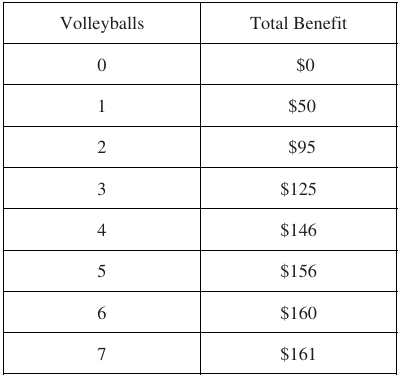
(a) Calculate the marginal benefit Kerri receives from buying the third volleyball.
(b) Assume the price of each volleyball is $9.
(i) Calculate Kerri’s total consumer surplus if she buys two volleyballs. Show your work.
(ii) How many volleyballs should Kerri buy to maximize her total consumer surplus from volleyballs? Explain using marginal analysis.
(c) Assume that the market for volleyballs is perfectly competitive and that soccer balls are a substitute for volleyballs.
(i) Draw a correctly labeled graph of the market for volleyballs, and label the equilibrium price as P1 and the equilibrium quantity as Q1.
(ii) If the price of soccer balls decreases, show the effect on the equilibrium price and quantity of volleyballs on your graph in part c(i).
(d) Assume instead that a 10 percent increase in income causes the demand for volleyballs to fall by 5 percent.
(i) Calculate the income elasticity of demand for volleyballs.
(ii) Does the value of the income elasticity indicate that volleyballs are a normal good or an inferior good? Explain.
Question 3
CleanIt is a perfectly competitive, profit-maximizing trash collection firm. CleanIt hires workers in a perfectly competitive labor market.
(a) Draw side-by-side graphs for the labor market and for CleanIt and show each of the following.
(i) The market wage, labeled W , and the quantity of workers hired in the market, labeled LM
(ii) The marginal factor (resource) cost curve, labeled MFC
(iii) The marginal revenue product curve, labeled MRP
(iv) The wage paid by the firm, labeled WF, and the quantity of workers hired by the firm, labeled LF
(b) Assume that CleanIt is the only firm in the industry to adopt a new technology. The new technology increases the productivity of CleanIt’s workers.
(i) In the short run, will the wage paid by CleanIt be higher than, lower than, or equal to WF? Explain.
(ii) In the short run, will the number of workers hired by CleanIt increase, decrease, or stay the same? Explain.
(c) CleanIt uses capital in the form of trucks, which it rents for $10,000 each. The marginal product of the last truck used is 100,000 units. If CleanIt is minimizing its costs and the marginal product of the last worker hired is 500 units, calculate the wage. Show your work.
Multiple-choice answer key
Answers reproduced from the website. No FRQ scoring guide was provided in the question pages.
1: C | 2: B | 3: C | 4: E | 5: D
6: C | 7: B | 8: E | 9: B | 10: C
11: C | 12: A | 13: C | 14: A | 15: B
16: E | 17: B | 18: A | 19: B | 20: C
21: E | 22: D | 23: B | 24: B | 25: C
26: D | 27: A | 28: B | 29: B | 30: A
31: D | 32: C | 33: B | 34: A | 35: B
36: B | 37: B | 38: C | 39: E | 40: A
41: C | 42: C | 43: C | 44: A | 45: C
46: D | 47: C | 48: D | 49: B | 50: D
51: C | 52: C | 53: C | 54: C | 55: B
56: C | 57: D | 58: B | 59: C | 60: B